OnlineDM Mailbag #2: MapTool versus Fantasy Grounds

Welcome back to the exceedingly irregular OnlineDM Mailbag series! My first mailbag column came back in November 2011, and now in July 2012 I’m finally getting around to the second. I’d love to do more of these, so if you have a question you’d like me to answer on the blog, please send it to me at onlinedungeonmaster@gmail.com.

Tobold writes:

Hi Michael!

I was looking into virtual tables for D&D 4th edition, not necessarily
to run a multiplayer game on, but for preparing my “real table”
campaign by playtesting combat encounters. I know you are a big
MapTools fan, but I’ve also seen several people claiming Fantasy
Grounds 2 was good. Did you ever try Fantasy Grounds 2? Do you have an
educated opinion of which program is better, MapTools or Fantasy
Grounds 2?

OnlineDM answers:

I do know that Fantasy Grounds 2 is quite popular, and from the people I’ve spoken to about it I believe that it’s a great tool. I haven’t personally used it, though, despite the research I’ve done into it.

My conclusion is that Fantasy Grounds is the “pretty” version of MapTool. The 3D dice rolling is very popular. The user interface is designed to look like you’re sitting at an actual wooden table. There are the equivalent of MapTool frameworks built for lots of games, including 4e.

However, I come down firmly on the side of MapTool for my own games. The biggest reason, frankly, is that it’s free. If you want to buy a Fantasy Grounds license that will let you run an unlimited number of games for anyone who wants to play, it’s going to cost you $150. For MapTool – nada. That’s a big deal to me; not that I can’t afford the $150, but MapTool does everything that FG2 does, so why would I pay for FG2?

I love the full customizability of MapTool. I can use it in a very bare-bones way, or I can go nuts with programming the fanciest stuff I can imagine. FG2 allows for this kind of development, too, but again, why pay for it?

Basically, I haven’t seen anything from FG2 that has ever tempted me to pay for it when MapTool is free. If MapTool had failings that FG2 addressed, I’d definitely give FG2 a shot. But it doesn’t have those failings, at least not in my games. I’m totally happy with MapTool and see no reason to pay to switch.

So, just to be clear, I think that Fantasy Grounds is a cool program, and I’m sure that lots of people will find it to be worthwhile. But for me, since I’m already very comfortable with MapTool, I wouldn’t want to pay the kind of money it would cost to use FG2 in the way I use MapTool (letting an unlimited number of people play in games that I host without having to pay a cent).

-Michael the OnlineDM

OnlineDM1 on Twitter

Making the Game part 3 – Outside interest and deciding to go for it

Previous entryPart 2 / Next entry: Part 4

Welcome back to my blog series Making the Game, in which I talk about the process of creating my card and dice game, Chaos & Alchemy. In Part 2, I discussed my first real playtesting sessions and the process of adding a theme to a game that started as raw mechanics.

Tuesday, June 5, was an important turning point in the development of Chaos & Alchemy. This was the day that I took my playtest version of the game (slips of crappy-looking black and white paper stuck inside of sleeves with Magic cards) down to my friendly local game store, Enchanted Grounds, to see if I could get anyone to try it out. The game still didn’t have a name at this point.

I knew that the name would probably have something to do with alchemy, since that was the theme. During my Sunday evening playtest, my game designer friend pointed out that I needed a special word for what happens when you roll doubles in the game, since that’s an important thing – this is when you re-roll the Fortune Die. He suggested that I might want to just make up a nonsense word to call out, sort of like “Uno” in the game of the same name (and yes, I know that’s not a nonsense word!). I thought that if I could find a good word, I could use that as the name of the game, but I had a devil of a time coming up with anything.

I eventually settled on “Chaos” as the word for what happens when you roll doubles and the Fortune Die changes.

For the name of the game itself, I tried out Alchemy Chaos for a little while, but it felt clunky. Alchemical Chaos… same problem. Just before I left for the game store on that fateful Tuesday afternoon, I took a sheet of card stock and some markers and created a quickie sign that I could put on the table to attract attention:

My first advertising attempt

This was the first use of what became the game’s actual name, Chaos & Alchemy. I found an empty table at the FLGS and set this sign on it, along with the deck of cards and a bunch of dice. I also had my iPad with me to take notes.

I sat there for a while, trying to catch folks’ eyes, but most of the patrons were doing there own thing. One guy came in and was standing around watching his friends play a game, so I invited him to join me – no thanks. Sigh.

Strangers play my game!

After a while, one of the guys who had been playing Magic came over and gestured to the sign to ask about the game. He thought the name sounded cool, and he wanted to learn more. So, he sat down and we started to play a two-player game.

A few minutes into the game, some of his Magic-playing friends who had finished their game started gathering around to watch and to ask questions. I invited one of them to take my place at the table so that I could take notes (okay, I mainly just wanted another person to play my game). The two of them had a blast and were already making suggestions about expansions and new ideas and asking when they could buy this game before they had even finished that first game.

Yeah, that was a good sign.

When they were done, their other three friends, who had been watching most of the game, decided that they wanted to play, too, so the five of them sat down for a big game. This one took about 45 minutes, which is on the high end for game length that I’m shooting for, but not bad for five players. These guys were hungry and delayed their dinner plans so that they could play some Chaos & Alchemy.

All five of them gave me their email addresses so that I could keep them posted about the game and when it would be available.

Turning point

At home that evening, I talked to my wife about the experience I had at the store. We were both feeling good about the game beforehand, but having strangers getting excited about it made a big difference. At some point she said the fateful words:

“You need to take this to GenCon.”

My first GenCon was last year (2011), and my wife came with me for that one. It was a ton of fun, but it looked like we weren’t going to be able to make it this year. Chaos & Alchemy was promising enough (after less than a week, mind you!) that my wife was sending me to Indianapolis.

I was already starting to poke around online to find out what it would cost to get art for my game if I decided to publish it, and this process now became serious. I also realized that I was going to need some legal advice, so I ended up getting in touch with Rob Bodine, who writes the Protection from Chaos column over on Loremaster.org (and yes, I see the irony of his column name when combined with the name of my game).

I would soon be a very busy dude.

– Michael the OnlineDM

OnlineDM1 on Twitter

P.S. The cover art for my new game has now come in from the talented Chris Rallis – take a look over at the Chaos & Alchemy web site. It’s pretty fantastic.

Making the Game part 2 – Outside playtesting and adding a theme

Previous entry: Part 1 / Next entry: Part 3

Welcome back to my blog series Making the Game, in which I talk about the process of creating my card and dice game called Chaos & Alchemy! In Part 1, I discussed the inception of the idea for my game and the first prototype I built and played with my wife.

Two days after the inception of my game, I found myself getting together with some acquaintances for a public playtest of D&D Next, which had just become available for testing about a week earlier. We had a little time to kill before one of our players would be showing up, so I broke out the cards that I had printed up and tried the game with them.

One of the guys totally got it. The other was pretty confused, but soldiered on. It was encouraging enough for me to feel like I should keep working on the game, but I knew that I needed it to have an actual theme rather than raw mechanics. My wife had already suggested something fantasy-ish, and I liked the idea of alchemy for some reason.

I spent a fair amount of time on Sunday, June 3, changing the generic names of cards like “Draw 2” and “Roll Extra” into things like “Quick Study” and “Oversized Cauldron”. I changed the references of cards being “in play” to being “in your laboratory”. A theme was taking shape!

Talk to the pros

I’m lucky to have a good friend who has worked for many years as a professional game designer on board games, card games and computer games, and I got together at his place with him and another friend of ours Sunday evening, June 3, to playtest the heck out of my still-nameless game. I didn’t realize that these guys would be up for three hours of solid playtesting, but that’s exactly what we did.

This was real playtesting at its best. We tried the game as I’d originally designed it, then talked about what was working and what wasn’t. In the initial rules, players had three things to do each turn: draw a card, play a card, and run an experiment (rolling a pair of dice) which could result in extra card draws and plays or in some forced discards (or a mixture). We started toying with this, going to a single draw/play option each turn and adding an extra die to the experiment (now rolling three dice instead of two). This changed things dramatically, making it much more likely that the target die (now renamed the Fortune Die) would change with people rolling doubles since doubles come up a lot more with three dice than with two.

We started focusing on what was fun in the game and what wasn’t. At this point, the main way you could win the game would be to get to 10 points by holding a bunch of cards in your hand – each card in hand was worth a point. This was rather unfun; playing cards to the table was cool and exciting, but just hanging on to a bunch of cards felt kind of lame in comparison. This was a change that would have to be handled at the drawing board rather than at the table, though.

Another issue that caused problems was that the game ended rather suddenly and randomly a lot of the time. If your opponent goes from 5 points to 10 points via a lucky turn, well, that’s it. I started experimenting with rules that said, “If one player ends his or her turn with 10 or more points, each other player gets one turn and then the game ends.” This had the problem of making it BAD to be the first to 10, since everyone else would dump on you. Tricky.

I left that evening with tons of notes and useful feedback, and I got to work. Changing the point mechanism from cards in hand being the main victory condition to cards in hand being worth nothing was surprisingly easy. Lots of cards that previously were played, had their effect and then went to the discard pile became cards that came into your laboratory, had an effect when they came into the lab, and then sat there for the rest of the game being worth a point or two.

Long-distance playtesting

I had sent a file with the cards and rules to my brother in Pennsylvania (I’m in Colorado) after the first night of inventing the game, and I sent him an update the following Monday morning to give him the improved cards with a theme and everything. Imagine my surprise when he said that he had already tried out the mechanics-only version of the game with his fiancee and another friend, and that they liked it! More awesome playtest feedback filled his email, and the game kept getting better.

Having people in other parts of the country playtesting my game would prove to be a constant, useful tool throughout the rest of Chaos & Alchemy’s development.

More to come…

I’ll wrap up this installment of Making of the Game here, with another request for feedback: Is this stuff interesting to my readers? I know that I personally would have enjoyed reading about other peoples’ experiences with game creation when I was getting started, but I might be the only one!

-Michael the OnlineDM

OnlineDM1 on Twitter

P.S. For those of you who are interested in the game itself, I now have an Art Gallery page up on the main site!

D&D Encounters Web of the Spider Queen – Week 6

Previous WeekWeek Four / Next Week: Week 7-8

I was out of town last week, so a substitute DM had the pleasure of running my table through an exciting encounter with Valan Jaelre and friends. The party was given the chance to take an extended rest after that fight (and somehow allowed to go shopping in an empty cave in the Underdark), ready for whatever I was going to throw at them this week.

My players immediately noticed that I had not brought my projector rig with me. “No battle this week?” Well, no map at least. I ran the game with my iPad for the adventure and a few honest-to-goodness physical dice.

After wandering deeper into the Underdark, the adventurers found themselves faced with a carved dragon/demon head on a wall, with a shimmering barrier inside its huge mouth. A message on the ground, magically changing to the language of whoever was reading it, said: “Enter and pass the tests in the name of the Queen of Spiders.”

Our intrepid (and now fully healing-surged) goblin slayer, Snarl, poked a finger into the shimmering barrier… and disappeared! He had been teleported away. Being bold adventurers, the rest of the party followed suit.

I ran the rest of the session by bouncing around the table, letting each PC tell me a bit of what they were going to do and then moving on to the next PC.

Test of Spiders

Snarl and our new drow ranger Drizzt (no relation) each found themselves in a chamber lined floor-to-ceiling with dusty ropes mounted in a spiderweb pattern. Three sharp spikes with dried blood on them stuck up from the ground, surrounded by bones of some tiny creatures. A channel ran along the tops of the walls near the ceiling with some movement visible within.

A message on one wall read, “Lure your prey onto the web, then impale them with your fangs. Three shall feed your ambition.” Snarl quickly decided to grab a spike, climb the ropes, and lure out a creature, which turned out to be a zombie rat. He speared the little thing, which made his spike start to glow. Wash, rinse and repeat, and the door opened, letting him out of the chamber.

Amusingly, Drizzt (no relation) decided to hack up some ropes with his sword, then climb up and hack some zombie rats with his sword. This had no particular effect, so he ultimately followed Snarl’s lead (even though they were in different, though identical, chambers) and speared some zombie rats.

Test of Shadow

The dice were kind to Zin, our drow wizard, who found himself in a room whose floor was covered with different colored tiles. The room was totally dark, but hey, drow have darkvision! Zin was easily able to walk the narrow path of dark colored tiles from one corner of the room to the other without slipping off, and the door opened for him.

Test of Deceit

Thoradin the dwarf fighter and Squintch the goblin scout each ended up in a room with a big statue of Lolth and an inscription on the wall that asked the adventurer to answer three questions about their motivation and talents. They both figured out that Lolth wanted to hear good lies rather than the truth, and they came up with some okay stories. The exception was Squintch saying that he didn’t know what his purpose was – Lolth found his lie to be sup-par and zapped him, and he then got on the right track.

Test of Demons

This one held the most challenge for my party. A statue of a horrific demonic creature stood on one wall with hands outstretched. The statue’s hands could clearly hold items, and there were six different weapons around the room. There were also four gems in the walls that seemed to have magic tied to different damage types (lightning, cold, poison and fire).

Helios the genasi sorcerer took a trial-and-error approach and was rewarded for his many errors with lots of damage. After getting zapped three times by incorrect weapon / damage type placement, he found himself teleported away, tumbling down a chute into a cage. Fortunately for him, this cage was suspended above the room where his more successful companions had found themselves, and they were able to get him out.

After getting zapped once, our goblin hunter Snipe decided to rack his brain for memory of what this statue represented. He recognized it as a balor, which usually wields a lightning sword and a fiery whip. He armed the statue appropriately, touched the appropriate gems, and walked out of the room when the door opened.

Balor Demon by Ben Wootten

Aftermath

After patching up a few wounds, the group walked down a passageway deeper into the Underdark and soon found themselves hearing a female voice telling them to surrender. Combat seems imminent… but it will have to wait for the next session. Since next Wednesday is July 4 and the store will be closed, we’ll get together in two weeks’ time and run a double session.

This was the first time I had run a no-map session for Encounters, and it was fun. This was our shortest session by far – we were done in about 45 minutes, even with seven PCs. Still, it moved along briskly and the players seemed to have a good time. It will be nice to get back to kicking monster butt next time, though!

– Michael the OnlineDM

OnlineDM1 on Twitter

Making the Game part 1 – Inspiration and first prototype

Next post in series: Part 2

Welcome to my new blog series – Making the Game. In this series, I’ll talk all about the process I’ve gone through (and am still going through) of creating a game and ultimately producing and selling it. In this particular case, I’m talking about my upcoming card and dice game – Chaos & Alchemy.

Chaos and Alchemy logo – by Bree Heiss

Inception

It all started on May 31, 2012. I was driving home from work, listening to gaming podcasts (as I often do), and I happened to be listening to an old episode of Jennisodes. In this episode, Jenn had recorded a panel of game designers at a conference, and Fred Hicks mentioned something about a game possibly being based around an innovative dice mechanic (nothing specific – he was just saying that an innovative dice mechanic is something that can make a game interesting, and that he might have a file with nothing but dice mechanics).

I don’t know why, but this comment got me thinking. I originally was thinking about role-playing game dice mechanics here, and I thought of a mechanic where checks are resolved by rolling two six-sided dice, each trying to meet or beat a target number. If they’re both over the target number, you have total success. If they’re both under, it’s total failure. If one is over and one is under, it’s a partial success. I was thinking that a tie counted toward success at this point, but I wasn’t sure.

This seemed like it had some potential, but I soon decided that it wasn’t all that interesting for a role-playing game (although if anyone builds a role-playing game around this mechanic, I’d love to hear about it!). Something more like a board game, though, might work.

What would the target number be? I liked the idea of having it change throughout the course of the game, and having a shared die in the middle of the table that people are trying to meet or beat. This would be the “target die”. The game could work with cards, and beating the target die would let you draw cards or play cards while rolling under the target die would make you discard. Rolling doubles would make you re-roll the target die.

First prototype

Yeah, this was going somewhere! When I got home from work, I mulled this over as I cooked dinner for my wife, then decided to start making up some cards. Since I use Excel all the time at work, I decided to make up a little card template in Excel. One cell would hold the card name, the next cell would tell what you do with the card after you play it, and the third cell would have the rules text for the card. I messed around with the spacing a little bit and ended up with twelve cards to a page – four cards in each of three rows.

Actual examples of some of my initial playtest cards

Since this was a Thursday, which was my volleyball night at the time, I took a break for a while to go play volleyball. When I came back home, I finished putting together a few more cards (32 cards total), printed out 4 copies of each card, cut them up with my paper cutter and dropped them into sleeves with Magic cards (I just grabbed a few completed Magic decks from years ago that all had the same backs).

I talked my wife into trying the game out with me. We shuffled the giant deck of cards, drew two cards each, and started playing. At this point in time, the goal of the game was to get to 10 points, and each card in your hand counted for a point. The cards had names like “Draw Two”, “Take Random” and “Change Target”. There was no flavor at all – just mechanics.

And it was fun. Surprisingly fun!

I had just created a game from nothing, and it was actually fun for me and my wife to play. I decided it was worth continuing to develop it.

Next steps

From that point, development on my game continued, and I plan to talk more about this in future blog posts.

I want to ask at this point: Is this interesting stuff for my readers? I’m still playing D&D and will continue to write about it, but a lot of my free time is going to Chaos & Alchemy right now, so I’d love to share it if you’re interested.

-Michael the OnlineDM

OnlineDM1 on Twitter

Owner of Clay Crucible Games LLC

D&D Next playtest results and opinions

Since the launch of the public D&D Next playtest on May 24, I have been diligently trying out the game. I ran one session for my regular group of friends at home (home group), one session for a small group of players I know via play at the Friendly Local Game Store (FLGS group), and two sessions for my Friday night online group (once the prohibition against testing over the internet was dropped). All four sessions were with me as the DM, so I have not yet experienced D&D Next from the player’s side of the screen. I was using the Caves of Chaos adventure for all sessions.

Throughout the whole process, I’ve been keeping in mind that this is just the initial public playtest, not the final game, and I’ve encouraged my players to do the same.

The home group stormed the kobold caves in search of a piece of the Eye of Gruumsh. The FLGS group stormed the hobgoblin/goblin caves in search of a kidnapped heir. The online group got sidetracked into the kobold caves in their search for the Eye of Gruumsh in session one before heading in the right direction into the minotaur caves in session two.

Caves of Chaos map by The Weem

The good

Combat was quick, as promised. Whether online or in-person, combat was much faster than the 4e that we’re used to. It was nice not to have to track a bunch of fiddly bonuses and conditions – although this was only 1st level, and I don’t know how that stuff will be at, say, 8th level.

With the relatively light amount of plot and rules, I was forced to improvise a lot on the DM side of the screen, and I had a lot of fun doing so. I could probably achieve the same result if I just ran a low-prep 4e session, but I’ve never actually done that.

Players who lean toward older editions of D&D really liked the feel of the game. It looks like WotC is succeeding in making an edition that “feels like D&D” to a lot of folks.

Advantage/disadvantage is a fun mechanic on both sides of the screen.

Not being able to heal completely between fights made it feel like the players’ decisions mattered more. They liked that.

The Race/Class/Theme/Background setup of the characters made several players feel more connected to the characters from a role-playing perspective. Having a trade for the Commoner theme was great.

The Herbalism skill was popular – letting the cleric create potions and Healer’s Kits for half price.

Number of hit points felt about right for the PCs.

The dying mechanic felt fun and exciting.

Coup de grace is satisfyingly vicious in the right circumstances.

The not so good

The characters were pretty limited in their options in combat. We’re hopeful that this might change with later modules.

Since hiding requires your action for the turn, players pretty much never wanted to do it, even the rogue.

Jumping across a 10-foot gap is pretty darn easy if you let characters extend their arms – even an 8 Strength character can clear it.

Having magical attacks like Radiant Lance going against AC felt weird. Simpler, though.

Tactically-minded players found combat to be kind of boring.

We miss opportunity attacks – and yes, I know this will be coming in a later module.

We miss spell cards. It’s a pain to have to refer to a separate book to figure out what the wizard’s spells do. 4e had this right.

The rogue needs more options for explicitly getting advantage. Hiding, as mentioned earlier, was not fun.

The fighter seemed pretty ridiculously powerful compared to the other characters in combat. That’s a lot of damage! And it wasn’t even interesting – the fighter swings his axe and either deals a crapton of damage or 3 damage on a miss. Rinse and repeat.

It would be nice to have all of the skills in one place, rather than the Rogue’s split between two different pages.

We need rules for swarms of monsters – fighting 34+ kobolds, sometimes with advantage or disadvantage, would have gotten really slow if I hadn’t been using a computer for the dice rolling.

I’m hoping that published adventures in Next will not all be so sandboxy. The free-form stuff can be fun, but it can also be fun to have some plot. I’d like to see what Next can do with a set-piece encounter as well.

The players who like 4e and Pathfinder weren’t very excited about this game in general. They didn’t see anything yet that makes them feel like switching (again, though, this is an early playtest).

Summary

Overall, I had some fun with this first round of playtesting. By the end of the fourth session, though, I was pretty much done with it. The online group had a final  battle when they found the Eye of Gruumsh piece and it basically possessed the rogue, who turned evil and super-powerful, leading to a player versus player battle that ended in lots of death. With the party pretty much wiped out, I was relieved to be done.

I’ll certainly keep testing D&D Next as new playtests come out, and I’m hopeful that it will end up being a game that I really enjoy a lot. There’s some good stuff here, but it’s not as fun as 4th Edition to me right now. In its final version, though, here’s hoping!

-Michael the OnlineDM

OnlineDM1 on Twitter

P.S. Thank you again to the Weem for the awesome Caves of Chaos maps. They were tremendously helpful!

D&D Encounters Web of the Spider Queen – Week 4

Previous Week: Week Three / Following Week: Week Six

The same gang as last week (minus one, whose regular spot at the other 5:00 PM table had opened back up) gathered Wednesday evening for some more drow-fighting fun. It’s nice to have regulars!

  • A goblin hunter named Snipe
  • A goblin scout named Squintch
  • A goblin slayer named Snarl (who is completely out of healing surges)
  • A svirfneblin warpriest named Ziti
  • A drow mage named Zin
  • A dwarf fighter named Thoradin

As the party rested after a tough fight with a drow priestess, her archer allies and several rooms full of skeletons, a sudden flash of light filled the room. When it faded, a human female and an elf male were standing there. The woman was familiar to the group – it was Khara Sulwood, whom the party had met during the first session back at the Old Skull Inn. Her elf companion was Tharinel, and they had been teleported here by Elminster.

After a few niceties and introductions, it soon became clear that Khara and Tharinel were eager to help recover the Pendant of Ashaba that the drow had stolen.

To the fight!

There was no puzzle or anything like that this week. The party followed the path toward the deep Underdark and eventually came upon a large room filled with bad guys. Two drow archers stood on a platform on one wing of the room with a purple goblin nearby, while two drow scouts stood on the other wing of the room in front of some big spider gates, along with two more purple goblins.

Spider Gates – Gridded

Spider Gates – No Grid

The three goblin members of the party recognized the purple-skinned goblin enemies as Lolthbound goblins, which they hated. The PC goblins had +2 to hit the purple monstrosities.

As I’ve done for the past three weeks, I left the encounter as written, even though I had six PCs and the encounter was written for five. And once again, I feel like this was still a good challenge for the party. Having two NPCs to help definitely made a difference. Snarl’s player controlled Khara the knight and Snipe’s player controlled Tharinel the scout. The players seemed to have a good time directing the NPCs around the board, even though I had forgotten to print out the stat blocks for them.

We ended up with two PCs dropping unconscious this time – Snipe and Thoradin – but fortunately they both had plenty of healing surges. Snarl, the surgeless wonder, managed to end the battle with more hit points than he’d had at the start thanks to some splash healing from Ziti the warpriest. Ziti has been a real MVP the past few weeks, keeping the healing coming as her allies dropped around her. Squintch got the moment of greatness award this week for a particularly memorable charge-crit-max damage on secondary attack move against one of the drow scouts.

At the end of the encounter, five of the six PCs leveled up to level 2. Woo hoo! This will make a big difference in the weeks ahead, I’m expecting.

Sadly, I will be out of town next week and unable to run Encounters, but I’m looking forward to being back in two weeks’ time for the start of Chapter Two!

-Michael the OnlineDM

OnlineDM1 on Twitter

Post Script

The card and dice game I mentioned last week is coming along nicely. I’ve contracted with a graphic designer for the card layout and other work, and I’ve started contracting with artists for sketch art for the initial version of the game. I’m planning on doing a small print run for GenCon, and if it succeeds I’ll do more from there (probably a Kickstarter for full color art and a larger print run). I’ve formed an LLC for publishing the game, hired a lawyer… it’s exciting! More to come as I get to the point where I can start sharing details.

D&D Encounters Web of the Spider Queen – Week 3

Previous Week: Week Two / Following Week: Week Four

Our intrepid heroes gathered again this week to chase the drow into the underdark, in search of the Pendant of Ashaba that the drow had stolen. The same six players as last week were once again at the table, although we did see one player switch characters and another change his character’s name. We also had a seventh player at the table this week. I’m never one to turn away a player!

  • A goblin hunter named Snipe (formerly known as Ferrin)
  • A goblin scout named Squintch
  • A goblin slayer named Snarl (who doesn’t speak but just, well, snarls)
  • A svirfneblin warpriest named Ziti
  • A drow mage named Zin
  • A dwarf fighter named Thoradin (replacing Lloyd the eladrin wizard from last week)
  • A dragonborn slayer named Draco (new to my table)

I’m pleased to note here that the nameless player who introduced himself to me last week and mentioned that he had read my blog did follow up with an email. He’s Justin. Hi Justin!

A puzzle!

Anyway, my gang headed down the stairs from the bottom floor of the Tower of Ashaba and found themselves following drow tracks through a dusty cellar. The tracks led to a large room full of tombs – clearly a crypt – but here the tracks stopped because the crypt was enchanted by a spell that kept it dust-free. The biggest tomb was labeled with the name Lord Ashaba, whom our drow historian recognized as the first lord of Shadowdale. Lord Ashaba was also known to be a water wizard.

The group started looking for secret doors and soon discovered a slight crack where Lord Ashaba’s tomb met the ground. They tried moving the tomb out of the way with brute strength, but it wouldn’t budge. Searching for magic, they noticed some kind of magic sensor that seemed to be focused on a bowl-shaped indentation in the lid of the tomb. Eventually, remembering that Ashaba was a water wizard, they tried pouring water in the indentation… and lo and behold, the tomb swung aside! Stairs led down into darkess, covered with dust, cobwebs and drow footprints.

Arise, my dead kinsmen

At the bottom of the stairs, the group found themselves in another crypt – this one much older. They were on a small upper level with stairs leading down to a larger chamber lined with stone coffins. To the south, a longer stairway stretched into darkness, and on this stairway was an unfriendly-looking drow priestess of some sort. She tossed her pretty necklace to the ground and called for her dead kinsmen to rise up and fight the intruders.

White mist began billowing out of the necklace, and skeletons began moving about in the coffins. The fight was on!

Hall of the Dead - Gridded

Hall of the Dead - No Grid

The adventurers did a good job of rolling well on initiative, and the drow priestess, despite her retreat down the stairs, soon found herself being mauled by two slayers before she had even acted. Ouch ouch! She dropped a cloud of poisonous spiders on them, swung at one with her totem, then tried to retreat down the stairs. She was dying by the end of the first round.

She was not alone, however, as skeletons started clambering out of their coffins whenever the white mist reached them. These were soon found to be minons however, and even in large numbers (eight to start with, and three more each round) they weren’t too scary.

We also had a few drow archers in this encounter, who made life much more miserable for the party – especially Snarl the goblin, who came into the encounter with only two healing surges left. Poor Snarl got wrecked by a critical hit from an archer in the third round and found himself on the ground, dying. He was soon revived by his goblin brethren, and ended up spending both of his remaining surges. He will enter encounter 4 with no surges and 11 hit points. Eek!

That didn’t stop the little dude from wrecking foes left and right. He charged right after the archer who had dropped him, all by his lonesome. That was worthy of a Moment of Greatness for sure.

The rest of the party wasn’t waiting idly, either. Zin the mage became the first PC I’ve seen to earn the “kill three or more minions with a single attack” achievement for toasting some skeletons. Ziti got to smite some undead. Squintch and Snipe kept the pressure on the bad guys, and Thoradin and Draco did their best to soak up damage for their more fragile friends. It was a great team effort and a well-deserved victory.

-Michael the OnlineDM

Post script – a new game by the OnlineDM

Those of you who follow me on Twitter may have seen me mention a new dice/card game that I’ve been working on. This game is the reason I haven’t been blogging much in the past week.

I came up with the idea and the first prototype last Thursday (May 31) and have tried it out with several different groups since then. In the last two days, I’ve had two different groups of strangers at the local game store play the game, and both times had people asking me when they can buy this thing.

So, I’m actually developing a game! It’s fun, too. I’m not ready to share a ton of details just yet, but I will say that it’s themed around alchemy, that it uses both cards and dice, and that it’s designed to be quick to play (15 minutes for two players and up to about 45 minutes for five players). I plan to do a small print run in the next couple of months, and if things go really well I plan to eventually run a Kickstarter to fund a bigger print run and some nice, professional artwork for the cards.

I’m in the process of looking for artists right now, so if you know anyone, send them my way!

Wish me luck!

D&D Encounters Web of the Spider Queen – Week 2

Previous Week: Week One / Following Week: Week Three

Week Two of the story picks up where Week One left off, in the Old Skull Inn in Shadowdale just after the heroes have fended off a drow invasion. We had five of the same players at the table as last week, and one player who has played D&D 3.5 but who was brand new to 4th Edition:

  • A goblin hunter named Ferrin
  • A goblin scout named Squintch
  • A goblin slayer named Snarl (who doesn’t speak but just, well, snarls)
  • A svirfneblin warpriest named Ziti
  • A drow mage named Zin
  • An eladrin wizard named Lloyd (the new player)

If you’ve been reading my blog for a while, you know that I love introducing new players to the game. Sure, he already knew how to play D&D, but he’s new to 4th Edition, so I’ll take it! I’ll also mention that there was another person in the store who was going to be playing at the later table, and he mentioned that he had seen my Week One post and recognized me. Hi there, dude whose name I failed to catch!

Anyway, after fending off the drow invasion, the svirfneblin cleric in the party received a Sending message in her head from the great wizard Elminster. He explained that he was busy fighting off drow, and that he wanted the adventurers to go get the Pendant of Ashaba from the Twisted Tower.

They soon learned from the innkeeper that the Twister Tower is where the lady of the city, Addee Ulphor, lives. However, the goblins in the group were more interested in checking out the inn’s cellar, where these drow invaders had come from.

Sidebar: Svirfneblin became Smurf Zepplin at our table. I’m picturing one of those giant balloons from a parade now. Awesome!

Smurf Zepplin

Let’s go off the rails!

All right, sure. So, the cellar was a pretty typical storage cellar, except for the clear drow tracks coming from a broken, heavy-looking wooden door in one corner. On the other side of the door was a long ladder heading down into darkness (note that I was making all of this up on the fly, but I faked it well).

Elminster jumped in to the svirfneblin’s head again, complaining about how Lady Ulphor wouldn’t listen to him when he told her not to keep the Pendant in the tower. Ziti used the reply function of the Sending ritual to tell Elminster that the party was ignoring him and instead going into the Underdark beneath the Old Skull Inn.

Well, that got the old wizard’s attention! With the goblins at the bottom of the ladder and starting to explore the long tunnel down there and Ziti halfway down the ladder, Elminster whipped up a Mass Sending to yell at everybody and tell them how important it was that they help at the tower.

Heavy-handed of me? Maybe. I was actually expecting them to still ignore Elminster, in which case I would be making up D&D Encounters as I went along! Hey, I like improv. Fortunately, the party did decide to go check out the tower after all.

Note that they didn’t ask any questions about the tower – let’s roll!

The direct approach

Now, the adventure gives the party lots of options for approaching the tower carefully. A few PCs can scout ahead and enter the front door. The whole group can be stealthy. They can try a water approach, coming to the dock on the back of the tower.

Not my group! “Hey look – there’s the front door. I go knock on it.”

Okay then. The door was damaged and off its hinges, so the party walked right in.
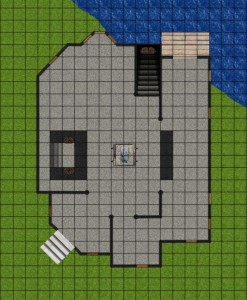
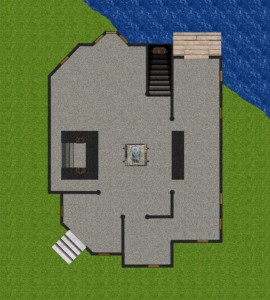
Tower of Ashaba - Gridded

Tower of Ashaba - No Grid

In the middle of this large area, they saw Lady Addee Ulphor. She was backed against a sepulcher and looking nervous. She told the party to leave, “… or else they’ll kill me.” With this, she glanced nervously to the left and right.

A little back and forth with Lady Ulphor followed, until eventually Zin the drow decided to make an Insight check. Ferrin and Ziti did likewise. Ferrin got the feeling that something wasn’t quite right here, but it was Ziti who rolled a critical success on her Insight check and saw that Lady Addee was in fact not Lady Addee at all, but some kind of shapeshifter disguised to look like the Lady.

Attack!

This combat was against the shapeshifter, three drow templars (soldiers) and two drow informants (sneaky guys who can become invisible). Since we had six PCs instead of the five that the adventure assumes, I was planning to throw in an extra informant.

The sneaky, invisible informants won initiative, and I just had them hang back and hide in round 1, maintaining their invisibility. Poor Snarl went next; as a slayer, he was the closest thing the party had to a defender tonight. He charged in and attacked the lady/shapeshifter.

Then came the templars. Snarl was soon in deep doo-doo.

The ranged characters hung back while the cleric and scout started mixing it up, but they soon discovered that the spear-wielding templars had defender auras and could beat the crap out of them if they shifted.

In round three, the shapeshifter was bloodied, so she started retreating. Meanwhile, the informants finally got close enough to start attacking. Squintch was soon unconscious, and Ziti had a moment of awesome by letting Squintch make a saving throw that ended up getting him a 20 and back in the action.

I had decided by the end of round two not to bring in the extra informant; the party already had their hands full. Lots of bloody PCs were limping around the battlefield by the time the drow were wiped out, and the shapeshifter had gotten away, swimming across the river.

I fear that if I had used the extra informant, I might have some dead PCs on my hands. As it stands, Snarl and Squintch are down to two or three healing surges each already. Eek!

Aftermath

So, it was a much tougher fight for the party this week. They explored the tower and saw that the real Lady Ulphor had apparently escaped, but that the Pendant of Ashaba was nowhere to be found. Furthermore, they found drow tracks not only coming UP from the cellar, but also going back DOWN. It seems that the party’s path lies below…

-Michael the OnlineDM

OnlineDM1 on Twitter

May of the Dead: Spooks Under Silverymoon

My contribution to the May of the Dead blog carnival is an adventure for low-level D&D 4th Edition adventurers: Spooks Under Silverymoon. You can download the PDF here, and maps for use in MapTool (scaled to 50 pixels per square) are below.

I originally created this adventure for my wife, my wife’s brother, and his wife. My brother in law and his family were visiting us for the week of Christmas 2010, and I introduced them to D&D. We first played the Castle Ravenloft board game, then created characters for a real D&D game.

The first adventure I ran for them was a Living Forgotten Realms adventure – LURU 2-3 Forgotten Crypts, Hidden Dangers (which you can download here). They enjoyed it very much, and they wanted to know what happens next. So, I spent most of the next day creating what happens next, and Spooks Under Silverymoon is the result.

The basic plot is that the Lady’s College of Silverymoon has started to become infested with ghosts, and the party is hired to go into the catacombs beneath the college to figure out why. It’s a fairly straightforward adventure, with the potential for clever players to bypass combat in a few places.

I’m considering this as a first draft for publication, since I have only run the adventure with a party of 3 PCs before but have written it here for five. Feedback is welcome!

Zombie Chamber - Gridded

Zombie Chamber - No Grid

Fetid Pool - Gridded

Fetid Pool - No Grid

Square Chamber - Gridded

Square Chamber - No Grid

Ghost Prince Chamber - Gridded

Ghost Prince Chamber - No Grid

-Michael the OnlineDM

OnlineDM1 on Twitter