D&D Next – First playtest report

I had the pleasure of having my gaming group over to the house on Sunday for our first playtest of D&D Next. We played for about 4 hours, with the first 30 minutes being about character selection and rules discussion and the last 30 minutes for talking about the session and providing feedback.

First, I want to give a big shout-out to the Weem, who provided a great map for the Caves of Chaos that I used in my MapTool + projector setup at the table. It’s so nice to not have to draw the maps myself! I’ll admit that I was a moron and that it took me a while to realize that each square represented 10 feet instead of 5, but that’s not Weem’s fault – the map says it quite clearly!

Preparation

Since I always run my games via MapTool, even in-person, I started by plopping the Weem’s map into a fresh campaign file, and then built some monsters. I began with my own 4e campaign framework, and then stripped things down to work for D&D Next. This was mostly easy, though it was a bit messy to write a macro that correctly handles advantage and disadvantage. I got there, though!

There are 34 monsters in the Bestiary for Next, and I prepped about 20 of them prior to the game. They’re pretty quick to put together, fortunately. I like that! Note that prepping them means that I’ve set up tokens in MapTool with an appropriate image, the right stats (hit points, AC, ability scores, speed, XP, etc.), buttons to track damage and buttons for each attack that the monster has.

The characters

Since we had six players and only five pre-generated characters, the party chose to double up on the dwarf fighter. Since it’s a hill dwarf, the first player to pick the character decided that it was a hillbilly dwarf. He named the character Bill to reflect this, which led the person playing the human cleric of Pelor to name his character Ted. The dwarf cleric of Moradin then became Rufus.

The party was rounded out with Gimli the dwarf fighter, Shazzam! the high elf wizzard (she likes the letter Z – and exclamation points), and Stealthy the halfling rogue (my wife likes Once Upon a Time, even though her character wasn’t a dwarf).

I’ll note here that one of my friends was interested in the rogue until he discovered that hiding takes an action. That was a bummer for him.

The adventure begins

My players tend to be more interested in killing bad guys and taking their stuff and less interested in plot. This worked fine with the Caves of Chaos, which does not come with a plot by default. I gave my players some choice among the potential plots listed in the adventure, and they liked the idea of seeking the piece of the Eye of Gruumsh that had ended up in the Caves of Chaos. Off we go!

The group decided to look for tracks near the first cave they saw (Cave A on the map), and a good Wisdom check from Ted revealed kobold tracks. When he went closer to the cave mouth to listen, some kobolds revealed themselves and combat began.

I decided to run this combat in the “theater of the mind”, so we rolled initiative and started killing kobolds. They only had two hit points each, which meant that both fighters and the wizard could reliably kill one kobold per turn (the fighters with the miss effect on their attack and the wizard with Magic Missile). The little lizard creatures went down pretty quickly. This entire combat took all of 10 minutes and 15 seconds. Not bad for fighting nine kobolds with six PCs!

The kobolds didn’t have any treasure or distinguishing markings, so the party left the bodies alone and moved into the cave. They saw a passage sloping down to the right, and to the left was a passage with a nasty smell. They decided to investigate the smell and found a garbage pit full of rats.

Rat stomping

Combat number two was another “theater of the mind” one, with the tiny rats swarming all over the PCs. I decided to throw 24 rats at them – four per PC. The rats started nibbling at PC ankles, and the characters started stomping on them.

When the wizard’s turn came around, she decided to use Burning Hands – our first Vancian spell! She waited until her friends got out of the way, then toasted a dozen rats.

Bill the dwarf fighter strode boldly into the garbage pit and took out the dire rat in one shot, and when the three surviving rats had a turn in round three, they fled. This combat took only 13 minutes; not too shabby.

Traps!

From here, the party started heading down the slope, only to trigger a pit trap. Three PCs fell in, and attracted the attention of four kobolds. Our rogue spent the first round of combat fiddling with the trap to get it open so that the fallen PCs could climb out.

We noticed here that the jumping and climbing rules make pit traps not very scary once they’ve triggered. Getting out of the trap is easy enough; unless the walls are particularly slick, you can climb right out at half speed. As for the people who didn’t fall in, they could jump a number of feet (edit: I originally said “squares” instead of “feet here – not what I meant!) equal to their Strength score, which was at least 8. Add in two feet for extending your arms, and even the wimpy wizard could jump, grab the far edge, and pull herself up. Maybe I was too easy on my PCs here, but that’s the way I ran things.

Anyway, the fight against these four kobolds was pretty easy for the party since they had bright light, giving the monsters disadvantage on their attacks. As I wrote about recently, disadvantage is a big deal, equating to about a -4 or -5 to attack. Still, with all of the shenanigans surrounding the pit trap, this combat took 19 minutes. It’s amazing that this feels like a long combat!

The little boss – a battle with a map

From here, the gang noticed that the passageway eventually ended at a large chamber filled with dozens of kobolds. I decided that this chamber would probably actually have a door, so I created one on the fly. They decided to explore a different passage instead, finding themselves at a locked door.

No problem – we have  a rogue in the party! The pregen rogue has a very cool ability that says she can’t roll below a 10 for any skill that she’s trained in. So she rolls, and if it’s less than 10 we treat it as a 10 on the die. This means that opening locks is no worse than a 16 for her, which popped the storage room right open.

The most interesting item in this room was a cask of wine, which one of our fighters created a hole in with his axe. He then replaced the water in his waterskin with wine.

From here, the next clear direction was down the hall to a chamber that had three tougher-looking kobolds standing around and talking. A frontal assault was declared, and we rolled initiative. I decided that, since there were two waves to this fight and the enemies had the potential to actually take a hit and keep fighting, we would use the map and minis.

All three of the “elite” kobolds were dead by the end of the first round. In the second round, six more regular kobolds came out of a far room, escorting their chieftain. The chief actually had some hit points, but it didn’t matter – he never landed a blow with his axe, even though he was getting two attacks per round. He always had disadvantage thanks to the bright light from the wizard. The whole battle took just under 20 minutes.

Getting a little bit of treasure in the chief’s room was a nice find for the party, although the wizard continued to be disappointed with the lack of hits from her Detect Magic. No magic loot here, guys – this isn’t 4th Edition any more!

Kobold genocide?

The only remaining chamber in this part of the Caves of Chaos was the one that had dozens of kobolds in it. Back down the hall the party went, checking for traps and then opening the door.

They saw a group of 36 adult kobolds in their living quarters, with eight kobold hatchlings in the back corner of the room. A debate ensued among the party members about what to do – kill them or leave? Bill the fighter won initiative and decided to step into the room, slaughter a kobold, and then step back.

At this point, the kobolds reached for their daggers and started throwing, mostly at Bill but some at Gimli who was next to him. Rufus, the cleric of Moradin, was standing right behind them, which meant that her Guardian ability kicked in – all of the kobolds would have disadvantage on their attacks.

Thankfully, I was using the computer to roll the dice. Having to roll twice for each of 35 kobolds would have been a major pain in the butt. When all was said and done after those 35 attacks, the kobolds had only dealt 5 damage – 5 dagger hits for 1 damage each. Disadvantage is POWERFUL! They only needed to hit AC 15, but you only have a 12% chance of doing that when you’re just +1 on your dagger attack and you have disadvantage.

The rogue, the wizard and the cleric of Pelor shot some bullets and magic at kobolds as they backed down the hallway. The cleric of Moradin stayed in place to provide her fighter allies with some protection, but she refused to slaughter the kobolds.

In round two, we had 33 kobolds attacking the fighters with disadvantage. A few more points of damage landed, but nothing too serious. At this point, the cleric of Pelor left her fighters alone with the kobold menace.

Now the kobolds could show what they could do. Since they were out of the bright light, the Guardian was gone and they outnumbered the fighters, this meant the kobolds now had advantage on their attacks. Spears and daggers started landing left and right, and before half of the surviving kobolds had acted, they had dropped both fighters to unconsciousness. The kobolds slammed the doors to their chamber.

The surviving party members came back, stabilized their fighters, and dragged them out of there. The aborted kobold massacre took about 18 minutes, including some time at the end that was just about the dragging of the fighters out of the kobold caves.

Opinions

I’ll put up another post later with our actual feedback from the playtest, but I’d say it was a successful test overall. There’s no way we would be switching from 4e to this game in its current state, but everyone seemed to feel like it has real potential. The one person in our group who’s been playing for 30 years especially enjoyed the game.

We’ll keep on testing, of course. There are plenty of things that we weren’t crazy about, but we feel like this game can be a good one. Definitely a promising start!

-Michael the OnlineDM
OnlineDM1 on Twitter

Advantage and Disadvantage in D&D Next: The Math

Everyone will be sharing opinions about D&D Next today and for the foreseeable future. I wanted to do something a little different and focus on just one thing: the math behind the Advantage and Disadvantage mechanic.

For those who haven’t read the playtest material yet, if you have Advantage for a die roll, you get to roll twice and take the better result (kind of like the Avenger in 4th Edition). If you have Disadvantage, you have to roll twice and take the worse result.

In reading through the rules, I noticed that being blinded gives you disadvantage for your attacks, while being prone gives you the same -2 to your attack that you would get in 4th Edition. So what’s the impact of disadvantage? Is it similar to a -2?

Averages

My first thought was, what’s the average of 2d20 keeping the highest (advantage), and what’s the average of 2d20 keeping the lowest (disadvantage)? I know that the average of a single d20 roll is 10.5, so knowing the average of advantage or disadvantage should tell me whether it’s equivalent to +/-2, +/-3 or what, right?

I decided to simulate this by having Excel roll a whole bunch of dice (over a million pairs of d20 rolls) and then taking some averages. For those fellow Excel geeks out there, my d20 roll formula is: =ROUNDUP(20*RAND(), 0). I generated two columns of these, then a column that was the maximum of the two results (=MAX(A2, B2)) for advantage and one that was the minimum (=MIN(A2, B2)) for disadvantage.

I got a result of about 13.83 for a roll with advantage and 7.18 with disadvantage. I later learned that the precise values are 13.825 and 7.175.  Comparing this to the 10.5 average you get for a single d20, advantage adds 3.325 to the average roll and disadvantage subtracts 3.325.

Done! Right?

It’s not all about the averages

However, as my fellow EN Worlders soon pointed out, this isn’t the most useful way to look at things. In D&D, what you care about is your chance of success or failure on a die roll. And when you change the distribution of results from a uniform d20 roll (equal 5% probability of every number from 1 to 20) to the maximum or minimum of 2d20, the impact is not the same as a straight plus or minus to a d20 roll.

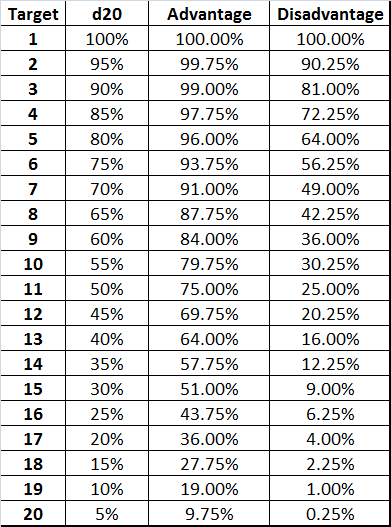
The most useful way I’ve found to look at this is with the following table. The first column shows you the target number you need to roll on the die in order to succeed. (Note that if you need an 18 to hit but you have +6 to hit, then the target number on the die is a 12.) The second column shows the percentage of time you’ll get that result or better on a single d20 roll. The third column shows how often you’ll get your number with advantage, and the fourth shows the same for disadvantage.

What does it all mean?

Let’s take an example from the table. Assume you need to roll an 11 to succeed. With a straight d20, you have a 50% chance of success. With advantage, this goes up to 75%. That’s the equivalent of a +5 bonus to the roll, since you would also have a 75% chance of success if you only needed a 6 or better on a single d20. Pretty impressive!

On the flip side for the target of 11, disadvantage means you only have a 25% chance of success, equivalent to a -5 penalty to the roll (when you need a 16 or better on a d20, you also have a 25% chance of success).

So does that mean advantage/disadvantage is equivalent to +/- 5? Not all the time. In fact, it’s only that big when you need exactly an 11 on the die.

Let’s say you need a 15 on the die to succeed. With a single d20, you’ll only get this 30% of the time. With advantage, you’ll get it 51% of the time – about the same as you would get an 11 or better on a single d20. So advantage in this case is worth about a +4. Disadvantage, similarly, is about a -4: You only succeed 9% of the time with disadvantage, which is about the same as a single d20 with a target of 19.

At the extremes, advantage makes the least difference. If you need a natural 20 to hit, that’s only going to happen 5% of the time normally. Advantage ups your chance to 9.75% – equivalent to getting a +1. Disadvantage takes you chance down to 0.25%, or 1 in 400. That’s the chance of rolling back to back crits – not a common occurrence. But in terms of a modifier, it’s not much different from giving you a -1 to your roll when you need a 20 – it’s just about impossible.

In reality

Most of the time, D&D tends to set things up so that you need somewhere between a 7 and a 14 to succeed on a task unless it’s trivially easy or ridiculously hard. If you look at the percent success in the d20 column for those rows, then find the equivalent percent success in the Advantage column, you’ll see that this is usually similar to getting a +4 to +5 bonus to the roll. Disadvantage is exactly the same in the opposite direction.

So there you have it. For target die rolls that are reasonably close to the middle of the range, advantage or disadvantage is about the same as having a plus or minus 4 or 5 to your die roll. It’s pretty powerful – much more powerful than the +2 for combat advantage that you get in 4th Edition.

Note that I haven’t factored in the additional chance of a critical hit with advantage, since I don’t really care about damage per round or anything like that. Suffice it to say that your chance of critting with advantage is 9.75% instead of 5%, and you can do the rest from there.

– Michael the OnlineDM

@ClayCrucible on Twitter

D&D Encounters Web of the Spider Queen – Week 1

Previous week: Week zero / Following week: Week two

And so the adventure begins!

We had a total of twelve players for two tables of D&D Encounters at 5:00 PM at Enchanted Grounds today. I had four of the same five players from last week (father, son, daughter, another boy) plus two more players (adults). Our party consisted of:

  • Two goblin hunters (that is, hunters who happened to be of the goblin race, not people who hunt goblins) named Ferrin and Pointy
  • A goblin scout named Squintch
  • A goblin slayer named Snarl (who doesn’t speak but just, well, snarls)
  • A svirfneblin warpriest named Ziti
  • A drow mage named Zin

They decided that the four goblins were traveling together, and the drow and svirfneblin were another pair of travelers. The drow saw himself as a spy for the underdark. Hm. This could be interesting.

Six adventurers walk into a bar; specifically, the Old Skull Inn of Shadowdale. After some suspicious glances at the rather monstrous party before her, Ghessla Silvermane welcomed the group to her inn (extracting a promise that they weren’t in Shadowdale to cause trouble – especially the drow). She waved her burly employee Thrad over to start taking some meal orders. The Shadowdale Special was popular with the goblins (especially after the drow mage used Prestidigitation to make their meals wiggle).

The goblin hunters explored upstairs, finding that half of the second and third floors were under construction for some renovations. Downstairs, the goblin scout made friends with a smelly old man called Old Dogsbreath. He started raving about seeing drow in the woods, which Zin was quite curious about.

An attractive woman with long, dark hair told Zin that she was known as Khara Sulwood, and she had recently moved to Shadowdale. She mentioned that Doust Sulwood was her great-grandfather; Zin recognized the name as belonging to a lord of Shadowdale long ago.

A pair of dwarves welcomed Pointy into their merry drinking games.

After a while, folks started heading for bed. Ghessla pulled some of the party members aside and mentioned that allowing people into the Underdark was strictly forbidden under the laws of Shadowdale, laws that just aren’t worth breaking for less than, say, 100 gold pieces. She’s a fun one, that Ghessla.

When down in the inn there arose such a clatter…

Wouldn’t you know it, the quiet of the night was broken by a commotion downstairs. Everyone rushed down to find that the inn was under attack by drow! One invader attacked Ghessla, who crumpled to the ground, her light going out (I was using lighting features in MapTool for the first time, so this was cool). Old Dogsbreath was menacing a drow using his rusty dagger, and the two dwarves were in the process of surrendering when the heroes charged down the stairs.


Sounds and sights of more fighting were noticed outside the inn, so it was going to be up to this ragtag group to save the Old Skull Inn themselves.

Fortunately, they were up to the task! Noticing that I had used a female drow picture for the archer, Zin (our party’s drow) told the gang to try to get after her, since female drow tended to be nasty. Clouds of darkness started popping up left and right, especially once more drow came up from the cellar in round two, but a couple of PCs used their amulets from the character creation week to make the darkness go away.

Poor Snarl couldn’t land a hit on the drow he went after, even burning his action point. He soon found himself bloodied and poisoned, with Ziti having to heal him twice.

As the battle wore into the third and fourth rounds, the adventurers got the upper hand and turned the tide once the strikers started rolling well. The goblins and svirfneblin discovered that I would let them move freely under the tables of the inn, which was great fun. Before long, the inn was littered with the corpses of vanquished enemies, and Ghessla was popping up off the floor, having only played dead.

As the inn patrons were thanking the party and everyone was assessing the damage, Ziti the svirfneblin suddenly heard a voice begin speaking in her mind: “This is Elminster…”

And on that note, we wrapped up week one. Pretty cool stuff!

-Michael the OnlineDM

D&D Encounters Web of the Spider Queen – Week Zero

Following week: Week one

I’m so excited and happy to be running D&D Encounters again! I ran Encounters last summer for the Dark Legacy of Evard season (recaps of those sessions start here), and I had a blast. I especially love helping newer players get into D&D, and Encounters tends to attract a lot of new players.

This time, the season begins with a “week zero” session for character creation. I had been told that most players don’t bother showing up, since they’ll just make characters on their own in the Character Builder later. I’m happy to say that the players at the 5:00 PM tables decided that week zero was important. I believe we had nine players show up just for character creation.

Once again, I’ll be using my projector rig to run games, and my reputation preceded me at the store. Two of the players were the father and son I first introduced to D&D 4th Edition last summer at Encounters, and they’ve apparently been playing ever since! The father has also been bringing his younger daughter to play, and two more younger players were at my table as well (friends of the son, I believe). So, I’m running a table for four kids ranging from about 8 to 12 years old, plus one adult.

I don’t have kids myself, but I like kids well enough. When it comes to running games for kids, I’m enthusiastic about the opportunity! I really want to encourage the next generation of gamers, and this particular group is already pumped up. They’ve apparently been playing together at Encounters for a while, and when they saw that I was going to be running a game (knowing about my projector), they declared that they were all playing at my table. That’s a pretty good feeling!

As for character creation itself, we had a fun time last Wednesday. The boys all came to the table with ideas about what they wanted to play – two hunters and a paladin. They were excited about the new races from Into the Unknown, too; I believe we’ll have at least one goblin.

The young girl at my table wasn’t sure what she wanted to play, but since she already had experience with playing a controller, defender and striker, she decided to go with the warpriest – a leader – for a change of pace. She originally really wanted to be a kobold, but when we started flipping through the books and realized that the kobold didn’t get a bonus to Wisdom she nixed that idea. This really surprised me – I thought that she had her heart set on being a kobold (and it can totally work to have a kobold cleric), but she wanted that +2 to Wisdom. So, she build a svirfneblin instead.

I spent most of my time helping her through the character creation process, and she did really well. It was fun to build from the books instead of just using the Character Builder, and I really enjoyed the custom character sheets that were provided for this season of Encounters.

DMs were also given some treasure cards to represent a very cool neck slot item, one that can pierce a drow’s Cloud of Darkness ability. I believe these were intended to be given to players who participated in an event at PAX, but since we’re in Colorado we didn’t have any PAX-goers at our store. The DM for the other 5:00 PM table had decided that giving these cards out as a reward for showing up to character creation would be appropriate, so that’s what we did. If we have new players come later in the season, they might be able to earn the item through sheer awesomeness; we shall see.

I’ve already prepped the first week’s encounter in MapTool, and I can’t wait to get going. This is going to be fun! I’ll post weekly recaps, along with the maps that I’ve created for each session. Stay tuned!

Subsequent week: Week one

-Michael the OnlineDM

OnlineDM1 on Twitter

What’s the OnlineDM up to in May 2012?

Here are a few notes on what I’ve been up to lately.

Podcasting

I’ve now appeared on quite a few episodes of The Tome Show, including the recent review of Lords of Waterdeep and, before that, the review of Heroes of the Elemental Chaos. I’m currently reading Into the Unknown: The Dungeon Survival Handbook in preparation for recording a new episode with Jeff Greiner and Tracy Hurley next week.

Kickstarter

I backed the recently completed Roll20 Kickstarter, and I’m a backer for the currently active Prismatic Art Collection and Sentinels of the Multiverse. Check them out – they’re OnlineDM approved!


I also just received my Dice Candies in the mail from last year’s Kickstarter, and I plan to ask my friendly local game store to carry them. And hey, they’re made in Boulder, not too far from my home in the southern suburbs of Denver!

I’m also excited about my participation in the recent Admiral of the High Seas Kickstarter, in which I subscribed at a level that allows me to have a person or place named after me in an upcoming ZEITGEIST adventure. Look for the cursed island of Odiem (ODM – Online Dungeon Master) in a future adventure.

D&D Encounters

I’m happy to share that I’m once again DMing for D&D Encounters. I don’t have my usual Wednesday night bowling league in the summer time, so I get to run some D&D. This week is the character creation session, and the adventure begins in earnest next week. Woo hoo!

May of the Dead

I’m participating in the May of the Dead blog carnival, with my post coming out on May 29. I’ll be sharing an adventure that I had originally created a year and a half ago to help hook my brother in law and his wife on D&D: Spooks Under Silverymoon. Ooooh!

Other fun stuff

I’ve been playing in a recreational volleyball league on Thursday nights, which has conflicted with Living Forgotten Realms games lately, but I’ve enjoyed the exercise (even though I’m lousy at volleyball). I’m also starting a regular tennis game.  Yes, OnlineDM is getting in shape.

I’ve done a lot of work on my MapTool framework for D&D 4th Edition, setting up pretty character sheets. The problem I have right now is that it’s slow to update for PCs with lots of powers (as is the case for the 20th-level party in my Friday night game). I think I know how to speed things up, but it’s going to take some time to program, which I don’t have at the moment. Someday, though, I shall have awesomeness to share.

– Michael the OnlineDM

OnlineDM1 on Twitter

New maps from Tobold – Iron Keep from Reavers of Harkenwold

A few months ago, Tobold from Tobold’s Blog reached out to me for maps from Reavers of Harkenwold. I ran the adventure last year (review here) and had put up my own recreated maps for the adventure on my blog. (I later discovered that the official maps were available from the Wizards of the Coast web site for D&D Insider subscribers.)

Tobold made use of some of my maps, but he also took the time to create his own versions of the Iron Keep main tower maps using Campaign Cartographer. He was gracious enough to allow me to share his versions here as well. These maps, along with all of my other maps, can be found on my Map Library page. As you can see, his versions are a significant upgrade over what I had originally made!

Grand Tower 1st floor by Tobold

Grand Tower First Floor - My version

Grand Tower 2nd floor by Tobold

Grand Tower Second Floor - my version

Grand Tower 3rd floor by Tobold

Grand Tower Third Floor - my version

Thank you to Tobold for sharing these maps! And if anyone else wants me to share their maps on my site, please reach out to me at onlinedungeonmaster@gmail.com.

Five new maps from Josh Cayer

Online Dungeon Master is usually a one-man operation (that’s me), but I welcome guest posts and contributions. Today, I’m pleased to share some maps and MapTool files created by one of my readers, Josh Cayer. These maps have also been added to my Map Library.

Wizard Tower

The MapTool file can be downloaded here. Josh explains:

It is a combo puzzle/encounter….I have left the solution in place.  Just remove the Orbs from the map.
Upon entry, the illusionary wizard at the bottom of the map appears and tells the players they must place 8 orbs on the map.  The orbs cannot “see” each other horizontally or vertically.
Like I said, there are no orbs on the map at the start.  A new one can be obtained from any of the three bowls.  Only one orb can be in play at a time.  Once an orb is placed, it grows to fill the square, making it impassable.
Once an orb is placed, moving next to it results in a small amount of lightening damage.
A misplaced orb can be moved but there is lightening damage.
The beholders, if killed, continue to come back until all the orbs are placed.

Wizard Tower by Josh Cayer - Gridded

Wizard Tower by Josh Cayer - no grid

Valley map

I particularly like this one. The MapTool file is here.

Valley by Josh Cayer - Gridded

Valley by Josh Cayer - no grid

Cave complex

This is a gigantic map! I’ve done what I can to reproduce it from the MapTool file with good resolution, which means that it’s a big file.

Cave Complex (very large) by Josh Cayer - Gridded

Cave Complex (very large) by Josh Cayer - no grid

Ruined temple

The MapTool file for this one is here.

Ruined Temple by Josh Cayer - Gridded

Ruined Temple by Josh Cayer - no grid

Small ship with dock

The MapTool file is here.

Small ship and dock by Josh Cayer - gridded

Small ship and dock by Josh Cayer - no grid

Thank you so much to Josh Cayer for submitting these maps! I’ve already received some more maps from another cartographer, which I’ll be posting about soon. If you have maps you’d like to see hosted by the Online Dungeon Master, please send me an email at onlinedungeonmaster@gmail.com.

– Michael the OnlineDM

Fiasco – first play session and review

My RPG career has consisted mostly of Dungeons and Dragons Fourth Edition, a game I love. However, I’m always interested in discovering new and exciting things. Having heard great stuff about Fiasco on the Jennisodes podcast and elsewhere, I decided I should check the game out. I paid my twelve bucks for a PDF of the game just before leaving for my cruise vacation a couple of weeks ago and then read the game for the first time while aboard the ship.

Game overview

Fiasco is a story game with no game master. The game begins with four six-sided dice for each player – two white and two black (although we used gold and purple in our game). All of the dice are rolled into a central pile, and then the players take turns choosing dice to let them pick from lists of Relationships, Objects, Locations and Needs for the characters that they’re creating on the fly. These lists come in Playsets, four of which come with the base game: Suburbia, Small Southern Town, Antarctica and Wild West.

At the end of this setup, each character will have some sort of relationship with the characters on either side of them, and each of those relationships will have a Detail associated with it (object, location or need). All the dice go back into the central pool, and the Scenes begin, with players taking turns.

When it’s your turn for a Scene, you can either Establish or Resolve. If you establish the scene, you describe what’s going on with your character in the scene and perhaps describe some conflict that the character will be working through in that scene. The players then role-play this scene at the table, bringing in the elements from the setup (relationships and details) as they go. At some point in the scene, the other players will decide whether the scene is going to end well for the main character, in which case they’ll give the player a white die from the central pile, or poorly, in which case they’ll give the player a black die. They’ll then play out the positive or negative outcome of the scene, and then the player will give their die to someone else (whoever they want).

If the player decides to Resolve the scene, then the other players decide what the scene will consist of, and the player in the spotlight will decide whether the outcome is positive or negative. They’ll take the appropriate die, play out the consequences, then give the die away.

After each character has had two Scenes, we get to the Tilt. Everyone rolls whatever dice they’ve collected so far (an average of two per player, but you could have anywhere from zero to six dice) and nets their white total against black. The highest net white total and the highest net black total will each get to pick an element from a Tilt Table: Crazy crap that will happen to the characters in the second half of the game.

The game then tells you to take a break and get a snack, talking about the game so far and where it’s headed. I like this rule!

You then move on to Act Two: two more scenes per character, working mostly the same as Act One. The differences are the Tilt elements, of course, but also the fact that the player who gets a black or white die based on their character’s outcome then keeps it instead of giving it away.

At the end of the game (two scenes per character in Act One, then the Tilt, then two more scenes per character in Act Two), each player again rolls their dice and nets white against black. The closer to zero your total, the worse the Aftermath for your character. You then take turns narrating what happens to your character after the movie is over, based on their Aftermath. A high white total or high black total will be a good ending for the character; low numbers are usually death or even a fate worse than death.

Our experience

Seven people showed up for games over the weekend, and Fiasco is not designed for more than five. So, three people who weren’t that interested in role playing decided to play Lords of Waterdeep while four of us sat down for Fiasco.

After I explained how the game worked, we passed around the play sets and decided on Wild West. A note here: Definitely print out the play sets with two pages on each sheet of paper. It’s plenty big enough to read, and then you only have four pages (one each for Relationships, Objects, Locations and Needs) instead of eight pages cluttering up the table during the Setup.

The ultimate layout for our Fiasco game. Tilts are in the middle of the table

My character’s relationships were Gamblers on one side and Criminal/Detective on the other, so it became clear that I was an outlaw. I decided to call him Pecos Pete.

The Detective to my left was Detective Stanton, a half-Chinese man from Chicago who was in Last Chance, Arizona – our made-up setting. Detective Stanton and Pecos Pete shared a Need to get away from an honest woman, ruined.

Stanton’s other relationship was Professional/Client, and we had established that Stanton was the professional detective. His client was the town sheriff, Sheriff McGinty, who had hired him to come to Last Chance to hunt down Pecos Pete. This relationship shared a location – the White Star Chinese Laundry.

Sherriff McGinty was a bit of a dirty cop, however, since his other relationship of Sheriff/Deputy was tied to a Need to get rich through fraud and trickery. He was working with his deputy to ultimately trick Detective Stanton into helping them defraud Pecos Pete out of his gambling winnings.

The deputy’s name was Roscoe, and he was trying to get rich along with the sheriff, but he was also a gambling associate of Pecos Pete. The two of us (I was Pete, remember) shared an object: A doctor’s black bag with and a jar of acid. Hm.

Act One saw the arrival of Detective Stanton in Last Chance and his first interactions with the gambling Pete and Roscoe, ending with him getting invited to a high-stakes after-hours game. We also saw the sheriff and his deputy, Roscoe, have a falling out after the sheriff learned that Roscoe was double-crossing and working with Pete to rob Stanton.

Stanton, meanwhile, ended up coming to the high-stakes game in disguise as Ling Wei, a Chinaman from the laundry who fancied himself a card player (but really had no skill). It was also established that the honest woman, ruined, that Pecos Pete and Detective Stanton shared a need to get away from was named Ruth. She had followed Pete from Chicago to Last Chance years before, and she had once been a lover of Detective Stanton’s.

Stanton closed out Act One with a jump ahead to a scene where he was standing over Ruth’s dead body in the laundry, hands bloodied. Deputy Roscoe came into the room, aiming to rob the detective, but instead stumbling upon the murder scene. Unfortunately for Roscoe, the Sheriff was also following Stanton, who managed to pin the crime on Roscoe. Poor Roscoe ended up in jail, awaiting trial for a murder he didn’t commit.

The Tilts introduced for Act Two were Innocence: Collateral Damage and Something Precious on Fire.

We began Act Two by establishing that Sheriff McGinty was going to try to get Pecos Pete to rob a government stagecoach for him, thus getting rich through fraud and trickery. Roscoe escaped from jail and switched Pete’s jar of acid with his sack of whiskey (I guess whiskey comes in sacks in Last Chance), without Pete’s knowledge. Stanton got stinking drunk after the murder of Ruth and decided to come and kill Pete, which failed miserably.

The sheriff hired some of his posse to act as snipers at the stagecoach robbery, killing Pete once he had taken out the driver and guard. Poor Roscoe came on the scene disguised as the sheriff – not knowing that the posse assassins were secretly associates of Pecos Pete and were planning to kill the sheriff on sight. Blam – dead deputy.

Pete managed to get onto the stagecoach and tried to use his acid to take out the driver, but since it was actually whiskey it ended up igniting thanks to a nearby lantern, engulfing the whole stagecoach in flames.

In the aftermath, things went badly for everyone. Pete ended up dead, having gotten only ashes of burned money for his trouble and then dying by acid when he tried to drown his sorrows in whiskey. Stanton ended up captured by Indians and tortured for years. The sheriff ended up dead, I believe self-inflicted, and Roscoe of course died in the final scene thanks to the double-crossing assassins and a poorly chosen disguise.

The review

Fiasco is an interesting game, and great for people who really love role playing. I think I had expectations that were a little too high, though. Our group isn’t great at role playing, so we struggled a bit. We still had fun and came up with a rollicking tale, but we had our awkward moments.

The whole game took us less than two hours to play, which was good. We kept our scenes short, and even had a few scenes that didn’t really involve role playing, just narration. This worked out well.

I was surprised to learn that my friends strongly preferred wackier play sets. I was expecting that we would start with Suburbia or Small Southern Town, but Suburbia wasn’t even considered. They preferred the zany settings. This was fine with me, but I wasn’t expecting it.

Overall, I’d say that I’m glad I bought and played Fiasco. I don’t think it’s going to be a game that’s in heavy rotation at my tables, since my friends seem to prefer killing monsters and taking their stuff rather than getting deeply involved in role playing. That’s okay with me, too, but it’s fun to play a game like Fiasco every now and then. I’d definitely give it another go sometime.

-Michael the OnlineDM

Cruise ship D&D

There were no new blog posts for me last week because I was on vacation, taking a Caribbean cruise. My wife and I went with some friends of ours and had a lovely time, getting to spend time in Puerto Rico, Saint Maarten and Saint Thomas.

We also had several days at sea, so I naturally brought along some games to play. During one of the sea days on the way out to the islands I managed to persuade one of our friends to play San Juan with us, the card game version of the Puerto Rico board game. It was definitely in-theme for the cruise, and we had a nice time with the game.

On the way back from the islands, I mentioned D&D at lunch and was pleased when the woman in the couple we were traveling with asked about the game. She really knew nothing about it, but she knew that I really liked it and that my wife played, too, so I started describing D&D to her.

D&D is ultimately a cooperative storytelling game. Each player has a character that they get to play, and they have a sheet of paper with information about that character, explaining what the character can do. The dungeon master describes a situation that the players’ characters find themselves in, and then it’s up to the players to tell the DM what their characters do. If it’s something straightforward, like “I walk over that way,” then the DM just narrates the result. If it’s something that the character might or might not succeed in doing, like “I scramble up that tree,” then the DM might ask the player to roll some dice and determine the result of the action based on the result of the die roll.

D&D is a fantasy game, like the Lord of the Rings, and the players get to play the heroes. This means that they’ll probably find themselves in combat with bad guys from time to time, and the game has rules for taking turns in combat, attacking enemies, getting hit by enemies, and yes, even death.

Given that description, my friends were interested in learning to play. Fortunately, I had come prepared!

Usually I run D&D games using my laptop and a projector. While I did have my laptop with me on the cruise, there was no way I was bringing my projector rig. Instead, I had grabbed the Dungeon Master’s Book from the Essentials Red Box set, along with the poster map and the sheet of tokens that came inside the Red Box. I also brought the pre-generated characters from D&D Encounters, which I had from last summer, and a container of dice.

The Red Box adventure, The Twisting Halls, assumes that the players start off by going through the solo adventure in the player’s book, creating their characters that way. I wanted to get the new players into the action as fast as possible, so I just gave them pre-gens and a little back story.

The adventure began with the party having been hired by a merchant to go to some goblin caves to recover a box that had been stolen from the merchant. The merchant also mentioned that he had seen a scary dark rider and thought that the rider might be involved. That was it for story; off we went into the first combat with two goblins and a wolf (scaled down from two wolves since we only had three PCs).

D&D in the ship's cafeteria. Note the ice cream bowls full of dice. Awesomeness.

Our first combat went smoothly enough, with the new players getting a feel for what their characters could do. They won the fight without much trouble and then sent their drow ranger down into a passageway to scout ahead. She was very stealthy and saw a couple of goblins standing in a room, not noticing her.

She asked, “Can I shoot this one?” Well sure! Surprise round, go for it. And thus began the second combat, with the rest of the party still at the top of the tunnel.

This combat was intentionally harder. I ran the full combat for four PCs, but I did it in waves. In the first few rounds, the players noticed someone peeking out from behind a door that was ajar, and the door later closed. Then, as combat with the goblins and their guard drake was almost over, a goblin spellcaster came out from behind a closed door and started blasting the party with magic.

My wife’s character, the cleric, spent some time making death saving throws, one of which fortunately ended up on a 20. From there, the party was able to handle the fight with no problem.

At this point the party discovered a little treasure, and I decided to call it a day. I could tell that our friends were starting to get a little tired, and I didn’t want to overwhelm them.

I was a little disappointed that I had picked an adventure without much real exploration or role playing at the beginning; we basically just had two fights and that was it. I’d like to give new players more of a sense of adventure, so that was a mistake on my part. But still, I was glad that my friends were intrigued enough to give them game a shot. We’ll be visiting these friends in Minnesota in a few weeks, and I’ll bring my D&D stuff along, just in case!

-Michael the OnlineDM

Maps! Lots of maps! And all in one place, too!

I’ve just returned from a very relaxing vacation, during which I did some extremely cool stuff with nice-looking PC character sheets in MapTool (a preview image is below).

However, since it’s going to take me a long time to write posts about the ridiculous quantity of work I did to put that together, I thought I’d get back into the blogging groove by pointing out that I have updated my Maps page.

Did you know that I had a Maps page? It’s under the Downloads section of my blog. I originally set it up in the earliest days of the blog, back when I was using OpenRPG and Gametable. I sort of abandoned the page, even though I kept creating maps.

I shared most of the maps I created on various places on the blog, but I thought it was high time to put them all on one page so that people who are looking for a variety of maps can find them all at once.

I haven’t done much in the way of organizing the page yet, though maps from the same adventure are grouped together (Reavers of Harkenwold, D&D Encounters Dark Legacy of Evard, etc.). These are all created in MapTool, and I wouldn’t call them super-fancy, but they work great for games in MapTool or Fantasy Grounds or similar programs. I’ve scaled them all to a 50-pixel grid, and I’ve provided versions both with and without the grid for nearly all of the maps.

As of this writing there are between 40 and 50 maps on the page, and I plan to keep adding maps to the page as I create them and post about them.

Enjoy!

-Michael the OnlineDM