D&D Encounters Web of the Spider Queen – Week 11

Previous sessionWeek 10 / Next session: Week 12

As is usual these days, I had seven PCs at my table for D&D Encounters. The party was moving through the drow city of Zadziferryn in search of their friend Khara Sulwood and the broken Pendant of Ashaba. They found themselves in the drow torture theater, where two torturers with scourges were beating and killing prisoners while being cheered on by drow in the stands. Combat began pretty much right away.

Torture theater map – gridded

Torture theater map – no grid

Most of the party hung back in the first round, which let one of the clerics cast a spell to increase everyone’s defenses by 2 points; this would be extremely useful later.

The drow torturers each used a pit of blood to summon a demon made up of a gigantic toothed maw and little else. Meanwhile, the drow in the stands grabbed weapons and rushed into the arena to fight the intruders. The spectators turned out to be minions, and our spellcaster finally achieved the toasting of three minions on a single attack.

The demons were easy to hit, but they had a lot of hit points. They also had a nasty habit of chasing after bloodied PCs and trying to eat them.

The real threat, though, was the pair of drow torturers. These creatures used spiked scourges to attack PCs from two squares away, dealing a bunch of damage on a hit plus a grab that dealt ongoing 10 damage (only ending when the PC escapes the grab). The torturers couldn’t make other attacks while grabbing a PC, but that’s okay – they were nasty enough. They also had the highest AC the party has faced so far in the adventure.

Once the minions were wiped out, the party started focusing on the demons. They killed both demons in the same round, whereupon the torturers used minor actions to summon new demons! Ouch.

By this point, the torturers had already killed our drow ranger Drizzt (no relation), using the ongoing damage from the scourge to rip off of the ranger’s head and cast it into one of the fonts of blood (hey, if a PC is dead-dead, let’s at least make it entertaining). Our spellcaster was busily failing death saves, and our goblin scout was barely staying above zero hit points. Finally, at long last, the party managed to finish off one of the torturers, which caused both it and the demon it had summoned to be dragged into the Abyss in a cloud of black smoke. With only one torturer left to deal with, the party was able to gang up and finish it off.

This encounter is written for a group of five PCs. We had seven at our table, and I didn’t scale it upward at all. The party had also done well on last week’s skill challenge, which meant that no minion reinforcements joined the battle. And with all of those advantages, it was still a hard, hard fight, and the players did well to escape with just the one dead adventurer.

I realized belatedly that I forgot to tell my party that they found half of the pendant of Ashaba on the belt of one of the torturers; I’ll say that it dropped to the ground when the drow was dragged into the Abyss.

-Michael the OnlineDM

OnlineDM1 on Twitter

Making the Game part 8 – Marketing

Previous entryPart 7 / Next entry: Part 9

Welcome back to my blog series Making the Game, in which I talk about the process of creating my card and dice game, Chaos & Alchemy. Today, it’s time to talk about getting people interested in the game.

I’ll be the first to admit that I’m not a natural salesman. I have a good head on my shoulders and am easy enough to get along with, but I’m not someone who will naturally draw people in and make them want to buy whatever I’m selling. Still, when you run your own company and have a good product (even if it’s a game), you have to be able to get the word out if you plan to actually get people to buy it.

Because I had so many parts moving at the same time, I had to figure out marketing while I was still developing the game itself. It’s not an easy task to market a product that you don’t yet have available for sale! But it can be done.

Blog

Frankly, the blog series you’re reading right now is a form of marketing. Those of you who read my blog regularly and like my style might be interested in a game written and developed by me. I don’t want to force Chaos & Alchemy on my blog readers, and I do intend to keep writing about Dungeons & Dragons, but I realized early on that I was putting a lot of my gaming energy into my new card and dice game, which meant that there was little left over for D&D.

Also, I write my blog because of passion, not because of some goal of being hired as an RPG writer or anything like that. Since I’m passionate about my new game, I’m writing about it! No one has complained so far, so I think I’ve done an okay job of balancing “Here’s something else I’m passionate about, even though you probably started reading my blog for D&D stuff” with “Here’s some D&D content, too.”

Web Site

With a new game and a new game company, I was going to need a web site for it. I did the first part of this fairly early on, registering a bunch of domain names related to my game, but I didn’t start a real site right away. Once I was ready, I called up the company I use for hosting here at onlinedungeonmaster.com and learned that the simplest approach would be for me to upgrade my existing web hosting account to allow for multiple sites on the same account.

The web site for Chaos & Alchemy came in fits and starts. At first I was hosting it at claycrucible.com, since the name of my game company is Clay Crucible Games. However, I made a marketing decision that I didn’t really care so much about the Clay Crucible Games brand, at least not now, since the focus should really be on the game itself. Thus, I migrated everything to ChaosAndAlchemy.com.

At first, I just had a simple home page. Since I’m familiar with WordPress from this blog, I installed it for use on the Chaos & Alchemy site as well. I used the logo that Bree, my awesome graphic designer, had put together for the banner at the top of the home page. I wrote a few lines describing the game and left an email address as a “for more information” link.

Then, as I started getting actual content, I started adding pages to the site. When artwork for the cards started coming in, I added an Art Gallery page. When I was ready to accept pre-orders, I added a tab for that. Sample cards. Rules. Print-and-play cards. FAQs. Even a page with a link to all of these blog posts for people who want to read about how the game developed over time.

The web site is obviously important from a marketing perspective because it’s the only way I have right now to let people actually buy the game. It’s also the way for people who are curious about the game to figure out if they want to buy it or not by letting them see the rules, the cards and the artwork.

I should note here that I intentionally decided to take a very open approach to my game on the web site. The full rules are available for download with all of their glorious formatting, as is a set of print-and-play cards for people who want to try the game out and don’t mind a little arts and crafts work. The print-and-play cards don’t have the artwork and formatting, but that’s intentional – there has to be something special you get for actually buying the game aside from a box and dice! 🙂

The rules look beautiful; this is the inside of the booklet.

Twitter

I don’t have a ton of Twitter followers; I just passed my first demi-milliwheaton (250 followers), but I have enough that makes it worthwhile to let folks know about the development of my game. I try to make sure that my Chaos & Alchemy related tweets are something I think will interest my followers; stuff about game development, calls for playtesters, announcements about new stuff they can check out, etc. I try to be sensitive not to flood my feed with marketing, but I know that I have followers who are interested in the game.

As with lots of marketing, it’s a fine line.

Facebook

I have a personal Facebook page for friends and family, most of whom are not gamers. Still, I popped onto Facebook with the occasional post about my game, mainly focusing on how excited I was about it. I did let people know about pre-ordering, and I was surprised to see how many non-gamer friends and family did so, just to support me. I have awesome people in my life.

Suffice it to say, this is not a marketing channel I plan to use much any more now that the game is done and I don’t have tons of exciting announcements about the thrill of development. But if anything changes with the game (expansions, etc.) I’ll mention it for folks who might be interested. I’d rather my customers be mostly gamers rather than just kind friends and family in the end.

BoardGameGeek

This is one that I knew about but that I waited to get involved with until the game was done. I’m glad I finally jumped on board, though, because BoardGameGeek is a community that’s great to be a part of. I’ve found it enlightening just to read the forums over there.

Once I was ready to talk about Chaos & Alchemy on BGG, I started a thread in their Board Game Design forum where I mentioned the game, talked a bit about it and linked to the site. I was encouraged by the folks on that forum to submit my game to the BGG database, where it has now been accepted and even expanded upon by other users (another kind user submitted a link to the game rules).

Intriguingly, BoardGameGeek was also how I was contacted by a person from a well-established game company asking if I would be willing to swap a copy of Chaos & Alchemy for a copy of one of their games. Having a game publisher approach me to say that they wanted to get their hands on my game… well that’s pretty cool! My game was also added to a list of “games debuting at GenCon.” Which brings me to…

GenCon

As I mentioned in an earlier post, once we realized that Chaos & Alchemy had actual potential, my wife told me that I should go to GenCon to show it off. While I plan to find open tables and drape my banner over them, demoing the game to anyone who’s up for it, I thought it might be good to spread the word a bit more as well.

The banner I’ll be displaying at GenCon


First, I happened to hear about the GenCon Social on the Jennisodes podcast. This is an event that’s mainly for RPG podcasters rather than card and board game players, but it sounded like a fun event. If I were to pay some money to sponsor the event, I could put some kind of advertisement in the goody bag that will be going to folks who come to the dinner. I thought it might be fun to put a card from my game in the bag, and I hit upon the idea of creating a special GenCon promo card. Every attendee at the GenCon Social will get two Chaos & Alchemy cards – one random card from the game with normal black and white art, and one special GenCon 2012 promo card that has the web address in the flavor text. The promo card also has color art (which looks amazing, I must say), but I’m going to hold off on showing you that card until GenCon itself.

I’ll mention here that anyone who buys a copy of Chaos & Alchemy at GenCon will also get the promo card (while supplies last).

The other sponsorship I decided to participate in for GenCon is the This Just In From GenCon podcast. I’ll be appearing on the Thursday evening podcast from the convention. I’ll be curious to see if this actually results in anyone discovering my game!

Also, if I get the chance to see Wil Wheaton while I’m at the convention, I’m totally giving him a copy of the game.

Beyond

Past GenCon, I have no idea what I might do for marketing Chaos & Alchemy. If the game doesn’t really succeed, I probably won’t do much. I’ll leave the web site up, and that will be it. If it does succeed, well, who knows? A Kickstarter to do a bigger print run with color illustrations would be my dream, but I have no idea if that’s going to happen. We shall see!

– Michael the OnlineDM

OnlineDM1 on Twitter

D&D Encounters Web of the Spider Queen – Week 10

Previous sessionWeek 7-8 / Next session: Week 11

I was out of town last week for work and for my brother’s wedding (I actually spent Wednesday evening going to the circus in a small town in Ohio), so I don’t have a week 9 recap for you. However, I was told that the party took the direct approach of beating down some ogres and some drow. We don’t need no stinking negotiation!

After finding someplace to rest, the party began this session fully rested and ready to delve deeper into the drow city of Zadzifeirryn. They found themselves in a twisting set of tunnels with spiders on the ceiling, known as the Flycatcher Tangle. An obvious trail of blood led them to the badly beaten, but not dead, elf ranger Tharinel. They had last seen Tharinel back in week 5, just before he and Khara Sulwood were abruptly teleported away by Elminster.

Someone handed Tharinel a Cure Light Wounds potion, which got the elf back on his feet, and he asked the party if they could help him avoid drow patrols long enough to escape. After some debate, the party agreed to do this, which led to a fairly easy fight against some drow scouts.

Flycatcher Tangle map – Gridded

Flycatcher Tangle map – No grid

Meanwhile, as the group had been navigating the Flycatcher Tangle, they ran into two problems every five minutes. First, the swarms of spiders on the ceilings would attack everyone, potentially dealing 10 poison damage. Second, they had a chance of running into drow patrols, which wouldn’t lead to actual combat but could lead to some lost healing surges.

I played this as written for the journey to find Tharinel, but I soon got sick of having to attack all seven PCs with spiders, so I skipped that part. They still had to roll for drow patrols and distracting the drow, but I had a hard time making it interesting.

This skill challenge didn’t really “pop” for me, but it did wear down some healing surges, I suppose, so that’s something. The combat was fun for the party – they got to feel powerful. Still, I think this was one of the weaker sessions of the season.

-Michael the OnlineDM

OnlineDM1 on Twitter

Making the Game part 7 – Playtesting

Previous entryPart 6

Welcome back to my blog series Making the Game, in which I talk about the process of creating my card and dice game, Chaos & Alchemy. Today, I’m going into more depth about the playtesting process over the course of my game’s development.

I came up with the idea for what would become Chaos & Alchemy on the last day of May, and within a week I had made the decision that I wanted to have this game available for sale at GenCon in mid August. This meant that I had to start moving on a lot of different projects all at once in order to make this happen – legal stuff, graphic design, artwork, production details. And since the game had only existed for a week at this point, I still had plenty of playtesting to do.

In an ideal world, it would probably be best to completely playtest a game before moving forward with any of the production details, but I didn’t have that luxury. That was okay, though, since I had the basic framework of the game nailed down and could start ordering art and graphic design right away. If the text of the individual cards changed somewhat, I would still be able to use the illustrations and design elements I had ordered.

Early playtests

The first wave of playtesting was purely internal – me and my wife. We played just a handful of games, enough to convince me that the game was worth investing more effort.

The second wave of playtesting was with close friends – especially my friend Nate, who is a professional game designer. His feedback was particularly useful in helping me focus on what makes Chaos & Alchemy fun and what was getting in the way of that fun. Playtesting a game is a lot like editing written material; the goal is largely to cut out the crappy parts to let the good stuff shine through. Yes, you’ll occasionally need to add something entirely new as the result of playtesting, but if you’ve got a fundamentally good game you’ll probably spend more effort getting rid of what’s not working.

My brother Danny was also pivotal in this second wave of playtesting. He was very excited about Chaos & Alchemy even before I had the whole alchemy flavor, and he took it upon himself to print out updated cards as they became available, trying the game with multiple groups of players with varying levels of game experience. This helped me to figure out who the target audience for Chaos & Alchemy is (basically, people who aren’t gamers at all probably won’t want to start with this game, but anyone who likes games already will probably grasp it immediately).

Side note: This past weekend I was in Pennsylvania at Danny’s wedding; please join me in congratulating him and his beautiful bride, Jill! We had a blast, and it was awesome that Danny and his friends and our family could be the first to see the final Chaos & Alchemy cards in print with me.

Broader playtests

The third wave of playtesting was with a broader swath of people online, plus some in-person testing with strangers myself. On my end in Colorado, this mainly involved hanging out at the friendly local game store (thank you, Enchanted Grounds!) and seeing if anyone wanted to try my game. A few of my D&D players were up for it, as were some other random folks I met at the store.

The online part of this playtesting involved some friends in New York and Florida plus some hearty Twitter volunteers who expressed interest. I had five Twitter followers who said they wanted to be playtesters, and I ended up getting actual playtesting feedback from three of the five (not a bad rate, frankly, given the level of effort required to print out the cards).

Lots of evolution. Top: Two cards that were later cut/drastically rewritten. Middle left: Evolution of success/failure tracking. Middle right: Evolution of card back. Bottom: Evolution of a single card.

Goal of playtesting

So what was I looking for from playtesting? I kept my requests broad. Fun was the focus. I asked folks to tell me what they liked and didn’t like. Were there cards or rules that were especially confusing? Was any part of the game just pointless? Were there any cards that felt bad to have in hand? What suggestions did they have to make the game more fun?

I received tons of great feedback, most of which I incorporated in subsequent iterations of the game. My New York friends suggested some kind of playmat to keep track of Successes and Failures, which evolved into the Success/Failure cards included with the game. Lots of folks asked questions about cards that were unclear in play, which became edited (or rewritten) cards and FAQ entries. I received ideas about how to make the endgame less abrupt and more fun, which became a succession of different endgames before finally ending up at the simple “race to 10 points” base rule plus an optional “Transmutation for the King” advanced rule.

The Success-Failure tracking card, inspired by a playtester’s suggestion.

Bottom line: My playtesters were awesome. Friends and family and helpful strangers all took the time to build their own card sets, try the game, and provide detailed feedback. It made a huge difference, and the final game is much better for it.

-Michael the OnlineDM

OnlineDM1 on Twitter

P.S. I’ve now made the “print and play” cards for Chaos & Alchemy available to anyone who wants to try them, just like my playtesters did! These cards don’t have the fancy formatting, illustrations or flavor text of the actual cards, but they have the rules that you need to try out the game to decide if you want to buy it. The pre-order period will last until the morning of July 24 – one more day from the time this post goes live! After that, the 10% discount will go away and I’ll take orders at the regular $25 price, still with free shipping to US buyers. Check it out, and place an order if you like the game!

Making the Game part 6 – Hiring artists

Previous entry: Part 5

Welcome back to my blog series Making the Game, in which I talk about the process of creating my card and dice game, Chaos & Alchemy. In the earlier entries in this series I’ve discussed the inception of my game idea, my first outside playtests and the development of the game’s theme, the point where I decided to actually produce the game, the process of working with my awesome graphic designer, and legal stuff including the formation of an LLC to publish my game.

Once I had decided that I was actually going to produce my game, I started moving on a lot of projects at once. I’ve written about some already (legal stuff, graphic design) and will write about more in the future (playtesting, production details). Today I’m focusing on artists.

Sadly, I have poor skills of an artist. And since stick figures weren’t going to cut it for Chaos & Alchemy, I knew I would have to hire some artists to illustrate my cards. There’s a delicate dance here, though; I wanted art that would look good, but I couldn’t afford to pay tons of money for it.

Also, I don’t know any illustrators. This could be a problem.

I started by putting out a call online for suggestions of artists on Twitter. My network isn’t all that big, but a response from Michael Olsen led me to one artist: Beth Sobel. I think Beth’s art is really outstanding and a great fit for Chaos & Alchemy. She was one of the last artists I contracted with, and she asked if she could sign up for all 10 of the remaining illustrations I needed at the time. Thank you, Beth!

Adjacent Laboratory by Beth Sobel

I next thought about places where I might find artists online, and I came up with the folks from the Prismatic Art Collection, which I had recently backed on Kickstarter. I think the project is a great idea, and I know that part of the whole point is to get exposure for these artists so that they could get more paid work. Since I was offering to pay, this seemed like a good place to find artists.

I started by pinging Tracy Hurley just to make sure I didn’t need to go through her or Prismatic Art before contacting the artists (nope, I could go straight to them), and then I started emailing artists. I looked through the stuff they had submitted to Prismatic Art so far as well as stuff on their web sites (for those artists who had web sites) and picked a few people to email.

Saboteur by Andres Canals

Some of them got back to me quickly, but were unfortunately too expensive for me to work with. Some never replied. One replied over a month later, by which point I had already contracted out all of the art. But one, Andres Canals, did get back to me promptly and was willing to do black-and-white illustrations for a price I could afford (which turned out great).

Going through this process with the Prismatic Art folks helped me crystallize my plan. I would hire a bunch of different artists for low-cost black-and-white illustrations for the cards themselves. I would also hire one artist to create a single full-color illustration that I could use on the cover of my game. Each time I contacted an artist from here on out, I would ask for two quotes: One for black and white card art and one for a full-color cover illustration.

Volatile Solvent by LochaBWS

I found one artist in-person in Colorado at the friendly local game store. She goes by LochaBWS professionally, and she spends a fair amount of time in the store with a sign on a table offering to draw character portraits for RPGs for $10 apiece. I noticed her there in my first week of creating Chaos & Alchemy, and I approached her after I was done running D&D Encounters a week later. She would indeed be interested in doing sketches for my cards, so I had her flip through the cards and pick out a few that she had ideas for. I hired her to illustrate four of them, with more to come if she did a good job and was interested in more work. She delivered her work on time, and ended up illustrating a total of 13 cards.

One artist came to me directly via D&D. I have been running a Friday night online D&D game for a couple of years, and when development work on Chaos & Alchemy took off in earnest I had to step away from running the game. During the last session that I ran, I was talking about Chaos & Alchemy, and a few people in my game mentioned that they might be interested in doing some illustration work for it. One of these, Lana Gjovig, latched on to the physical objects in the game that needed illustrations and offered to take those. She also recruited J.J. Mason to illustrate another card. Networking!

Fun side note: Lana uses an alias for our online games; putting together a contract for her illustration work was the first time I heard her real name.

Replacement Codex by Lana Gjovig

Royal Inspector by J.J. Mason

Another artist came via networking in a different way. LochaBWS (the artist from the local game store) had gone to Denver Comic Con in June and brought back a business card from an artist who worked fast and who she thought might be a good fit for Chaos & Alchemy. I contracted that artist, and she was far, far too expensive for me, but she in turn put me in touch with another artist, J. Embleton, who was interested in the work I was offering at the price I had in mind. J is primarily a comic-book artist, and you can see that in the work she’s done for Chaos & Alchemy, but I think we came up with a style that fits the game nicely. J also signed up to do the sole full-color card illustration in the game, which will appear on my GenCon promo card (to be revealed later).

Call for Knowledge by J. Embleton

Each artist had to sign a contract (put together with the help of my lawyer, Rob Bodine) that specifies:

  • Our respective names and addresses
  • The work they’ll do
  • The dates they’ll do the work by (including proofs if applicable)
  • The fee I’ll pay them for the work
  • The fact that they’re assigning my company the copyright in their art once I pay them for it
  • The fact that they’re an independent contractor rather than an employee

I used the same contract with all of my artists (except the very earliest art, which came before my lawyer had drawn this contract up), which worked out nicely.

With all of the individual card illustrations contracted (43 unique cards, plus the one promo card), that left only the cover illustration. This one would be more expensive, I knew, but I was willing to splurge a little bit to make the game look good on a shelf (and to have some awesome art to use in marketing on a web site or a vinyl banner, for instance). I had asked a few folks involved with Prismatic Art Collection about cover illustrations, but it didn’t seem like that was going to be the way to go.

I next turned to deviantART, a web site where all kinds of artists can display their work. I searched for “alchemy” and other similar terms and started putting together a batch of favorites.

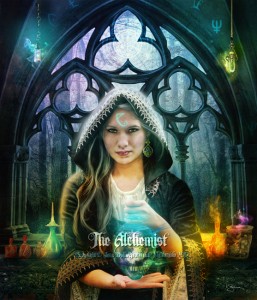
My absolute favorite piece among those that were already created was “The Alchemist” by Jena DellaGrottaglia.

The Alchemist by Jena DellaGrottaglia

I could see this piece being used as-is as the cover art for Chaos & Alchemy, so I reached out to Jena to talk about buying or licensing the rights to the art for my game. Unfortunately, Jena was busy with other things at the time and couldn’t get back to me until I had already passed the point where I had contracted with another artist. Also, apparently Jena is much more established in the art world than I realized (doing book covers and such) and her rates were too expensive for someone like me. But she’s a heck of an artist, you have to admit!

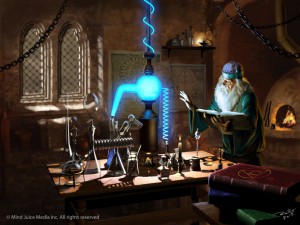
With Jena not able to get back to me in time, I turned to another artist I found via deviantART, Chris Rallis. He had created this piece for a video game called Spellchemy:

The Alchemist by Chris Rallis – For Spellchemy by Mind Juice Media

I thought that Chris’s style would fit very nicely in Chaos & Alchemy, so I inquired about fees and timing for creating something similar for my game box. Chris was very professional and said that he would be able to create artwork in a little over a week’s time (full color and all), but his rate was on the high end of what I could pay.

I talked with another artist about creating something similar, and while the other artist’s rate was lower than Chris’s, I definitely liked Chris’s style the best. So, I bit the bullet and paid for some awesome artwork:

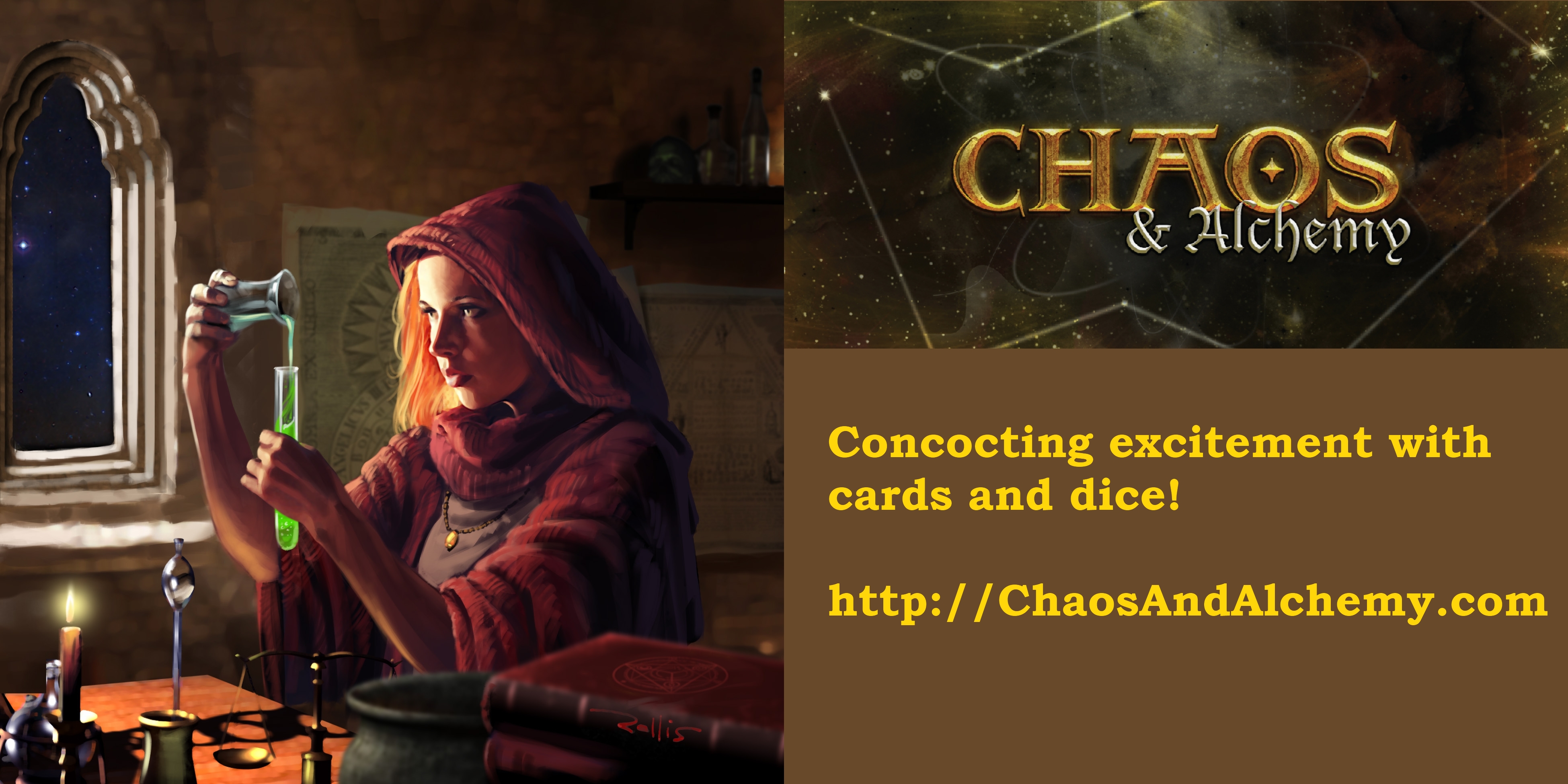
Chaos & Alchemy cover art by Chris Rallis – Logo by Bree Heiss

Seeing the results, I have zero regrets! Chris did an amazing job.

And with that, the art for Chaos & Alchemy is complete! You can see all of the card illustrations over on the Art Gallery, and you can see an illustration from each artist in its final form within the card frames on the Sample Cards page. I hope you like them – I sure do!

-Michael the OnlineDM

OnlineDM1 on Twitter

P.S. Pre-orders are still open for another day or two for Chaos & Alchemy at 10% off the regular price plus free shipping.

Review: DM Minion

A few weeks ago, around the same time that I was approached by BannersOnTheCheap with the offer of free stuff in exchange for a review, I was also approached by Goathead Software with an offer of free stuff in exchange for a review. In this case, the free stuff consisted of their tools for D&D 4th Edition: DM Minion and Player Minion. Yes, I’ve hit the big time now, folks; free stuff is coming my way thanks to my influence (note: tongue firmly in cheek here).

The timing of the offer was good. I had recently received an iPad as a gift from my awesome wife, so I was in a position to be able to try out these kind of apps in a format that makes sense. I spend most of my time on the DM side of the screen, so I would be focusing on DM Minion.

The basic idea of the app is that it lets you run combat efficiently. It’s intended to help you keep track of initiative, hit points, conditions and monster power usage. Several other free tools are out there for this purpose already (MasterPlan and D&D 4e Combat Manager are two that I’m familiar with, and I know there are others), but DM Minion is a paid app (I believe its list price was $4.99, though as I said I was given a free review copy). One of its killer functions is that you can import characters and monsters from the D&D Insider tools… more on that in a minute.

Downloading the app was easy enough. It comes with a 17 page Quick Guide PDF to help you navigate the program. Using it takes a little learning, but the Quick Guide helps.

The highly non-intuitive thing that you have to learn with DM Minion is that it’s not really a stand-alone app; you use it in conjunction with a free account on the Goathead Software web site. From the web site, you can import your .dnd4e files and your .monster files. Once you’ve imported them to your Goathead account, you can access them in DM Minion.

So to recap, the steps are:

  • Create characters/monsters in the DDI tools (Character Builder and Adventure Tools – Monster Builder)
  • Export the .dnd4e / .monster files from the DDI tools to your computer
  • Log in to your Goathead account
  • Upload your .dnd4e / .monster files to your Goathead account
  • Within the DM Minion app, import the PCs / monsters from your Goathead account

I compare this to the fantastic (and free) Power2ool site (which is not built for running combat, to be clear), which integrates directly with the DDI Compendium to allow direct monster import; Power2ool does it right. With Power2ool you can directly import monsters into the program rather than going through the export to PC – import to web site steps (let alone the import to web site – then use in app step). I’m guessing that there are some technological limitations on the iPad that make this impossible or something like that, but the extra steps involved with getting monsters into DM Minion are a major pain.

The main combat tracking screen

As for functionality, DM Minion seems to do what it promises. It’s pretty easy to track initiative (including delayed actions and readied actions), track monster HP, track conditions (including the variety of times that they can end), add new combatants to the fight, track which monster powers have been used, etc. It’s not so user-friendly that it blows me away with its simplicity, but it does what it needs to do.

My verdict: If you really want to use an iPad or another tablet to track your combat, DM Minion can do the job if you’re willing to jump through the hoops to get it all set up. I personally use MapTool to do all of this, of course (plus building and editing monsters), and if I weren’t using MapTool I’d probably go back to the free DnD4eCM rather than pay for DM Minion, but if I really wanted to use the iPad I might go for DM Minion.

-Michael the OnlineDM

OnlineDM1 on Twitter

P.S. Amusingly, I believe the creator of DM Minion and Player Minion ended up using some of the MapTool token art that I created for my web site as their icons. Small world! To be clear, I don’t own those images or anything like that, and I thought it was amusing to see someone else using what I created.

D&D Encounters Web of the Spider Queen – Weeks 7 and 8

Previous session: Week 6 / Next session: Week 10

Since our Friendly Local Game Store closed early on Wednesday, July 4, for Independence Day, we did not have D&D Encounters that night. Instead, we ran two sessions back to back on Wednesday, July 11. Yeah, this was a little bit nuts. In retrospect, it would have been great to run sessions 6 and 7 on the same night, since session 6 wasn’t an actual combat and didn’t take very long.

But a DM’s gotta do what a DM’s gotta do.

Week 7 – Jaelre Elite

After the Tests of Lolth, the party found itself in a cavern full of elite drow from the house of Valan Jaelre (the apparent big bad of the adventure). Not a lot of story here; the drow demanded surrender, and when they didn’t get it, combat began. The only real story element was that the drow priestess leading the group mentioned that the human girl and her elf pet hadn’t put up much of a fight; a reference to Khara and Tharinel that the party pretty much ignored.

The fight itself was a pretty cool one. We had the priestess, who liked to shoot venom from long range, a two-blade ranger with a sewn-shut mouth and a spider companion, a burly drow male with a maul and a sneaky female assassin who climbed the walls and threw daggers tied to spidersilk rope.

Jaelre Elite cave map – gridded

Jaelre Elite cave map – no grid

With seven PCs at the table and a limited time for the fight, I didn’t scale anything up. Aside from our dwarf fighter getting totally beat on and knocked unconscious in the first round (he got better), the fight wasn’t too much trouble for the gang. It did take more than half of our two-hour time period, though, so I moved on quickly.

Week 8 – The Demonspur

The party found a secret passage out of the Jaelre Elite’s chamber, which ultimately led them to a huge cavern. They were entering via a tunnel high on one wall of this chamber, which had a massive stalactite hanging down from the ceiling with rope bridges connecting it to various side tunnels (including the one the PCs were coming from). The stalactite was basically an inverted tower of several floors, and red lights could be seen glowing inside of it.

Walking along one of the other rope bridges going into the stalactite (known as the Demonspur) were several drow leading a bunch of goblin captives.

The party did an excellent job of sneaking along the rope bridge to the top floor of the Demonspur and surprising the drow within. Since we had three goblins PCs and there were goblin captives in the Demonspur, the party agreed not to attack any goblins that didn’t attack first.

This fight was pretty quick, and confined to the top floor (we were short on time, so I didn’t do anything fancy). The goblin PCs worked hard to persuade the goblin captives to fight the drow, with pretty good success. The bugbear captive (“Big Eddie,” the goblins called him) didn’t get the memo, though, and had to be fought along with the drow. Not a problem for our intrepid band of heroes, however, especially with goblin help.

Demonspur map with spiderweb – gridded

Demonspur map with spiderweb – no grid

Unfortunately, I’m going to be out of town for Week 9, so I’ll resume my recaps with Week 10 in two weeks’ time.
sadf

Review: Banners on the Cheap for vinyl banners – and battlemaps!

A few weeks ago I received a surprising offer: a person from a company called Banners on the Cheap (which also runs Signs on the Cheap and Magnets on the Cheap) wanted to give me a free banner in exchange for a review on my blog. This was surprising mainly because, let’s face it, Online Dungeon Master is pretty small potatoes as a blog! I’ve never had anyone offer me anything in exchange for exposure on my blog (aside from some obvious spammers).

Vinyl Banners

The creative twist here is that Banners on the Cheap thought I might be interested in ordering vinyl banners for use as RPG maps. See, many dungeon masters / game masters use a vinyl wet-erase mat with a grid on it for their basic mapping needs, drawing buildings and trees and chasms and so on for each map, then erasing. These folks thought that DMs might be interested in printing their own custom vinyl maps with whatever images they like.

It’s a creative idea, you have to admit. Unfortunately, I’m the Online Dungeon Master – I use MapTool for my online games and a projector for in-person maps, rather than a physical map on the table. So close but so far!

Except… as you may have heard, I’m in the process of developing a new card and dice game called Chaos & Alchemy. The game doesn’t use maps or anything like that, but I do plan to be at GenCon and having a cool vinyl banner to advertise the game sounded like an awesome idea. I get a free banner in exchange for this write-up on my site? Works for me!

I decided to keep things fairly straightforward in designing my first advertising sign. I wasn’t quite sure how big the banner should be, so I went with 6 feet wide by 3 feet tall (figuring that this might hang nicely over the front of a game table). The Banners on the Cheap folks seem to be able to do whatever size you want, which is cool.

From there, all I had to do was upload an image file, no bigger than 12 MB. I already had some beautiful cover art for my game, so I put that on one half of the banner. I also had a cool logo, so I put that on the top part of the other half of the banner. For the bottom right I put a slogan and the web site for my game. The image file I created looks like this:

Since I was given a $40 store credit and the 3′ by 6′ banner only cost $23.56 (excluding shipping), I decided to add hemming and grommets to make it easier to hang in case I end up hanging it somewhere. That added $6.99 to the cost. Shipping of around $8 brought my total to $38.58; still below my store credit. Excellent!

I let my BannersOnTheCheap contact know that I had placed my order, since she had offered to expedite it for me (ooh, the benefits of being a big-shot blogger!), and less than a week later I had this in my hands:

My apologies for looking kind of messy in the picture; I had just gotten home from playing tennis and was too excited to wait to open my banner. Cracking open the box revealed a bit of a “vinyly” odor, but nothing overpowering.

So how is it? I think it’s awesome! My art and logo look fantastic writ large, and the print quality is outstanding. The hemming and grommits feel very sturdy. The material itself is a bit reminiscent of the stuff duct tape is made of, but heavier – it has a web of some kind of reinforcing material running through the vinyl.

Since it’s a vinyl mat, just like a lot of the mats that most DMs use, it works great as a wet-erase mat (I tried this on the white reverse side of my banner). And just like those mats, this is not a dry-erase mat (dry-erase marker is permanent on it). The reverse side of the banner has more of the webbing texture, which may affect your ability to draw on it with wet-erase markers (you get a “bumpy” effect in your lines). The front side is plenty smooth, though.

So, what’s my verdict on Banners on the Cheap as an option for DMs/GMs? The quality is amazing, and the price is quite reasonable for what you get. I can see several situations where this kind of thing could make sense as a gaming map:

  • Putting together a few “evergreen” maps that you can use in lots of different situations (generic outdoor, generic cavern, generic castle, etc.)
  • Printing a simple grid on one of these maps to use as alternative to a Chessex mat (it looks to me like it would be a lot cheaper than Chessex, especially if you’re not using both sides of the Chessex mat)
  • Creating an awe-inspiring map to pull out for a campaign-milestone set piece battle
  • The GM is really rich and enjoys printing fancy new maps for each battle and then collecting them

I’ve got to say that this seems like a pretty intriguing option for DMs out there. A 2′ by 3′ custom-printed vinyl banner from Banners on the Cheap costs $12.81, plus shipping (which is admittedly pricey at $7.17, but that covers shipping for multiple maps). Still, that’s a big, durable, wet-erase-writeable vinyl map delivered to your door for less than twenty bucks.

To compare apples to apples with Chessex, I’ll go with 2′ by 2′. That banner from BannersOnTheCheap would cost $9.38 plus shipping. Chessex lists the equivalent size Battlemat on their web site for $22.98 before shipping (which is $7 for orders under $100). Now, that Chessex mat is reversible and the Banners on the Cheap mat only kind of is (again, the “bumpiness” on the reverse is not ideal), but I personally only ever use one side of my Chessex mat. You can get the Chessex mat from Amazon for $21.49 (and free shipping if you’re on Amazon Prime). If you’re a one-sided map user, BannersOnTheCheap is still cheaper for a plain gridded mat, shipping and all! And that’s even before you consider the fact that you can, you know, print a full color map on the BannersOnTheCheap option.

Ultimately, I’m surprised at how attractive this option is to me. If I weren’t a projector-toting DM, I think I’d spend a few bucks on some “evergreen” maps and one or two plain gridded maps from BannersOnTheCheap. They’re quite durable, they’re wet-erase, they look fantastic when you print designs on them, and they’re darn affordable.

Who knew? I’m actually really glad that these folks approached me, even though I don’t personally need physical maps. I think a lot of DMs might get some serious use out of this. If you do, please tell me about it here!

– Michael the OnlineDM

OnlineDM1 on Twitter

Making the Game part 5 – Legal Stuff – Trademarks and forming an LLC

Previous entryPart 4

Welcome back to my blog series Making the Game, in which I talk about the process of creating my card and dice game, Chaos & Alchemy. In Part 4, I discussed working with a graphic designer to develop a cool-looking card face and how it evolved from rough sketches to a polished product.

Once I had decided that I was really going to try to publish my game, I knew that I would have some questions for a lawyer. I’m a fan of the Law of the Geek podcast, so I had some idea of the intellectual property issues involved with game design, but I didn’t know anything about business structure and I wasn’t sure if I needed to be worried about patents, trademarks, etc. So, I started searching for a lawyer.

Finding a lawyer

I began by calling the office of the local lawyer who helped my wife and I draft our wills. Unsurprisingly, they don’t handle intellectual property stuff, but the receptionist told me that she’d have one of the lawyers email me a list of local attorneys I could try. I never did receive that list; hm. I did later learn that the guy who drafted my will is a gamer – when I called weeks later to ask him if this game company would mean I need to change my will (answer: no), he asked if Chaos & Alchemy is like Dominion, which is a game he enjoys. Yay for having a gamer lawyer!

Since the local lawyer search wasn’t going anywhere, I turned to the internet. I used the Law of the Geek contact page to send a message to Geoff and Melina; unfortunately Geoff’s reply ended up in my spam folder for over a week! I did eventually talk to Geoff on the phone, and he had some excellent advice for me, but by that time I had already found another attorney to work with.

Thanks to a Twitter tip from Paul Baalham, I ended up seeking out a friend of Matt James who is a lawyer and who writes a column on Matt’s site called Protection From Chaos. The lawyer in question is Rob Bodine, and he practices law in Virginia. Rob is a gamer himself and is very interested in the legal side of gaming; he’s working on building a reputation as a “gaming lawyer”. Since I was starting a game company to produce a game, Rob was interested in working with me.

Copyright, trademark and patent

Let me start by saying that I am not a lawyer, so please don’t take any of this as actual advice! But I’ve had to learn a few things about copyright, trademark and patent over the course of making Chaos & Alchemy (although I learned much of this previously from Law of the Geek).

Copyright covers a creator’s right to be the person to make and distribute copies of his or her work. You don’t have to file for it – you automatically have it whenever your creative work (words, art, music, whatever) is “fixed in a tangible medium”, which even includes a file saved on your computer’s hard drive. The words on my game cards and the words in the rules are copyrighted automatically when I write them, for instance. The game mechanics, however, are not protectable by copyright.

Trademark covers my use of the name Chaos & Alchemy, for instance, or my logo. Technically you can get trademark rights just by making use of the trademark in promotional materials and such, but if you want to really protect it you can register it with the US government (there are also state trademark registrations, which are cheaper). My understanding is that the fee to file for a trademark is about $300, and you’ll likely need to pay a lawyer for his or her time on top of that to actually put together and file the paperwork.

My (trademarked) logo for Chaos & Alchemy. The TM will become an R in a circle once the registration goes live

Patent could theoretically protect a game mechanic if it’s innovative enough, but that’s unlikely in my caes. I understand that Wizards of the Coast has a patent on “tapping” a card by turning it sideways from Magic: The Gathering, for instance (although some people think that the patent shouldn’t have been granted; I’m not going there!).

My needs in talking to a lawyer were:

  • Figure out if I need a patent (nope, that was pretty clear from the start – it’s just too expensive)
  • Figure out if I needed to worry about infringing on someone else’s patent (probably not, but doing a thorough search to find out is too expensive for my tiny company)
  • Figure out if I need to register any trademarks (probably a good idea for the name of the game and the logo)
  • Get a contract that I can use with artists to handle the transfer of their copyright in the work they create to me once I buy the work and the rights (doable in about two pages)
  • Learn about setting up a company to publish the game (cheaper and easier than I expected, actually!)

Rob and I exchanged a couple of emails, then had a 45 minute phone conversation to establish the points above (no patent work, yes on a trademark registration or two, yes I could hire him to draw up an artist contract, and yes I should start a company). It was a pretty painless process, and I would definitely recommend Rob for other game designers who need some legal advice.

Setting up a company

One part of my conversation with Rob where I took detailed notes was around setting up a company to publish my game. While I could just publish the game under my own name as a sole proprietor, it would be a good idea for me to set up an LLC – a limited liability company – to publish the game. An LLC is quick and cheap to set up, it doesn’t require complicated paperwork to run, it can have just me as the single member, and it protects my own assets from any liability claims (such as if someone injures himself on my game or someone sues the game publisher for some reason). The LLC is only liable up to the amount of capital that I put in (plus any profits if they materialize, I guess) as long as I set it up correctly.

The steps I followed to set up my LLC were:

  • Pick an available name for the LLC
  • Go to the appropriate web site for my state government and fill out a few pages online, paying a $50 fee to register the company
  • Go to the IRS web site and apply for an Employer Identification Number (EIN) – basically my company’s Social Security Number (no cost)
  • Go back to my state government’s web site and apply for a state business license, which mainly sets me up to pay sales tax for in-state sales ($60 or so for Colorado)
  • Check to see if I need a local business license (in my case I don’t, but that’s apparently unusual)
  • Head to a local bank to set up a bank account for the company

The first step – picking a name – was harder than it should have been. I could have called the company Chaos & Alchemy LLC, but if I ever publish a second game that might seem weird. I liked the idea of Chaos Games LLC, but there’s already a retail store in Colorado with a similar name (Chaos, Games and More). The store name isn’t quite the same, and I could legally use the name I wanted, but I called the store owner as a courtesy and it was clear that he wasn’t thrilled with the idea of me starting a company with a similar name. Since this is exactly the kind of store that might one day carry my game on its shelves, I didn’t want to alienate him!

So, after much brainstorming with my wife, I settled on the idea of picking a card from the game and using its name: Clay Crucible Games LLC. Tagline: Concocting fun with cards and dice!

Handling all of the online paperwork took about took about 30 minutes, if that. I thought I was going to have to wait for something in the mail in order to open a bank account, but I actually could have done it right away.

Opening a small business account at a local credit union required the Articles of Organization that I had submitted to the state online, a certificate of good standing (which the credit union was able to print out on the spot by going to the state’s web site), and my LLC’s bylaws. I didn’t have bylaws, so I asked if I could write them out longhand right there in the credit union, which I did.

Boom: I have a business bank account! And with that, I was off and running; paying lawyers and artists, setting up PayPal, getting a Square reader account, heck yeah!

Cash inflow?

So far, of course, the money has only been flowing out. But I’m finally to the point that I’m ready to take pre-orders for Chaos & Alchemy over on the game’s web site. I’m offering the game at a 10% discount from its regular price to pre-order customers (normally $25, but only $22.50 for pre-order), and I’m throwing in free shipping for US buyers. This means that I won’t be making much of a profit on these games, but that’s okay – I’m mostly curious to see if there’s any interest out there! I’ll be delivering games in early August and the price will go up once the game goes to print, so hop on over if you’re interested.

– Michael the OnlineDM

OnlineDM1 on Twitter

Making the Game part 4 – Graphic design

Previous entryPart 3 / Next entry: Part 5

Welcome back to my blog series Making the Game, in which I talk about the process of creating my card and dice game, Chaos & Alchemy. In Part 3, I discussed the first playtest of the game with strangers, and the way the name of the game came to be.

At this point, I had decided that I was going to develop this game to the point of doing a small print run. Furthermore, I wsa going to do it in time for GenCon. Keep in mind that this was early June, and GenCon is in mid-August, so I was working on a 10-week timeline. Aggressive, but exciting!

The cards at this point looked like this:
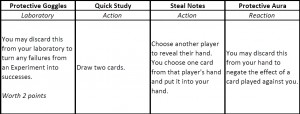
Kind of uninspiring, don’t you think? I knew I was going to need art for the cards, but more importantly I was going to need well-designed cards. While I don’t personally know any illustrators, I do happen to be close friends with an outstanding graphic designer, Bree Heiss.

I called Bree one evening to talk about my game and the role I thought she might be able to play. There were several things that needed some awesome graphic design in my game:

  • Layout of the fronts of the cards (a very big task, incorporating different information for different card types, point values, artwork, artist credit, legal stuff, plus rules text and flavor text)
  • Design for the backs of the cards
  • Design for the box that the game comes in
  • Design for the rules sheet that comes in the box
  • A logo for the game itself

You’ll note that not included in this list is illustrations for the cards or the game box; the graphic designer’s job is design, not illustration. How are the elements arranged on the card? How do the words on the game box intersect with any artwork on the box? These are the kinds of things a designer can help with.

Fortunately, Bree was available for some design work. She even put a contract together for the work she would be doing; very professional (more on contracts in the next segment!). I was thrilled to find that she had given me three options for paying her: A single set fee, a lower fee plus 5% of game profits, and no fee plus 10% of game profits. While I went with the straight fee, I was tickled to see that she had enough confidence in me and my game to be willing to give up her fee in exchange for the chance that I might make a profit. (Note: While anything is possible, I am not assuming I will make any profits here!)

And with that, we started working together. Bree has been my main sounding board throughout this process; it’s amazing how the graphic design and the game design are closely intertwined! She started off by doing some sketches of potential card layouts.

The graphic design magic begins!

From here, I started providing feedback. I liked the idea of making the point value of a card in play nice and clear, as on Mortar and Pestle. I liked that Bree provided variation on themes as well as totally different themes.

At this point, I wasn’t sure if I was going to be able to get even black and white sketch art for my cards, and one of my playtesters (my brother in Pennsylvania) had suggested that an all-text layout might be the way to go. I asked Bree to try one of these. We also talked about ways of trying to clarify which cards in play had ongoing effects and which simply did their thing and then sat there, and one idea was to use a horizontal layout for cards with ongoing effects, to make them clearly different.

The next set of sketches incorporated some of these ideas:
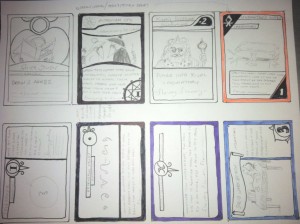
New ideas start to develop

There were some innovative things here. The side-by-side art and text of Telescope on the bottom left and Solid Workbench on the bottom right was a cool idea, but we soon decided that the whole horizontal layout was just too much of a pain to deal with in-hand, even though it looked good on the table.

I liked the circular doo-dad that held the point value of Double Pelican (bottom row with purple border), but I liked the placement of the point indicator on King’s Disfavor (top row, second from right). Having the point value up top meant that players could stack up the cards that had no ongoing effects in their laboratory, showing just the name and the point value.

I also liked the black background of the negative point value on King’s Disfavor; it made it clear that this was a negative card to play on someone else.

With this back-and-forth, a vision for the cards started to take shape. Bree’s next set of sketches showed this zeroing in on a plan (and she also had gotten her scanner set up by this point, so we’re seeing scans instead of photos from here on):

Variations on a theme

Lots of cool stuff going on here. The design I enjoyed the most was this variation on Double Pelican (top row, second from left). I liked the big point indicator on the top right corner of the card. I liked the art box with a nice space but with some curves to it. It felt both clean and cool. Bree wasn’t thrilled with some of the blank spaces on it, so I sent her back a modification of her sketch (note that I am a poopy artist here, and it shows):

Note my efforts at editing the bottom right part of the art box

Bree understood where I was going with this, and put together an actual wireframe using some art she found online (not actual game art – sorry).
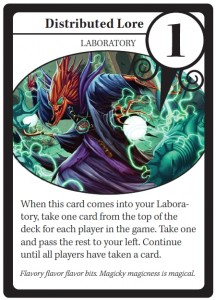
I love Bree’s flavor text

Yeah… this was looking good.

Now, there’s more to card front design than just arranging the parts – there’s also font to deal with! Bree supplied me with a dozen different fonts for the title and for the main text. We also used this process to pick a font for the card back, but I’ll address that later (we set the fronts aside for a while to work on the backs).

Once we came back to the fronts, Bree was ready to go all out – color, shading, legal text, art for the cards we had in, the whole nine yards.

I’m liking the color and the point indicator – Bree was experimenting with having it point downward for some cards and left for others. The art looks great (Beth Sobel did a fantastic job on this, her first piece for my game), but the art box is just so… rectangular.

This one is definitely not a rectangle. The filigree below the art window is kind of cool. The point indicator is too orange, though, and the oval art window was a little on the small side; not every piece would look good in it.
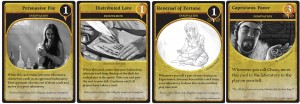
All right – now we’ve got some interesting choices! I personally loved the second layout of these four, Distributed Lore. A slightly curved art box, still plenty of space for text… yeah! I wrote Bree an email, and somehow screwed it up, telling her that I liked number 3 (Reversal of Fortune).

In the ultimate bizarre irony, here’s what I got next:

Yes, I got four cards mocked up to look like card number 1 from the previous set. I liked number 2, I mistakenly said number 3, but Bree did number 1. It was a weird mix-up, but Bree got it all worked out in the end:

Final layout in all its glory

Mmm, delicious! It’s clean and easy to read, but still beautiful. The swirly bits on the point indicator and the filigree beneath the art indicate that this card has an ongoing effect (cards without an ongoing effect will lack this). I just love everything about this layout.

Sharp-eyed readers may have also noticed that this card is of the “innovation” type, which wasn’t present in earlier versions. The rules are still in a little bit of flux based on playtesting, and I only in the last week renamed the Laboratory card type to Innovation in order to avoid confusion with the use of the word “laboratory” that refers to each player’s board.

It’s pretty amazing to see how far the card design has come in just a few weeks. It helps to have an amazing graphic designer like Bree Heiss on your team! None of you are allowed to hire her just yet; she’s still working on Chaos & Alchemy for the next few weeks, so hands off! 🙂 After that, though, hire the heck out of her; as you can see, she’s awesome.

And just wait until you see the  work Bree has done with the card back for Chaos & Alchemy. Fantastic stuff, I promise.

-Michael the OnlineDM

OnlineDM1 on Twitter