Running my first in-person Living Forgotten Realms game

Today I officially became not only an online dungeon master but also an in-person dungeon master.  I finally ran a Living Forgotten Realms game at my friendly local game store, Enchanted Grounds (spoiler alert: I ended up killing one of the PCs).  I started preparing for this game (and talking about it on the blog) almost a month ago, and I already ran this same adventure for my online group last week, so it’s fair to say that I was well-prepared!

The module was WATE1-1: Heirloom, a Living Forgotten Realms adventure for a party of four to six players of levels one to four.  There will be some spoilers for this particular adventure ahead, just so you know.

The game was scheduled to start at 9:00 AM.  I got to the store around 8:45 to get ready – and then realized at 8:50 that I had forgotten the handouts for the players (they explain the laws of Waterdeep, show a map of Waterdeep, and show a list of stolen items that was provided to the City Watch in the story).  Fortunately, I live within walking distance of home, so it took me only two minutes to drive back, two minutes two print the handouts and two minutes to get back to the store.

We were fortunate to be allowed to play on Enchanted Grounds’ fancy new gaming table, which has an inset in the middle for the battle map and a special pull-out tray with a built-in screen for the game master.  There were four players at game time, and two more were on their way but running late.  We waited about 25 minutes before starting – and naturally the two latecomers showed up just as we got going.  No harm done!

Since this blog is meant to be educational, I think it’s worth talking about what I did to prepare for running this adventure:

  • Read the adventure at least twice, paying special attention to the point of the story and, on later read-throughs, the details of combat tactics from the enemies
  • Create the maps in MapTool, convert them to posters with PosteRazor, print them out in color and tape them together
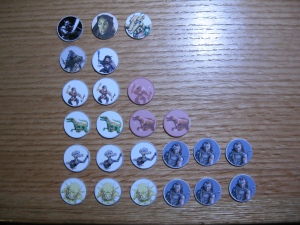
  • Get monster minis together – I used self-made tokens.  I wish I had also brought some generic non-combatant NPC tokens, but that was a minor oversight.Tokens
  • Get some way of keeping track of conditions such as bloodied, slowed, marked, etc.  I went with little rubber bands from Target that are intended to be hair bands for girls.  I believe my wife Barbara found a big container of them for $3.  I sorted them by color and stored them on twist-ties.
  • Get dice.  Lots of dice.  No, a few more than that.  Yeah, that’s the ticket! (Note the awesome d12s that have Roman numerals for 1 to 4 printed three times – actually rollable d4s!  I got them from Dicepool.) 
  • Write the name of each type of monster on a half index card and roll initiative for it.  Write that number on the half index card.
  • Get blank half index cards for each player character.  Write the character’s name (along with race and class, maybe the player’s name and a description of the mini so you know who it is – all optional, but nice) at the top of the card.  As the players roll initiative for a battle, write the character’s initiative on the card, crossing out any old initiative number that’s on it.  You can then order the cards (PCs and bad guys) by initiative and use this to keep track of who’s up and who’s next – plus it’s easy if someone delays or readies an action to put them in a new position.
  • Get a blank piece of paper for each battle.  Write the name of each monster on a line, treating multiple monsters of the same type separately (so Guard Drake 1 has a line, as does Guard Drake 2).  Write in parentheses next to the monster its bloodied value, followed by a colon and the starting hit points.  As the monster takes damage, cross off the rightmost number and replace it with the new HP total.  Check it against the bloodied value to see if the monster is bloodied yet.
  • When you’re at the table, write down each player’s name, their character’s name, their race and class, their passive Insight and Perception scores and their initiative modifier

With that, we were off and running.  The adventure begins with a long skill challenge to find the thief who stole the title heirloom.  As with my online game, I never said that we were in a skill challenge.  Instead I said, “Okay, what do you want to do now?”  Someone decided to ask around the pub for information on where they might be able to find stolen goods – “Give me a Streetwise roll.”  That pointed them to another tavern, where they looked around to see if they could find anyone matching the description of the information broker they had been given – “All right, Perception.”  And so on.

In the middle of the long skill challenge, we had a quick-hit combat encounter with some drunken sailors.  There was some fun role playing, as one of the PCs tried to hit on the damsel in distress (she wasn’t interested, and I played her as such).  There was some great bluffing of the City Watch, too – “Honest, officers, these men just fell down drunk.  We didn’t attack them…”

Once the thief was located in his lair, the battle became more interesting.  I had ramped up the difficulty level of the battle a little bit, based on past experience, and I’m glad I did.  Lots of players ended up severely bloodied, but nobody dropped.  Our assassin got a little cocky after teleporting in behind a bandit and basically destroying him in one shot, so he ended up trying to take on a couple of halfling thieves by himself.  Bad idea – those guys love to get combat advantage and deal extra damage!

The players did defeat the thief and successfully interrogated him about the stolen heirloom.  He told them where to find the person who hired him to steal it.  I then asked the players what they wanted to do with the thief and his gang.  After a short discussion, they decided to execute them.  I had a bloodthirsty table!  But so it goes.  Had this been a home game, I would have made sure that there would be consequences from this in the future, but for a one-shot I decided to just move on.

The final battle against the gnome factor and his allies in an inn room was pretty cool.  Our assassin and our monk were stealthy about getting into position, seeing some gnomes in their room at the end of a hall and successfully hiding from the gnomes.  Our fighter tried to be stealthy but failed, making too much noise while coming up the steps.  The gnomes looked up, and our bard, thinking quickly, walked up the stairs and past the hallway, whistling merrily – so I had him make a Bluff check, which he totally rocked.  Thus, with surprise preserved, the party was able to charge down the hall in a surprise round before the battle began.

Our strikers jumped right into the thick of things, dealing tons of damage but leaving themselves exposed – especially the monk.  The gnomes spread the hurt around a little bit, but the two dumb guard drakes attacked the closest thing that was threatening their master, which was our monk.  The monk did get an opportunity attack on one drake as the drake moved into position between the monk and the gnomes, but then both drakes took big bites out of the monk.  Guard drakes, as it turns out, do tons of damage when they’re near allies, and the two big chomps put the monk at exactly his negative bloodied value.  He was dead – that is, dead dead, not just “I’m lying on the ground but I’ll be fine later” dead.  I felt a little bad, but that’s what happens when a relatively squishy striker charges into battle without waiting for defender support (a lesson I learned myself the first time I played an avenger).

Pretty soon the gnomes were all bloodied, facing our wizard’s Flaming Sphere, and several of them were invisible due to their fade away power.  When the gnome leader’s turn came up, with his invisibility in place, I had him open the window of the room, fey step down to the street below and start running.  Of course, all the player characters could see was a window opening.  They were left with a tough choice – attack the empty space where they had last seen the gnome leader, or try to go after him in case he ran.

The bard attacked the empty square and rolled well enough that I told him that he didn’t feel like there was anything there to hit.  So the wizard decided to run back down the stairs and into the alley leading to the front of the inn – where he spotted the gnome!  Meanwhile, back in the room, the fighter and psion took care of the guard drakes, the other gnomes jumped out the window (one killing himself) and the bard decided to take a flying leap after everyone.  He made his Acrobatics check, landed on his feet, saw the gnome leader and pegged him with two arrows (smart use of an action point).  Mission accomplished!

This was a fun way to spend a Saturday morning, and I know the players had fun, too.  Interestingly, the person whose player I killed, Jason, had played this adventure once before (in the same party as me when I had played it), and during the course of the adventure he said, “Wow, this is way cooler than the last time!”  That’s what I love to hear.  Even though his character died, he still role-played the things that his spirit was doing, cheering on the rest of the party.  The two players at the table who were new to fourth edition had a good time and learned a lot about how the game works.  Fun was had by all.

I’m learning that I really like being a dungeon master, whether in person or online.  I’ve also learned that I need to feel prepared in order to do well. (In my next post I’ll talk about my experience running my online group through the beginning of the War of the Burning Sky while not being as prepared as I’d like.) I think I’d like to do some more DMing for Living Forgotten Realms in the future.

Chaos Scar third session – swallowed by frogs

We gathered at our place today for what is becoming a Monday holiday tradition – grilling and gaming!  Since we all had the day off for the Fourth of July holiday, just as we did a month ago for Memorial day, we decided to grill some burgers, ribs and veggies and play some D&D.  This was our third session in the Chaos Scar.  (Sessions number one and number two are at those links).

BullywugsOur party had just finished fighting bullywugs (frog people) on the first level of a ruined keep last time, and we began the day today by heading down a trap door into the next level.  Amazingly enough, our minotaur on a horse had no problem squeezing through the trap door.  🙂

We played through three battles today – some random bullywugs in a muddy chamber, some bullywugs and giant frogs in a big laboratory and some mud men in a vault.  The first battle was pretty good – nice and balanced – though my character ended up spending the entire battle stuck in the mud.   Fortunately, my Avenger, Kern, does have an at-will ranged attack, so I wasn’t TOTALLY useless!  Still, the mud that attacked at the beginning of my turn to immobilize me (save ends) was pretty annoying, but at least it only hit me and not the rest of the gang.

The third battle against the mud men was also easy, and we squeaked through the skill challenge that followed with success.  The real story of the day was the second encounter.  We fought three Giant Frogs (the link only works if you’re a DDI subscriber).  There were some other bad guys in the room, but this battle was all about the Giant Frogs.  These guys have an at-will power that lets them swallow a PC on a hit.  A swallowed PC is stunned (save ends).  That means that the character doesn’t get to do anything on their turn except take five damage (from the frog’s digestive acids, presumably) and make a saving throw.  If they fail the save, they don’t get to do anything next turn, either.

This was a miserable encounter for Nate, whose minotaur fighter was swallowed for pretty much the whole battle.  He didn’t get to take a single action until the battle was almost over (something like five rounds).  It was touch and go for the party (Nate and I both had our characters swallowed at least once), but Barbara used the healing abilities of her runepriest very wisely, which let us pull through.

This was a fun adventure on the whole, and we ended with enough experience points to move up to second level, which we’re all looking forward to.  Bree, our DM, did something I thought was really cool at the end of the session – she asked for our feedback on what was fun, what was not fun, and how to make the game more fun for us.  This leads naturally to some DM lessons.

  • The stun ability needs to be used very, very sparingly, if at all.  Certainly I wouldn’t recommend using a creature with an at-will ability that can stun (save ends).  If it’s once per encounter, okay.  If it can only stun for one turn and it is a recharge power, that’s probably all right.  But stun (save ends) at will is just too unfun for the players.
  • Similarly, monsters that daze or dominate should be used very sparingly as well.  Anything that keeps the players from doing stuff on their turns is not a lot of fun.
  • Adjusting the challenge level of encounters for a strong party is tricky.  Adding an extra monster with a stun (save ends) ability was not the way to do it in this case.  Consider increasing the damage dealt by the monsters and increasing their hit points.  MAYBE consider increasing their defenses, but don’t overdo it (having the PCs missing with all of their attacks is not fun either).
  • Flexibility is good, especially when the pre-packaged material just doesn’t work.  We faced a skill challenge that required Arcana and Nature as primary skills.  None of us are trained in either of those (except our Shaman, who was absent today).  Our DM rewarded creative uses of Athletics and Acrobatics on the fly, which made the challenge way more fun.
  • Think carefully before allowing a character a mount.  This hasn’t been a problem in our campaign so far, but we have one character with a mount, which seems really, really useful.  More speed, saving throws from being knocked prone, etc.  It’s all upside, and it seems to be pretty significant upside.  As a DM, I would make mounts an all or none proposition – either the players are all on foot, or they’re all on mounts.

Bree is doing a good job as a DM, and it’s clear that she really cares about getting better and making the game fun.  I think that’s the most important thing – a DM who is focused on fun for the whole party.  If you’ve got that, you’ve got a very important ingredient for a good game.

A nice little addendum – Bree ended up using some of my monster tokens for minions today.  They worked great!  I’m looking forward to using them in my LFR game (which Nate has said he wants to play in – cool!).

Advice I’ve received for my LFR session

For my last several posts, I’ve been talking about my decision to plunge into dungeon mastering a Living Forgotten Realms game at my friendly local game store, Enchanted Grounds.  That game will be three weeks from today.  I’ve already put the maps and minis together, so all that remains is for me to get comfortable with the adventure itself and then to run it well.

To that end, I’ve been seeking advice from other DMs, both here on my blog and over on EN World.  Here is the advice that I’ll be trying to keep in mind as I get ready to run my first adventure in public:

  • Be enthusiastic!  Enthusiasm from the DM means enthusiasm and fun for the players.
  • Make sure to really know the story of the adventure, not just the monster stats and skill challenge mechanics.
  • Get a feel for the personalities of the NPCs, especially in skill challenges.  Try to make them memorable and act as they would act.
  • At the table, set up a sheet that reminds me of who the PCs are:
    • Name
    • Class and race (optional, but it helps me for roleplaying)
    • Passive perception and insight
    • Defenses, including non-asset class defenses
    • Initiative modifiers
  • Have a flexible method of keeping track of initiative.  I’ve seen some DMs with little tags that they move around, or I’ve seen people using index cards.  I’ve also seen a dry-erase board, or ultimately D&D 4e Combat Manager (which I love, but not for this particular session).
  • When announcing whose turn it is, also announce who will be after that so that the next person can be thinking about what they plan to do.
  • Look for opportunities for bad guys to do cool or unexpected things – grabbing an item a PC drops, trying a stunt, etc.  This may encourage the players to think creatively, too!  Just make sure I’m ready to handle the rules for cool stuff.
  • Have the bad guys taunt the PCs or otherwise talk or yell or whatever during combat.  Make them characters, not just stat blocks with weapons.
  • When the battle is over except for a meaningless minion or two, just call it.  Don’t take the time to make the PCs hunt down that last little dude who can’t really hurt them.  Have him surrender, or just say that the PCs eventually finish him.

Naturally, these tips apply to dungeon mastering in general, not specifically for Living Forgotten Realms.  What other suggestions do you have in order for me to make this fun for myself and, more importantly, for my players?  Have I forgotten anything obvious?

Living Forgotten Realms – Becoming a DM

I’ve officially taken a new step in my dungeon mastering today: I’ve decided to become a DM for at least one Living Forgotten Realms game (LFR).  I’ve played in three LFR games so far at my local store, Enchanted Grounds, and I’ve had a good time.  But I know that I really like being a DM, too, and when the person who organizes LFR games at the store sent out a message saying that he still needed DMs for several games and one of them was for a module that I’ve already been through as a player, I took it as a sign.

I sent a message to Rich, the organizer, letting him know that I was interested and asking what I needed to do if I wanted to be a DM for LFR.  He said that the main requirement was willingness, but that I also needed to become certified as a DM for organized play with Wizards of the Coast in the Role Playing Games Association (RPGA).  This meant that I had to go to the RPGA web site and take (and pass!) a test.  The test was a 20-question open book test, and I’m proud to say that I passed – but a little ashamed to say that I just barely passed.  I needed to get 16 out of 20 questions right, and that’s exactly what I got.  From the questions that I missed, I learned the following useful facts:

  • When a character or monster takes the coup de grace action to attack a helpless opponent, they still have to hit with an attack roll (bearing in mind that the target is granting combat advantage).  IF they hit, it’s an automatic crit, but if they miss, they miss.  I thought it was an auto-hit.  Hmm, maybe Zod shouldn’t be dead after all…
  • If you have total concealment against a creature (you’re invisible or for some reason the creature just can’t see you) then that creature can’t take an opportunity attack on you if you move away.  Logical, but I missed it.
  • If you’re dazed, you’re not allowed to delay your turn.  Go figure.

Anyway, I did pass the test, and Rich has sent me the module that I will be running: WATE1-1 Heirloom.  In the language of LFR modules as I understand it, this means that the module is set in Waterdeep (WATE), that it’s for low-level characters (the first 1) and that it’s the first in a series of Waterdeep modules for low-level characters (the second 1). I’ll be running it on July 24, 2010, which gives me a little less than a month to prepare.  That should be plenty of time.

WATE1-1One potential problem that I discovered is that I’m used to being an online dungeon master (hey, that’s the name of this blog!), which means that I don’t necessarily have the supplies I need to be an in-person dungeon master.  I do have a battle map, which is good, but I only have one.  When I’ve played in events at the store in the past, the DMs usually have multiple battle maps with the encounter areas already drawn on them (to save time).

The real problem is that I don’t own any minis.  None.  As the DM for the game, I’m responsible for providing minis for all of the monsters.  In looking through the encounter, I need a bunch of minis with a lot of variety.  I’m fine with using some kind of tokens (colored glass beads, for instance) for the minions, but actual creatures probably require actual minis.  I might be able to borrow some from Nate and Bree, but that’s not ideal.

What are your suggestions for acquiring or improvising minis?  How should I go about buying them, if I go that route?  I have no interest in painting minis, just to be clear.  Should I make my own out of Play-Doh or something?  I read another DM’s blog who talked about doing this and letting the players squish the bad guys when they killed them, which sounds like fun.

One option is to stick with what I know – MapTool!  There are sites out there that talk about setting up a projector with your laptop and using that to project the battle map and the monsters onto the table electronically. I’ve seen this sort of thing in action once, and it was way cool.  It’s expensive, though, and I’m not ready to sink that kind of money into a setup unless I know I’ll get a lot of use out of it.

I’m looking for suggestions!  What should I do about minis?

Treasure from the past

As I mentioned in my introductory post, I had tried playing a little bit of D&D years ago, under Third Edition (3e) rules.  My wife and I bought the 3e starter kit and later the core books (Players Handbook, Dungeon Master’s Guide, Monster Manual).  We played through some of the starter kit dungeons (I was the DM, she ran several characters) and had a good time.  One of the people she worked with was a regular D&D player, as was his girlfriend, and they were interested in playing with us.  We set up a session where I would DM and the three of them would play.

I remembered that I had run them through a pre-packaged module where they had quickly taken it off the rails, and I was unprepared as a first-time DM to deal with it, so that ended badly.  They also fudged their dice rolls to get extra crits, which I also didn’t know how to deal with.  That turned us off of D&D for years until we picked it up again in early 2010.

Now that I’m running my Fourth Edition party through the Keep on the Shadowfell I’m having a better time keeping my wits about me when the unexpected happens (and no one is fudging their dice, either, which helps).  I’ll admit that I’m starting to get a little tired of the Keep, though, and I’m thinking ahead to what might come next.  I had come up with lots of neat little ideas, trying not to put too much effort into any of them because I don’t know what direction things will go.  And then I remembered something:

Didn’t I do some prep work for my own Third Edition adventure way back when?

I found my old manila folders for D&D 3e stuff.  There was a folder full of character sheets for characters that both Barbara and I had rolled up.  I learned two things here:

  • Wow, we sure rolled up a lot of characters, especially without Character Builder!
  • I think the old way of rolling ability scores must have been overpowered – those characters had some amazing stats.

That was a nice trip down memory lane (ah yes, Barbara’s elf Druid named Lyssiah Stormwhisper!  I remember her…), but what I really wanted was in the next folder:

  • The printout of the ill-fated pre-packaged adventure that I ran
  • A map for a world of my own creation that I had drawn in colored pencils (two drafts, one on graph paper)
  • An arena dungeon with multiple levels that I had created myself (two drafts, one on graph paper)
  • A cavern-style dungeon with even more levels that I created myself (again two drafts, one on graph paper)
  • A typed, four-page write-up of a full-on adventure through the cavern-style dungeon, complete with monsters, traps, difficulty classes to find doors and so on, read-aloud text…

I was blown away by the amount of time I must have put into creating this stuff – and I never used any of it!  None!  The full adventure write-up amazed me.  It’s not quite up to the quality of a professional module, of course, but it’s not completely amateurish, either.  I remember devising this dungeon and the back story now that I’ve re-read it, and I remember that I thought hard about verisimilitude when I crafted the dungeons.  For instance, I thought about why these creatures would be living where they did, why secret doors would be hidden, where the creatures slept and spent their awake time, and so on.

The question now is, what do I do with this?  I don’t think I’d use the “published adventure” that I wrote as-is since it was customized for the characters who were in the party at the time.  I could totally see myself using the dungeon maps, though, just with new monsters and even the same general logic of what types of monsters can be found where.  They still seem like pretty cool encounter areas.

What do you think?  Is something like this worth re-using?  To give you an idea of what I’m talking about, I’ve put the world map that I drew below (click to enlarge).  If you’re interested in seeing the other maps and the adventure I had written, let me know.

Ervallen Map

Chaos scar campaign – Fighting mushrooms, lunatics and frogs

Our in-person D&D group gathered yesterday for our second session in the Chaos Scar (first session at this link).  I did indeed tweak Kern the Avenger a little bit so that he gave up some Dexterity for Constitution (a few more HP and surges seemed like a good idea), though I made it so the change wouldn’t go into effect until after the next extended rest.  Otherwise, it would have been too hard to figure out where my hit points should have been (okay, so I have one more surge now, and each of the eight surges I already used should have give me one more HP, but wait, I have AC that’s one lower now, so I probably would have taken some more hits…).

We also added a new player, Blaine, to the group with this session.  This brings us to five party members:

  • Kern, the githzerai Avenger played by me (Michael) – a striker
  • Zaaria, the dragonborn Runepriest played by my wife Barbara – a leader
  • Keira, the human Monk played by Kyle – another striker
  • Bullwark, the minotaur Fighter played by Nate – a defender
  • Iskander, the wilden Shaman played by Blaine – another leader

We’re doubled up on leaders and strikers and we’re without a controller.  That should be fine.  It’s worth noting that Barbara’s Runepriest is definitely a bit of a defender, not just a pure leader.  Also, Blaine’s shaman is at least trained in Arcana, which means we finally have someone who can identify magic items!  We’re not a smart party – Iskander’s intelligence of 13 leads the party, with Kern’s intelligence of 8 bringing up the rear.  Wise, yes; intelligent, no.

Yesterday’s session started off with a battle against some mushroom people who kept denying our PCs standard actions on their next turns – a real pain in the butt.  Since Kern was so low on HP, I had him stand in the back and shoot Radiant Vengeance for the whole battle until the very last round, where I used my encounter power to shift into melee and finish off the last bad buy with my fullblade.

We then got to do some nice roleplaying.  We had rescued a halfling slave from the temple of Torog in the previous session, so we decided to take care of him.  Bree (our DM) had to make up a name on the spot and decided to call him George.  With a few minutes to prepare later, she determined that George had been captured along with his sister and two brothers, who didn’t survive.  He was from a nearby town, so we returned him to his father.  Maybe that will be useful in the future!

Our next adventure hook was to help a goliath sorceror recover a staff of earthen might that one of his ancestors had created in a keep.  The keep had been ruined and the staff broken when the meteor came to the Chaos Scar.  The sorceror seemed to be on the up-and-up, so we took the job for the promise of the other treasure in the ruins of the keep.

On the way to the keep, we heard a horse whinny and some people shouting.  We found a horse and cart, with the cart sinking into a hole.  There was a lunatic on top of the cart who seemed to think this was our fault, and he ordered his minions to kill us.  The battle was interesting, as some giant ants came out from under the cart (apparently the hole was the ants’ home) and attacked the minions as much as they attacked us.

Finally, we made it to the keep, where we faced off against some bullywugs – frog people.  The setting was interesting (difficult terrain and the like), but the battle again was pretty easy.  We found the trap door that leads down to the next level but haven’t gone there yet.

We had a fun session, and I’ll admit that I was pretty focused on playing and thus didn’t pay attention to a lot of DM lessons.  Here’s what I picked up:

  • I’ve heard it said before, but having a list of names on hand is a good idea – you never know when your players are going to want to get to know a throw-away NPC a little better.
  • Monsters who take away the ability of PCs to do fun stuff (stunning, dazing, taking away standard actions) should be used sparingly, and it should be a big deal when they show up.
  • Asking players for wish lists of magic items they’d like to have is a good way to make sure the items they find are useful.  From the player side, though, I’m not sure how I feel about it yet.
  • Thinking of fun in-story tie-ins on the fly is not easy, but it’s rewarding for the players (such as the story of George the halfling).  Be flexible and creative as a DM, and you’ll be rewarded for it.

My online game is on hiatus at the moment as Lane, who is a newly-minted accountant, has to spend most of her free time studying for the CPA exams.  Good thing I have in-person D&D to keep myself occupied!

Free RPG Day 2010

Since yesterday was Free RPG Day, I decided to head down to my friendly local game store to participate in the festivities.  Specifically, I knew from their Facebook feed and their podcast (yes, I listen to my local store’s podcast!) that they were running a free Dark Sun adventure.  Since I’m never able to play in D&D Encounters thanks to my Wednesday night bowling league, I thought this would be a good chance for me to experience Dark Sun.

I went to the store a little before the 9:00 AM start time for the game, and had no trouble getting a seat at the table.  We soon had the full six players, and a seventh showed up about 10 minutes after the hour, which the DM accommodated by handing her one of the player cards from Encounters.  She played a second healer, which turned out to be much needed!

My character was a goliath fighter, a former gladiator in the city of Tyr who was fleeing the chaos in the city along with his adopted cousin and a friend, both clandestine arcane spellcasters (apparently arcane magic is taboo in much of the Dark Sun setting).  We joined up with the other PCs, who were on a quest to get water for their people living in the mountains.  We all signed on with a elven caravan going from Tyr to Alderak, hired to protect the elves and their cargo.

The first part of the adventure was a loose skill challenge or two about surviving the desert and badlands, which we had no trouble with.  We were then set upon by raiders in a canyon for our first battle.  I enjoyed role-playing my fighter throughout – he had 10 Intelligence and 8 Wisdom, so he wasn’t too bright and he was quite gullible, very willing to go along with whatever his allies wanted to do.  He liked to smash bad guys with his sword and defend his buddies when they were in trouble.  It’s all mechanics, but you can totally role-play these things, which I loved doing.

The battle with the raiders was most interesting for me because of the guy sitting next to me, who had never played an RPG before but who had apparently read up on things a little bit before coming into the store.  His character was a wizard, and he found himself surrounded by minions before he could act, so he was thrown right into the fire of having to learn about opportunity attacks.  Every single power that his character had was either ranged or area, which means that if he cast them while standing next to a bad guy, the baddie would get an opportunity attack on him.  I believe he took Second Wind in the first round, then was able to shift away and start blasting in the second round after the rest of the group had pushed some of the minions away from him.  It was fun to see him learning what he could do, including trying to climb a cliff to get out of harm’s way (with 8 Strength, that didn’t go as well as he would have liked).

I did get a DM lesson out of this battle.  The DM generally did a great job all day, with lots of role-playing of the bad guys and description of the effects of attacks and so on.  However, he made one decision that I would have changed.  The minions in this particular battle only took one hit to kill, as with typical minions, but they would then keep fighting until the end of their next turns, at which point they would drop.  I have no problem with the mechanic, and the adventure writers tried to give some flavor for it.  Where I would have done things differently, though, is on critical hits.  Crits on these minions were treated just like any one-damage attack, and the minion still got its next round of actions before dying.  I think it would have made the players feel more awesome if a critical hit would kill one of those minions outright, rather than letting it fight on for another turn.  It’s a minor point, but it’s the type of thing that I would change on the fly to make the game more fun for the players.

After the canyon battle, the party arrived at Alderak and hung out in an elven marketplace while the guy who hired us went into a tent.  My guy, being rather dumb and oblivious, had no clue that anything was fishy, but some of the other PCs didn’t trust the elf who hired us and tried to follow him.  The DM basically said no – which was okay in this case, because the PCs in question happened to roll low on their Insight checks.

Sure enough, the party was soon ambushed by something like eight elven archers and four insects, all of whom acted in a surprise round while only one of our characters acted.  Then the bad guys went first in the first round of combat.  Before I had a chance to act (despite getting a 19 on initiative in this battle, after the 3 I rolled in the last one) I was on the ground making death saves, soon joined by another ally.  Our healer brought me back on her turn, at which point I was immediately dropped again.  The elf leader came back out of the tent, and he was soon killed by two of the other PCs, at which point the town guards showed up and sorted everything out.

This particular battle didn’t feel like it was very well designed.  Being able to take down two PCs (one of them twice) before they even have a chance to act seems far too harsh.  And then having the battle immediately end halfway through that round when the surviving PCs dropped the leader seemed anticlimactic.  I guess this was how this battle was intended to go, but two or three of our PCs didn’t even get to their spot in the initiative order before the battle ended.  It didn’t seem like much fun.

Anyway, the authorities established that we were in the right here, and so they arranged for our party to be paid what it was owed.  In addition, they let us face the elves in the arena games that were going on.  Here is where things got pretty cool.  Instead of a simple arena combat (which is what I think the written adventure called for), our DM modified things to make it an interesting game.  The two sides (the party and the wicked elves) started on opposite sides of the arena (east and west).  In the middle was a pile of seven huge ceramic coins – big enough that they required two hands to carry, but no check to pick them up or move them.  At the north end was a closed chest for our team, and at the south end was a closed chest for the elves.  The goal of the game was to have more coins in your chest than your opponents have in theirs when the battle ends at some unknown time in the future.

The real twist was that we were not allowed to deal any damage directly to one another – doing so would result in forfeit for the team that dealt the damage.  However, the arena was littered with lots of razor vine, which would deal 5 damage to any creature that began its turn in the vines.  Most of the elves were minions, so if we could push or pull them into the brambles, that would be fine within the rules and would kill them off.

The elves acted first and managed to get three coins into their chest right off the bat.  We had an ace in the hole, though – our wizard had Sleep prepared, which was awesome.  Our team grabbed some coins, shoved some minions into vines, etc.  The tide was about even, when suddenly three monster hounds of some sort were released into the arena and started attacking everyone.  Fortunately, we were allowed to fight back, but this would distract from the coin game.  Still, our team took the upper hand after taking a coin from the elves’ chest, putting it in ours (giving us four of the seven coins), closing the lid to out chest and then having a PC stand on top of the chest.

My fighter and our barbarian were keeping the hounds occupied, and the hounds had just dropped (but not totally killed) the barbarian when the elf leader saw the handwriting on the wall.  The evil elf knew that the game was lost, and since the DM said, “This is Dark Sun after all,” the elf decided to coup de grace our unconscious barbarian.  The authorities immediately declared our team the winners and said that we were free to fight to the death now (it’s worth noting that this was a one-shot game, and this was the final encounter).

I followed with what I thought was a winning move.  Surrounded by the two remaining hounds, both of which were bloodied, I Cleaved.  I critted on the attack roll, so I killed off one hound and dealt 5 damage to the other.  That wasn’t enough to kill the second hound, but since it was standing next to the elf leader and the hounds had a history of going after the closest person, I shifted away, figuring that the hound would kill the elf.  He almost did, but the DM decided that would be anticlimactic, so he had the hound come after me instead, which dropped me.  Then the elf coup de graced me as well.  Finally, our wizard killed the last hound and the elf with one spell.

Even though my character was killed off, I didn’t really mind.  It was the last battle, and I understood that it was appropriate for the Dark Sun setting.  I had a good time at the game and I think I picked up a couple of lessons.  I don’t think the Dark Sun setting is my particular cup of tea, but I know that lots of gamers out there love it, so good for them!

I do want to mention one final note about Free RPG Day.  The store was offering 20% off all RPG products, which I hadn’t realized until the afternoon when I was listening to the store’s podcast as I mowed the lawn.  They mentioned that the store was open from 7:00 AM until midnight on Free RPG Day, so I figured I’d stop on by in the evening to pick up Divine Power and Monster Manual 3, two books I’ve had my eye on.  I went to the store a little after 9:00 PM and saw that they didn’t have MM3 on the shelf, but they did have Divine Power.  I went to the register to buy my books, asking about MM3 and hoping to get a rain check (no luck).  When the cashier rang up Divine Power, it came up to full price plus tax.  I asked about the 20% discount for Free RPG Day that they had advertised, and she told me, “That ended at seven o’clock.”

Um, what?  The store’s web site and podcast clearly talked about Free RPG Day lasting until midnight.  I put the book back and left.  I’ve emailed the store owner, whom I know very well from having purchased lots of D&D and Magic stuff in the past, and I’m expecting that he’ll honor the discount.  Assuming he does (and I’ll post the resolution here, of course), I’ll trumpet this as the clear reason that you should support your friendly local game store – they’re not a faceless corporation, and they’ll make things right when problems come up.  If for some reason he fails to correct this, though, my faith in local stores will be shaken.  I really want to support them, but this is the sort of thing that will send me to Amazon with a clean conscience.  Here’s hoping the FLGS comes through!

Edit: I’m happy to say that the owner of the store got back to me promptly and said that this was indeed just a miscommunication with the employee, and that the discounts were supposed to be in place all day.  Even better, they DO have MM3 in stock and have set both it and Divine Power aside for me to come and get at 20% off.  The friendly local game store comes through with flying colors!

When should I blog about campaign ideas?

I’m currently in the DC area on a business trip, so there hasn’t been time to devote to D&D this week.  I’m happy to say, though, that there’s a chance that we might be able to resume our online campaign into the Keep on the Shadowfell this Friday, after I get home to Colorado.

Over the past few weeks of online D&D hiatus, I’ve done a lot of thinking about our campaign (as explained in my last few posts).  I’ve discovered MapTool, my new virtual D&D tabletop of choice, and learned how to make lots of cool macros for it.  I’ve played in two Living Forgotten Realms games, learning more about other dungeon masters’ styles.  I’ve also been re-reading the Dungeon Master’s Guide and the Dungeon Master’s Guide 2 and pondering how to become a better DM myself.  Finally, I’ve been reading lots of D&D blogs and web sites, and I’ve listened to a bunch of episodes of NewbieDM‘s minicast (a cool little discovery – thanks NewbieDM!).

All of this pondering has led me to a question that’s really unique to dungeon masters who blog: At what point should I blog about ideas that I have for ongoing campaigns?  See, I know that some of my players read my blog, and I totally dig that.  I WANT them to be so into the game that they want to see what I’m writing.  At the same time, I’m coming up with ideas, big and small, for the campaign that I’m running for them.  I don’t want to ruin the surprise by writing about those ideas on my blog and having them read about them weeks before they ever encounter them in the game.  On the other hand, these are raw ideas from an inexperienced DM, and I’d like to get the input of other dungeon masters on these ideas before I try running with them.

What do you think?  Should I go it alone and then blog about my creations only after they’ve been put into action?  Should I go ahead and put them here, surprise factor be darned?  Should I discourage my players from reading my blog?  Or should I perhaps put spoiler alerts for my players and ask them to skip over the spoiler sections?  I’m looking for advice – please let me know what you think in the comments.

Living Forgotten Realms – Second attempt

Barbara and I were planning on dropping by our friendly local game store tonight to play some Living Forgotten Realms (LFR).  Since I wasn’t that crazy about the Paladin that I played at LFR a week ago, and since Barbara and I have already rolled up the characters that we’re going to be using in the new campaign we’re starting soon with Kyle, Nate and Bree, we planned to try out those new characters at LFR.  Unfortunately, Barbara wasn’t feeling well, so I went on my own and decided to stick with Rhogar, my half-elf paladin from last week.

Similarly to last week, I didn’t officially have a seat reserved at the table, but I was at least on the waiting list.  One of the other players hadn’t shown up by the start time and the DM said he was fine to play with seven players instead of six in case the other player did show up – which he did, about 10 minutes late.  So, we had seven players.  The DM, Doug, said that this module didn’t take long to run, so having the extra player wouldn’t slow us down significantly.

Last week’s session started with a combat encounter, then a lot of roleplaying, then a combat encounter.  This time was all roleplaying for a long stretch, then a random little combat encounter that took no time, then more roleplaying, then basically two back to back combat encounters to finish things off.  The party was hired to recover a sextant that had been stolen from the house of a noble family, along with some other conventionally valuable items.  The sextant was a family heirloom, which they believed would lead to their ruin if it were not returned.  Thus, we went off on a long series of roleplaying encounters to try to track down the thieves.

We went to taverns in sketchy parts of town, making lots of Streetwise, Diplomacy, Bluff and Intimidate checks.  Since my character is a heavily-armored good Paladin, he was a little out of place.  Thus, I hung back and didn’t say much.  The random battle with some drunk dockworkers was a bit of a waste of time, as it had nothing to do with the main plot.  We ended up having a battle with the were-rat thief who stole the goods, along with his bandit associates.  This battle was in the basement of a boot shop, and it led to some interesting movement and use of powers.  The thief told us how to find the gnome merchant to whom he had sold the sextant.

We went to the inn where this gnome was staying, hurrying there before he left town.  Here is where things got a little tense around the table.  Three of the seven players had played this module before, so when it came time to make decisions about what to do, they tried to stay out of it and let the other four of us decide.  I thought that sending four people upstairs and three people around to the alley below the gnome’s window was the way to go – that way, we could keep him from getting away.  This was voted down in favor of having six of us wait downstairs in the inn while one person (our pacifist dwarven Cleric) went to the alley to try to disable the gnome’s wagon.  Well, the gnome’s allies spotted the dwarf at work and fired at him from the window, thus starting combat with all of us downstairs and unable to do anything for the first turn except start to move upstairs while the gnome and his buddies took target practice on our Cleric.  It worked out okay in the end, and the battle of the inn room was an exciting one, but I think that my lesson is that I need to be more assertive around the table, even though I’m still a new player.

Doug wasn’t as engaging a DM as Aarrun from last week was, but he still ran a good game.  The lessons I’d take from playing with Doug are:

  • Feel free to make minor modifications to increase the fun of a battle (such as changing the pointless dockworkers from one-hit minions to two-hit minions)
  • Try hard to make sure all of the players have a chance to be heard (I didn’t feel heard tonight, and I don’t want my players to feel that way)
  • If the battle is well in hand, feel free to call it and wrap it up, even if there are still some baddies to mop up.

Barbara and I are going to be traveling for the next week, so it’s unlikely that I’ll be able to blog for a while. That’s a shame, because I’ve learned some really cool MapTool tips that I’m anxious to share, but I haven’t had the prep time to do so yet.  Soon, though!

Living Forgotten Realms – my first time

While I mainly use this blog to talk about my efforts at serving as a Dungeon Master for my own online games of D&D, I do like to play D&D, too.  At the moment I am between campaigns in real life.  I don’t mean that I have no prospects for my next campaign – the next one will start in a couple of weeks with my same play group, just with a different person taking a turn as DM (as I discussed in my post about the death of my wizard character, Zod).  The online game that I DM is also on hiatus as two of the three players are currently on vacation.  This has given me lots of time to learn about MapTool, for instance, which is great – but I miss playing D&D.

Fortunately for me, I live within walking distance of a fantastic local game store called Enchanted Grounds.  This is a game store / coffeehouse.  I mainly go for the games – formerly a lot of Magic: The Gathering and German-style board games like Pandemic and Settlers of Catan, and more recently of course for Dungeons and Dragons books and dice.  In addition to selling D&D stuff, Enchanted Grounds also runs organized D&D events.  They’ve been running D&D Encounters on Wednesday nights, which I’d love to check out but which unfortunately conflicts with the bowling league that Barbara and I are in (yes, we both play D&D and bowl).  They also have Living Forgotten Realms, or LFR, which I only vaguely understood.  I knew it was a D&D Fourth Edition game, but it’s set in a campaign world that I know nothing about.  Also, I wasn’t sure about the rules for creating a character, getting into a game, etc.  When I finished work Thursday evening, I had a hankering to play some D&D, so I printed out the character sheet for one of the three potential characters I had rolled up for the campaign that we’ll be starting with our friends in a couple of weeks (a character that I was pretty sure I was not going to play in that campaign) and headed off to the store.

I had checked the store’s web site and their LFR Yahoo Group before leaving, and I knew that players had to basically reserve their spots in the game in advance.  There were going to be two tables of players – one in an adventure for level 4-7 characters and one for level 1-4 characters.  I introduced myself to Rich, the man who coordinates the LFR games at Enchanted Grounds, and said that I had never played LFR before and would be watching and learning this evening.  However, when game time rolled around, one of the six seats at the low-level game table was empty because one of the scheduled players hadn’t shown up.  Lucky me – I would get to play!

I introduced myself and my character (Rohgar, the half-elf Paladin) to the group, and we were on our way.  The group had five first-level characters and one second-level.  We were a technically balanced party, though a little heavy on healing.  My Paladin was the only defender, and he was a healing-focused guy.  We also had two Clerics, one of which was a mega-healing pacifist.  We had a controller – a Psion, which I hadn’t seen in action before – and two strikers (a Ranger and an Avenger).

The adventure began with the local king charging our group with the task of investigating some evil activities in the area around the city, and we soon encountered an old man with a broken cart by the side of the road.  As we approached to help him, some shadow creatures came out of the trees and attacked us.  We beat them up without much trouble, fixed the man’s cart, then headed off in pursuit of a black-clad knight we had seen on a nearby ridge during the battle.

From here, the night turned into a long stretch of role playing, which was kind of fun (though mixing in a combat encounter along the way might have been more fun).  We were on horses and had to follow the knight’s trail down a steep slope, which was problematic for me as I was terrible at Athletics.  Most of us ended up breaking our horses’ legs in the descent (so sorry, Starshine!) and had to continue on foot.  We found the knight, who had a skull for a face, in a glade of white-painted trees, which a Religion check revealed were designed to ward off evil spirits.  We talked to the knight instead of attacking, and it turned out that he was a guy from town who had been falsely accused of treason, cursed by his father, and banished from the city.  The skull face was just a mask he used to hide his identity from the townsfolk who hated him (smart choice, going with a skull face).  We wanted to help him clear his name, so we took him back to town with us.

We arrived to find a big, torch-wielding mob freaking out about the evil activities and the approaching (unscheduled) lunar eclipse.  Our knight friend skedaddled.  We dispersed the crowd, repaired a holy obelisk, talked to the knight’s father (who definitely seemed fishy to us), tracked town the town official who had banished the knight (he was incompetent), tracked down some reports about the evil activities that the town official had hidden (they would help to clear the knight’s name) and finally ended up at a temple to an evil goddess.  The cult leader, naturally, was the knight’s father.  We dispersed the cultists and engaged the leader, who was about to sacrifice his baby son on the altar.  Our strikers teamed up on the cult leader while the rest of us handled the shadow creatures that were trying to get into the temple.  Again, it was a fairly easy combat.  We saved the baby, got a new hearing for the knight (I’m sure he’ll win) and were awarded the king’s favor.

My verdict on Living Forgotten Realms as a player is that it’s definitely a way to get that D&D fix when I can’t get it any other way.  I believe this store runs games three times a week, so there are plenty of opportunities to play if I so desire.  I was surprised at the low level of challenge in the battles, but the role playing was quite fun.  Our pacifist Cleric basically stood up and gave a fire-and-brimstone speech to the mob in the city, which had the odd effect of convincing the townsfolk to try to incinerate their lamps, but it was way cool.  My Paladin was supposed to be quite diplomatic, but I sort of stunk when it came to actually talking rather than rolling dice.  I’ll work on it, though.  I definitely prefer the home games with friends, but LFR is something I could see myself playing from time to time.

The magic item system for LFR is a little confusing.  During the adventure we came across a few different magic items, and we had to divvy them up for use during the adventure.  However, at the END of the adventure we could each take one magic item, and multiple players could pick the same thing.  To make matters more complicated, you can only USE a magic item up to four levels higher than your character (so, as a first-level character I could use up to a fifth-level magic item), but you can HAVE any level magic item.  Also, if it’s an enchanted weapon of a particular type, you can transfer the enchantment to any weapon you want.  In my Paladin’s case, I took a seventh-level magical dagger and transferred its enchantment to my longsword, but I can’t actually use that enchantment until I move up to level three.  Confusing, I know.

I could see myself playing LFR again in the future – hopefully with Barbara joining me – but I’m pretty sure I don’t want to play my Paladin again.  He did exactly what he was supposed to do – bring the enemies to himself, absorb damage, dish out healing, punish the enemies he calls out when they attack his allies – but it just wasn’t that much fun.  I really didn’t move around at all in either battle – I stood there and traded blows with bad guys.  It worked for the party, but it was kind of dull.  I know I’m going to play an Avenger in my main campaign with my friends, so I might try LFR again with a Warlord that I’ve rolled up.  We shall see.

How about DM lessons?  Aarrun, the DM for the game Thursday night, was a great DM in my opinion, and I feel like I could learn a lot from him.

  • He knew the rules forward and backward.  For instance, he knew what my Paladin’s powers could do much better than I did.
  • He kept the game moving, letting the table know whose turn it was and who would be up next.
  • He got into the role playing in a good way.  He had a favorite NPC – a batty old lady who ran a book and bird shop – who really came alive with Aarrun’s acting.
  • He let the players try whatever they wanted, even if it was stupid.  Hilarity often ensued.

I have a long way to go before I can be a DM on par with Aarrun, but I feel like I can get there one day.