United Kobolds of the Living Forgotten Realms

This evening I ran a Living Forgotten Realms game at my friendly local game store, Enchanted Grounds.  The amazing thing is that it wasn’t a big deal.

You might remember my post from July where I ran my first LFR game at the store.  That was a big deal to me.  I spent a month preparing for that game.  I talked on the blog and on EN World, asking for advice about running a game in public.  I had to work to create paper maps and tokens for the bad guys.  I read and re-read the adventure to make sure I understood the ins and outs (even though I had been through it already as a player).  I over-prepared.  And to be fair, I had a blast running the game.

This time I realized at some point over the weekend – oh yeah, I’m running a game on Tuesday!  No problem.  It helps that I had already run this particular adventure at TactiCon and I therefore had all of the files I needed on the laptop in MapTool, ready to run with the projector.  (This is TYMA 2-1 Old Enemies Arise.) Still, I really didn’t stress about it.

Fortunately, I didn’t need to stress.  Aside from my accidental unplugging of the projector during the game (twice – but fortunately never in combat), it all went very smoothly.  The party battled some kobolds by the side of the road.

They met with some farmers to investigate the kobold menace.

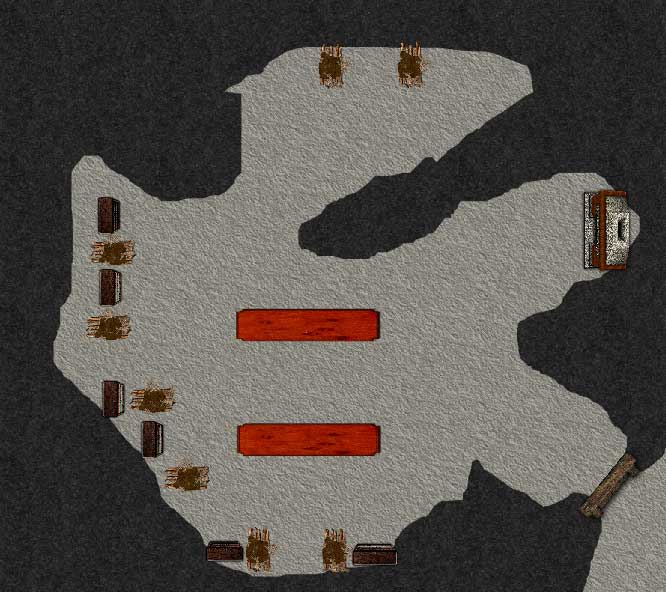
They fought in a cave full of spike traps.

And they battled the big bad guy in another part of the cave.

The first battle was fair – the defender took some serious damage, but never dropped.  The spike cave battle was lots of fun – I got to push and pull players into spikes all encounter long, when they weren’t stumbling into them on their own.  The final battle was kind of boring – I really need to find a way to spice up that encounter if I ever run this adventure again.

Part of what I enjoyed about this particular adventure was that two of my players are DMs whom I respect – Rich and Aarun.  You might remember Aarun’s name from my very first experience with Living Forgotten Realms – he was the dungeon master for my first game, and I absolutely LOVED the experience of playing under him.  He mentioned this evening that the blog post where I mentioned his name (with its unique spelling) shows up when you Google that name.  Well, Aarun – here’s another Google hit for you!

Anyway, it’s great to run a game for people you respect and for them to clearly have a good time.  I also hung around the store afterward to chat with Wes, another DM I greatly respect.  I’ve already signed up to play in some LFR games in December, and I specifically sought out games that Aarun and Wes are running.  If I can run a game for that type of person and they have a good time, I feel good about my dungeon mastering!

New campaign: Homebrew all the way!

As I mentioned in my last post, I’ve volunteered to take the next shift as dungeon master with the group I’ve been playing with here in Colorado for most of this year (my first real Dungeons and Dragons experience).  I had considered three options for this campaign:

  • War of the Burning Sky, which I am already running for my online campaign (though I would have to adjust for the fact that the in-person campaign is starting at level 5)
  • An adventure setting from Nevermet Press that I’ve volunteered to playtest (called Brother Ptolemy and the Hidden Kingdom)
  • A total homebrew campaign, based on an adventure I had written but never run for D&D Third Edition

War of the Burning Sky was originally my first choice, but after starting to work on the adjustments I’d have to make for the level issue and after talking to my current players and getting their thoughts on the matter, I decided that it didn’t seem like it would be as much fun for me (even though it would be a LOT less work).

The playtest game intrigues me a great deal, but the adventure would span several sessions, and I really didn’t want to commit to anything like that without having the time to really get to know the material first (the whole document is over 100 pages in length).

The more I thought about it, the more I realized that homebrew was what I really wanted.  Having discovered my adventure from years ago that never saw the light of day, I felt like I had to give it a go.I began by transferring my map of what was originally a goblin stronghold (the adventure was written for first-level characters) into MapTool.  It’s now an orc stronghold, since these characters are higher level.  I kept the geography pretty much the same as I had created it years ago, removing only a couple of pointless storage rooms (I like verisimilitude, but rooms that have no bearing on the adventurers at all should be cut).  I sketched out the whole complex, only making a couple of edits… and then realized that the party wouldn’t be STARTING in the stronghold, but out in a town where they’ll get the chance to find out about this thing.

So, I needed to back up and draw some more.  I started with a tavern, using a Dungeon Tile image.  I called it the Shady Maple Inn and built it around a huge maple tree in the middle of the place.  It was built and owned by an elf who loved the tree and made it part of his establishment (this made me very happy for some reason).  The players had the possibility of meeting some bandits along the road, so I created a bridge encounter map.

There was also going to be an attack by some insects during a night spent camping in the forest, so I put together a forest encounter map with trees and bushes.

This would be everything the party would face, at least for the first session.  I figured that we would get through some decent fraction of the maps I had prepared.  After all, there was a lot to get through in the first session:

  • Character introductions
  • Determining how the party members know one another – past adventures together, etc.
  • Meeting the NPC who would ask for the party’s help
  • Getting from the tavern to the manor house where a minor noble was looking for aid (likely encountering bandits along the way)
  • Meeting the minor noble and learning about the family heirloom that had been stolen
  • Investigating near the manor house to learn more about the thieves
  • Tracking the thieves through the forest
  • Battling creatures overnight in the woods
  • Getting to the stronghold
  • Dealing with the front door defenses
  • Working their way into the depths of the keep

Now, I don’t know if it was the efficiency of running the game in MapTool with the projector or what, but we got through a LOT in one session!

We started playing at about 4:15 this afternoon.  We spent about 30 minutes on character introductions and party backgrounds.  Then the action started, and the players jumped on it.  No gallavanting about, chatting with random NPCs – they heard about a mission, pounced on it without asking questions and started to complete it.  They wisely figured out that they could take a boat up the river to the manor house, which meant that they could skip the bandit encounter at the bridge.  At the manor house, they investigated the theft of the family heirloom efficiently and moved on to the forest.

Here, they were set upon by some creepy crawlies at night.  The luck of the dice had this encounter happen during the first watch, which meant that everyone would be taking an extended rest afterwards (some of them had just started doing so).  This worked out pretty well, actually – since the extended rest was coming, everyone was free to blow daily powers and action points.  The attack came from some centipedes and rot grub swarms (set to appropriate levels for the party, of course).  Even after I brought in some extra centipedes in the second round, the PCs had no trouble beating them all up.

The next morning we had a little skill challenge to continue the navigation through the forest to the orcs’ lair.  The party just barely failed this skill challenge, which made for a cool encounter.  Instead of being able to walk right up to the front door and trying to figure out how to get through, their failure meant that orc archers in the guard tower saw them coming and got a surprise round on them.  This was excellent, because the archers with surprise were pretty darn scary.  Even though these are only level 4 creatures, they have a burst 1 attack (a hail of arrows, basically) that deals d10+6 damage to everyone in the burst that it hits, and I rolled a 9 and a 10 for damage for the two archers who fired into the group.  Suddenly our healer was down to 12 hit points (out of a maximum of 43) and the party was legitimately scared.

Despite the fear, the party had the right tools to handle this problem: Area attacks.  By the rules of the game, an area attack only requires that the spellcaster have line of effect to the origin square of the area burst (which the arrow slit grants), and then enemies inside the tower would not have cover from the area attack because it’s originating inside the tower.  Unleashing a few of these helped bring the archers down before they could raise the alarm.

The door to the stronghold was trapped, and I allowed some active Perception checks to notice the trap before just setting it off on everyone’s heads.  This was a bit generous on my part, but our games haven’t involved a lot of traps in the past and I felt like it was unfair to shock them TOO much by springing a trap when they would never think to look for one.  Now they’ll think about it!

Once inside, the party used some good Stealth to sneak up on the orc minions (two-hit minions, as is usual in my games) in the next room, who were distracted by their dice games.  For this battle, the minions went to the far side of the bridge and pulled it back across, attacking mainly from range (even though they’re not great at range).  I made it clear that the river is nasty and the party does not want to fall into it.  Again, the PCs beat up the bad guys before they could raise a further alarm.

The last battle of the evening took place in the orcs’ sleeping chamber.  This area was dark, as the night shift orcs were sleeping.  One orc was awake – the cook over in the kitchen area, preparing a foul-smelling stew.  The party again made good use of Stealth, letting the party’s Monk get a surprise attack on the cook.

This battle was a little more interesting, as the orcs who had been asleep quickly woke up and did their best to sneak toward the party in the dark.  The Monk ended up bloodied a couple of times, and the Warlock/Sorcerer got a little bit beat-up as well, but since the baddies kept clustering, they were mowed down by burst and blast attacks.  Who says you need dedicated controllers in a party?At this point it was a little after 9:15 PM.  It had been five hours since we had started playing, and we had taken about an hour-long break for dinner in the middle.  We played through four combat encounters, plus the background stuff and some role-playing, investigations and skill challenges.  And this was all with brand-new characters and players who were still figuring out what those characters can do.  I was amazed at how far the party had gotten.  This was as much of the adventure as I had prepared, so we called it a night at that point (playing a few games of Zombie Dice first).

Today was a great start for a new campaign!  I feel like everyone had a good time, and the MapTool / projector combo continues to be a big hit.

DM Lessons

  • Once you’re comfortable as a dungeon master, run your own homebrew games whenever possible.  Time constraints may make this hard, but don’t let a lack of confidence stand in the way.
  • Drop future adventure hooks liberally – even if you haven’t figured out exactly where they’ll lead yet.  See what piques your players’ interest, and run with those, abandoning the others.
  • Preparation is huge.  Know the layouts of combat areas and how the enemies will use them before the battle starts.  If you can do the mapping in advance (such as with MapTool, or even pre-drawing the maps on battle mats or paper) it will save a lot of time at the table.
  • Be prepared for players to come up with ways to skip over combat encounters, and let them do it if they find a way.  Don’t get too attached to a battle.  You can probably find an excuse to use it again at some point in the future!
  • If you’re comfortable with it, technology at the table can automate the boring parts and help everyone get to the fun faster.
http://onlinedm.wordpress.com/2010/08/03/two-hit-minions/

Starting my first in-person campaign

The day has come: I’m about to serve as dungeon master for an ongoing, in-person campaign.  I’ve been running my online campaign through the War of the Burning Sky via MapTool and Skype for nine sessions over the past few months, and it’s gone very well.  I’ve also run one-shot Living Forgotten Realms games in-person at my local store and at TactiCon.

This is different.  This is in-person and ongoing, playing with people I already know (including my wife).  We’ve played two short campaigns with this same group of people.  Nate ran the first one, which took our characters halfway through third level in a largely home-brew campaign inspired by some published stuff.  That one ended when my character died and everyone else just felt like trying new characters and a new person wanted to DM.

The second campaign was run by Bree (Nate’s wife) and consisted of several of the Chaos Scar adventures.  That took our characters from first up to third level as well.  We wrapped that one up this past Saturday, with Bree deciding to step down as DM because of her other time commitments.  I had previously offered to try my hand at running the game if she didn’t have time, and she took me up on the offer.

So, here I am.  I will definitely be using my projector rig and MapTool to run the games.  I love the rig, and I love MapTool.  The next question is, what campaign will I run?

I’m considering running War of the Burning Sky (WotBS) since I’m already familiar with it and I have lots of maps and monsters already built in MapTool (meaning easier prep for me).  The complicating factor there is that this new campaign is going to start with the characters at level 5, and WotBS starts at level 1.  This gives me a few options.

  • Drop them in the middle of the second adventure, when WotBS assumes characters are around level 5, hand-waving the back story
  • Start them at the beginning of WotBS but skip most of the encounters from the first adventure, increasing the difficulty of those encounters that I do run to be fun for fifth-level characters, eventually getting synched up with level and adventure sometime around level 6.
  • Run something else.

I definitely don’t like the first option – dropping them in the middle of the story.  That just feels wrong.  I’m torn between the second and third options.  The second option wouldn’t be too hard.  I already have maps for the encounters I want to run, and I would just have to create new monsters (or level up the ones that I have).  I can do that… but I’m trying to decide how much fun that would be.  I’d really like the in-person campaign to be more free-form than that.

I could run a different published adventure.  More Chaos Scar?  Maybe Scales of War?  Those leave me feeling a little cold, frankly.  Tomb of Horrors is interesting to me, but that’s for higher-level characters (hey, this group will level up eventually…).

If I don’t go with WotBS, I think I’m going full-on homebrew.  I mentioned a few months ago that I discovered a complete adventure I had written (but never run) when I first tried D&D Third Edition a long time ago.  It’s actually pretty well fleshed out with nice maps and everything, and I could probably use it for this game.  I’d have to pick completely different monsters, of course, not just because this is a Fourth Edition game but also because I wrote the adventure for first-level characters.  I can do that, though.  That one adventure would probably last a couple of sessions, which would give me time to start planning ahead.

The more I think about it, the more I’m feeling like the homebrew option will be more fun.  Of course, it will be a lot more work, too!  What do you think?  Go with what I know?  Or go with the treasure from the past?

Simultaneous skill / combat encounter: Burning grove

In the second part of my online party’s recent session (part 1 is here), they attempted to help a dragonborn sorcerer remove the magical fire from a dryad’s grove.  This was mainly a skill challenge, with some combat thrown in.
I decided to use lots of color when drawing the map in MapTool, and I’m happy with how it turned out.  My only minor regret is that I used a lot of objects rather than just drawing on the map (the trees and flames are objects, for instance) and that meant a long load time for my players (about 3 minutes for some of them).  Lesson learned: Don’t overload MapTool with too many objects (unless you don’t mind some loading time for the party, which might not be a big deal).  Also, given the way the encounter played out, I would want to move the dryad and her children from the far left side of the map to a spot that’s a bit closer to the center.

When the encounter began, the sorcerer went to the altar in the middle of the grove to begin the ritual.  The players gathered around him, and those with Arcana training attempted to assist.  After a couple of minutes the ritual started to have an effect.  The burning grass died down, and the dryad screamed and started running toward the lake in the lower right corner.  A couple of players went over to assist her and her children, but most stayed near the altar.

Shortly after that, catastrophe struck.  A rift opened near the far left side of the map, separating the children from their now-running mother.  The four big trees surrounding the altar came to life, with vines attacking the players and force barriers going between each pair of trees.  And then the ground directly beneath the altar collapsed, casting the sorcerer down into a cave below.

It was clear to the players that the first priority was rescuing the children – the sorcerer seemed to be unconscious but alive at the bottom of the cave below.  The characters outside the force barriers started to use skills to get to the children and calm them down while those inside started working on the trees.  I was curious to see what they would try, and they ended up using skill checks to try to disable the magic of the angry trees.  Nature and Arcana eventually worked (hard DCs), and a crit on the third tree disabled both it and the fourth one.

Now the whole party was trying to help the children, and they did all right (barely).  Since we were in initiative order, it was a little awkward having the children so far out to the left, since players used their turns double running just to get partway over to them, and then had to do lots of running to get back to the lake.  It was awkward, but I hand-waved some of the distance in the end.

Two of the characters felt like there wasn’t much they could do to help the children, so they started working on rescuing the fallen sorcerer.  One set up pitons and a rope in the ground (good dungeoneering check) and then tied the rope to herself while the other held the rope and lowered her down.  She made it okay, tied the rope to the sorcerer and then moved into hiding (she’s a tiefling warlock who recently multiclassed to rogue).  Unfortunately, as the other character began pulling the sorcerer up, some fungus creatures came out of the darkness and cut the rope.

My favorite part: This is where we ended the session.  I love ending on a cliffhanger. The dryad children have been rescued (though the mother died in the effort), but now the warlock is alone in the lower cave with just the unconscious sorcerer for company and some fungus creatures coming out of the darkness.  I’ve already changed this next encounter up from the published version, and I’m excited to try it out next week!

Giving dungeon mastering advice

As my regular readers know, I’m pretty new as a dungeon master.  I only started playing Dungeons & Dragons in early 2010 and my first attempt at DMing was about six months ago.  I regularly make notes in my blog about the lessons I learn from other DMs that I play under.

It was, therefore, a little surprising when I was asked for MY advice from another DM.  This past Saturday I played a Living Forgotten Realms game at my friendly local game store, Enchanted Grounds.  It was a game for level 1-4 characters and I had planned to play a new cleric I had put together using Heroes of the Fallen Lands.  There were already two other healers at the table, though, so I instead played my trusty half-elf paladin, Rhogar, in his last 1-4 adventure (at the end of this session he had reached level 5).

The DM for this adventure was Andy, who had played in the first game I had run with my new projector setup about a month ago (I believe you can see Andy’s elbow on the left side of the picture on that post).  Andy is the one person I’ve met who has told me that he reads my blog, which was a very cool moment for me (Hi Andy!).

The adventure itself was a lot of fun.  Our party got off a ship in a genasi city and was beckoned by an elderly dragonborn to come over and talk to him and his elven companion.  The elf lady was the dragonborn’s ward, and she was very ill.  He was trying to take her to the realm of some elves who lived in some woods far to the south in the hope that they could cure her.  We agreed to help.

Andy ran this whole section really well – the roleplaying was great, and he got everyone around the table involved.  Rhogar decided that, being a noble paladin he couldn’t bear to make the poor elf woman walk all that way, so he rented a horse for her to ride.  Andy was great at improvising the existence of a stable, stablemaster and horse on the spot, even giving the stablemaster and horse some names. None of this made a lick of difference from a mechanics perspective, but it made the adventure come alive.

After about an hour of roleplaying, the party got into three combats.  The first two were tense, interesting affairs while the third was, frankly, a boring solo encounter (no fault of the DM).

At the end, Andy asked for feedback.  I’ve never been asked to give my thoughts on another DM before!  I told him the things I laid out above, and also suggested that he should feel free to modify combat if it makes sense to do so.  For instance, he could have had the solo monster have two initiative rolls if it wasn’t turning out to be much of a challenge, or have some more bad guys come in after a couple of rounds (a few more of those insects that grabbed and immobilized in an earlier encounter would have been vicious!).  But that’s subtle stuff, and a published adventure is supposed to take care of that sort of thing.

Most interesting to me, I realized that I actually felt fine giving dungeon mastering advice.  I didn’t feel like a fraud.  I certainly don’t have all the answers, and I will ALWAYS be looking for more advice on my own DMing, but I’m now a legitimate part of the dungeon mastering community and I have useful things to say.  That’s a good feeling!

TactiCon Days 3 and 4 (Saturday and Sunday)

The big weekend days of TactiCon were so big and busy that it took me until Monday to be able to write about them!  Thank goodness for the Labor Day holiday.

Here’s the “Too Long, Didn’t Read” summary:

  • Both of the games I ran on Saturday went great – the projector was a big hit.
  • I played in a very cool custom adventure Saturday night with a novice DM – another good experience.
  • I played in one game on Sunday, which was marred by the most annoying player in the world.
  • I got great reviews from my players and walked away with a free D&D book for my time.
  • I’m looking forward to running and playing more games at the next convention in February.

Saturday: Running the first game

Saturday was the day that I was signed up to actually run two games, though I had run an impromptu one the previous night when the need arose.  I got to the venue right at the scheduled 9:00 AM start time, which meant that I was later than a DM should be.  I arrived at the room where I would be running the game, and my players were already there.  I felt a little bit bad for running late, but no one seemed to mind.

The morning session was a repeat of the game I had already run the previous evening at TactiCon and earlier in the week at my friendly local game store: CORM 1-1 The Black Knight of Arabel.  My party of six players was actually a little underpowered compared to most of the parties I’ve played Living Forgotten Realms with, and it was kind of refreshing!  There was one brand-new D&D player (I love that so much!) and several characters that weren’t optimized to the hilt.  It was still a balanced party, though, so there wasn’t a problem.

This party was the first one I’ve seen that decided to go into Arabel after the initial shadow attack, rather than going after the dark rider on a distant hill.  This meant that I got to run the in-town skill challenge for once, and I had fun with it.  The party took on the optional combat challenge in the brewer’s basement to recover the broken obelisk – a better battle than I was expecting.  The final battle was run pretty much as scripted – I didn’t ramp up the difficulty at all, and it was still a good challenge for the party.  They, like the last party to go through that encounter, played “Grab the Baby from the Evil Cultist”, with the party bard eventually putting the baby in a balcony to keep it out of harm’s way.  Interestingly, this party never met the titular Black Knight of Arabel and finished the whole adventure having learned nothing about him.  Weird, but it worked out okay.

I had an hour between games, so I dashed to the hotel restaurant to get a burger to go.  The service was slow, and I was a little bit nervous leaving my laptop and projector set up in the hotel room with no one around, but when I got back everything was just as I had left it.

Saturday: Running the second game

My afternoon game was with a more experienced party, and we were playing the adventure that I was less sure about from a fun perspective: TYMA 2-1 Old Enemies Arise.  The first battle is the hardest one of the adventure, and I basically told the party as much during the battle so that they wouldn’t be too afraid to use daily powers as needed.  This party lacked a true defender, so the warlord played that role and found himself the target of a savage beating, ending the battle with only two healing surges remaining.  The group decided to take an extended rest in town, and since that made sense within the story I decided to allow it.

I ignored most of the scripted skill challenge because it just didn’t make any sense.  The party is supposed to talk to two different farmers outside of the skill challenge to get information about the kobold attacks.  Then they’re supposed to go BACK to town to start the skill challenge of gathering clues about where the attack is coming from, even though they already know at this point.  And this is supposed to require four successful checks.  Stupid.

So, once they knew that the attacks were coming from the west, I moved into a simpler tracking challenge, followed by some checks to narrow down which cave the kobolds were in.

The first cave combat is one that I ran for my online group a week before, and it was only so-so that first time.  I changed it.

  • As written, there are five trapped squares, and whenever any square is triggered, spears pop up from all five squares. This is boring – once the trap has gone off once, the players will just walk around all of the trapped squares, making the trap mostly irrelevant.
  • I upped the number of trapped squares to ten.
  • I also made it so that each square triggers independently, leading to an awesome minefield experience as the PCs tiptoe across the cave.
  • Finally, I gave the trap savant something to do – his crossbow bolt now pushes the target one square on a hit.

This encounter ended up being a lot of fun.  One character charges in and is hit by a trap.  The rest of the players tiptoe carefully, hoping to avoid the traps.  The decoys jeer at the players, trying to pull them onto traps and to hit them with their swords.  The savant shoots bolts from afar, trying to push players onto traps.  The final encounter after that one wasn’t super-interesting, in part because the dailies all came out, but everyone seemed to have a good time overall.

Saturday evening: Playing in the special event

In the evening, the LFR game was a special one written for the Con called In the Blink of an Eye.  All of the tables of all levels were playing in the same setting, but in different parts of it.  Our group scouted for a way to sneak into a castle and ended up going in the royal family’s emergency escape tunnel.  We were attacked by iron snakes that came out of the walls, retreated when bloodied, and reappeared later.  It made for a surprisingly cool fight.

We then dealt with a trapped corridor using skills, at which point we were at the stopping point for the adventure with time to spare.  The DM decided to make climbing some stairs into an athletics check, at which my heavily-armored paladin failed again and again, taking a little damage each time before finally succeeding.  He is now known as Rohgar Stairslayer.

It was fun to play at the table of a new DM.  She knew the rules well enough but was lacking a little in confidence.  I could see a lot of myself from a few months ago in her – a very interesting process.

After the stopping point, a 16th level rogue from another table was sent to join our party (I’m still not sure why) and we fought a hydra.  It was a 6th level solo, but with unloading of dailies we finished it in two rounds (without the high-level rogue having to do anything significant).  I’ve heard complaints about solos, and I understand them now.

Sunday

On Sunday I decided to sleep in, so I only made it in time for one LFR game.  The DM was one I had played under before at Enchanted Grounds, and he had lots of 3D props for the table (trees, bushes, rocks, etc.) which were pretty cool.  I liked the module, too – AGLA 1-1 Lost Temple of the Fey Gods.  The experience, however, was heavily marred by the presence of one player who was totally mechanics-focused and asked endless questions trying to push the envelope (Can I hide here? Can I see around this corner? Will I get anything useful if I use Arcana now? Could we put away our torch, blinding the rest of the party, so I can use low-light vision?).  He was horribly irritating to play with, and I pitied the DM for having to deal with him.  Had I been running the game, I think I would have paused the game, pulled him aside, and explained that he needed to just play rather than trying to squeeze every non-existent advantage out of the game and sucking the fun out of the table.  If he couldn’t do that, I would have removed him from the game.

Wrap-up

At the end of the convention, there was a little ceremony to thank the DMs.  Everyone was given a choice of various RPG products (I picked up the Forgotten Realms Campaign Guide – I figure I should probably take a look at it) and was recognized for their work.  There’s another somewhat bigger convention in February, Genghis Con, which I’m now looking forward to!

Overall, I had a great time at TactiCon.

  • I did get minis for Rohgar and Kern (though nothing for Zaaria) as well as a couple of miscellaneous minis for players to use at my table.
  • I ran three games and got fantastic evaluations – seventeen perfect scores and one score of 9 out of 10.  I’ll take that!
  • The projector setup worked beautifully and the players loved it.
  • I played a bunch of LFR and got Rohgar to level 4 – woo hoo, I can play in H2 adventures now!
  • I discovered a cool board game, Fresco, which I think I might pick up for myself.

I did not get to play any non-LFR RPGs, but I think I’ll remedy that at Genghis Con in February by just signing up for a slot in advance and diving in, most likely into Savage Worlds.  I’d also like to run a few more sessions if possible – maybe 4 or 5 next time.  It should be awesome!

Balanced-power parties are ideal

This post was inspired by my response to Robert J. Schwalb’s blog post about the Killer DM within.  A quick aside: I found Robert’s blog via a link on Sarah Darkmagic – a fellow RPG Blogger Network member whose blog I regularly follow.  I love the way RPG Bloggers leads me to so many interesting items online.

Some dungeon masters / game masters hate power gamers.  These are the players who try to find every possible advantage from any available material when putting their character together.  If there’s an overpowered angle to take on a character, they’ll find and use it.  This is sometimes referred to as “character optimization” or “CharOp”.  Those who don’t approve might call it “being a munchkin” or “twinking”.  This is the character who can easily kill monsters well above their own their level without breaking a sweat.

Robert talks about the Killer DM having the potential to emerge when the DM is frustrated with the players and the way they’re playing the game.  I think DMs in general are not fans of power gamers who min-max to the hilt.

Having thought this issue through, I’ve concluded that the problem isn’t exactly power gamers per se – you can always ramp up the difficulty to make it a challenge for them.  The problem is when you have characters of vastly different power levels in the same party.

If everyone in the party is super-powerful for their level, then the DM’s job isn’t too hard – you use higher-level encounters, give monsters extra abilities that will make them more challenging, and so on.  The problem is when one or two players are super-powerful but the others are of a normal power level.  In that situation, ramping up the difficulty to challenge the power gamers will make the monsters just plain deadly to the rest of the party.

The same problem can occur in reverse if you have a party of mostly average-power characters and one or two characters who have terrible stats for combat (the weak but charismatic fighter, for instance).  Those under-powered characters are not going to be able to fight interesting battles alongside their more powerful brethren and will be reduced to either standing in the back or getting themselves slaughtered.

In my opinion, the key to a fun gaming environment is to have a party of similarly-powered characters.  They don’t have to be all the same power level, but they should be close.  In that situation, the DM can create encounters that challenge everyone but that everyone can contribute to.  That’s what we want as dungeon masters.

I’m happy to say that my online campaign feels like the party is pretty well balanced from a power perspective.  When it comes to combat, everyone can contribute.  If we ever got to the point that one character was simply outshining all of the others, I would talk to that player about ways to bring the character in line, because otherwise combats will be too easy or too deadly for some part of the party.  A balanced-power party is a happy party.

Two-hit minions (and another gaming hiatus)

One-Week Hiatus (from gaming, not blogging)

After three Fridays in a row of running my online D&D game, it looks like we’re finally going to have to take a week off.  My wife and I have a date Friday (yes, I have a life outside of D&D!) and two of the five players have scheduling conflicts or potential scheduling conflicts, so we’re going to take the week off.  This is probably a good thing since I’ll be on a business trip to New York next Monday through Wednesday and probably won’t have a ton of time to get ready during the trip (although I’ll admit that several hours on a plane with the laptop does make for a lot of D&D planning time if I wish).  I’m pretty much set for the next session already, so getting a little ahead would be a good thing.

TactiCon Prep

Dark Skull - The Black Knight of Arabel

I’m also going to start getting ready for the Living Forgotten Realms game that I’ll be running at TactiCon over Labor Day weekend.  I’ve been through the adventure once as a player, and I’ve just finished reading through the published version this evening.  The DM who ran it was pretty creative with rearranging things on the fly; I might take some of his modifications into the game when I run it.

One thing that the DM who ran this adventure did that I liked was making minions a little tougher.  Minions in D&D 4e are enemies that only take one hit to kill, no matter how little damage they take.  That’s fine – it gives the wizard in the party a gang to blow up.  But honestly, minions end up feeling a little bit pointless.  I’ve been making a lot of my minions two-hit minions instead, and I think it makes them more fun.  The rules I use are as follows:

Two-hit minions

  • Minions begin with two hit points
  • Whenever a minion takes damage, that damage is reduced to 1 hit point
  • This first hit bloodies the minion (so any PC abilities that kick in on bloodying an enemy kick in)
  • Damaging a bloodied minion drops it
  • Dealing a critical hit to an unbloodied minion drops it
  • Dealing damage to an unbloodied minion of a type that the minion is vulnerable to drops it
  • Rule of cool – anything that should wipe out a typical enemy drops a minion even if it’s not bloodied (massive damage, etc.)
  • And if the PC does something that would wipe out an unbloodied minion but the minion is already bloodied, feel free to have the attack drop the bloodied minion and then bloody an adjacent unbloodied minion (or drop another adjacent bloodied minion)

These aren’t hard and fast rules, but I think they make minions more interesting.  Now that Magic Missile is an auto-hit (my players have already started calling it “Magic Hittle”), regular minions just seem boring.  Sure, the wizard has to use his standard action to drop one rather than doing something awesome someplace else, but it still feels boring.  I am against boring!

MapTool Macro Updates

I’ve continued to tweak my MapTool macros on the Downlaods page.  First, I’ve discovered that WordPress supports a fixed-width font that lets me show you the proper indenting for the macros.  This makes IF blocks and WHILE loops much easier to follow.  Second, I’ve added new Basic properties and new code to PC macros to handle Brutal weapons.

A weapon with Brutal X means that you re-roll any dice that are X or lower.  So, a Brutal 1 weapon means you re-roll any 1s for damage, Brutal 2 means you re-roll 1s and 2s, and so on.  I first programmed this very manually for the dwarven fighter in my campaign who was using a Brutal 2 Craghammer.  Then I realized from searching online that a d10 weapon with Brutal 2 is exactly the same as a d8+2 weapon.  With d10 Brutal 2, you have an equal chance of getting a 3, 4, 5, 6, 7, 8, 9 or 10.  And with a d8 + 2, you have exactly the same chance of getting exactly the same numbers.  Sweet!

My code now contains the following lines:

[h: DamageDie=Wpn1Dmg-Wpn1Brutal]
[h: NumDice=1]
[h: DamageRoll=roll(NumDice,DamageDie)+NumDice*Wpn1Brutal]

So, if your weapon doesn’t have the Brutal property, Wpn1Brutal will be zero, and the damage roll will be one weapon die plus zero.  However, if it’s Brutal 1, the damage roll will be a roll of a die that’s one number smaller than the regular damage die, and then one point will be added to the roll.  Note that for Brutal 1 this means that you’ll be rolling a d9 or a d7 or something like that.  This is obviously impossible in real life, but MapTool doesn’t care!  Feel free to roll a d23 in MapTool if you like.

Summing up

I’ll be okay without my online game for a week, but I’m really hoping that the in-person game that I play in will start up again soon (the DM has not been feeling well for a while).  I’ll throw myself into future prep work, which, I must admit, has led me to keep on dreaming about the projector setup that I talked about last time.  What’s wrong with me?  🙂

I’m curious: Do any of you out there use house rules for minions, or are they all one hit all the time?

MapTool – updated macros and using it for in-person games

It’s been a while since I’ve done a post about the nitty gritty of using MapTool, so I thought that would be a good topic.  I’ve been using MapTool for my online War of the Burning Sky campaign (we’re three sessions into the game so far), and it’s worked like a charm.  The only glitches that have come up have been minor errors on my part (putting the wrong power on a PC, forgetting to update an armor class, etc.).  MapTool continues to be an awesome program.

I’ve updated everything on my MapTool Macros page on the Downloads section of this site to reflect the properties I’m using today.  There are package files available to download for a PC and for a monster, as well as sample tokens for a PC and a monster with all of those macros included.  You’ll still find the single target and multi-target attacks, along with damage, healing, initiative (I’m actually using MapTool’s initiative window now), visibility toggling for monsters, and a macro I wrote for our shaman PC to summon and dismiss his spirit companion.

Of additional interest to me right now is a visit I made to the friendly local game store, Enchanted Grounds, to see a wonder in action: A local GM (Ian) who uses a laptop and projector to put the map and monsters on the game table.  With this setup, the players still use minis for their characters and move them around on the table, but the GM prepares the map in advance along with the monsters and creates a projected image for everyone to move around on.  If I had a setup like that, I wouldn’t need to worry about printing out my maps with PosteRazor – I could just take the electronic version with me and have the ability to change it on the fly.  Given my love of MapTool for my online games, this would be great!

In order to run a setup like this, I would need to do several things.

The hardware

If I go the projector route, I need to build a projector setup.  This, of course, is the biggest obstacle to this approach.  Building a setup with a projector and game surface is expensive and difficult.  However, it’s been done before.  I like the approach laid out by Sean Pecor on his web site.  Check out the image of his setup:

I like!  It cost him just under $800 to get this together, and most of that (about $550) was the cost of the projector itself.  I could swing this if I REALLY wanted to, but unless I had a regular home game, I don’t think it would be worth it.  Still, if I go this route I will probably use this design.

For what it’s worth, Ian’s setup (the one at the local store) is a great deal more involved than this.  It consists of a free-standing wooden stand that has a table for the DM’s laptop/papers/dice, which then extends far upwards (probably about 8 feet off the ground) to an upside-down mounted projector that shoots forward onto a mirror and from there onto the table.  There isn’t a fixed surface – Ian just uses a large piece of white foamboard that he puts on the game table.  It’s neat, but Sean’s setup looks way more portable (a big win, in my opinion – especially if I want to use this for LFR or convention games).

It pretty much goes without saying that another necessary piece of hardware is the laptop to run the game.  I have a Dell laptop that I got in May 2010, so I’m in fine shape there.

The software

Ian spent some time showing me the software he uses for his game.  First, he builds maps in Dundjinni.  From what I’ve seen, Dundjinni is a fine mapping program, but I’ve settled on MapTool and I don’t see myself changing.  Apparently Dundjinni creates maps that are sized for A4 paper, and if you want a bigger area than that you’re making multiple maps.

Ian then exports the Dundjinni files as JPEGs and sticks them together in Photoshop.  He also resizes them to 60% of their native size, which evidently makes them the right size for his setup to project them at a one-inch square scale.

The software that I was REALLY interested in turned out to be a homemade program that Ian had written in Visual Basic.  This program lets him load up a map and send whatever part of it he likes to the table.  It also lets him pop monsters onto the map, show attack rolls, etc.  He showed me a lot of its features and I realized something:

MapTool does all of that already.  It’s also free, and I know how to use it.

Now, the one software piece that I didn’t understand at all going in was how Ian managed to project one image onto the table (one that only shows what he wants players to see) while still seeing the full image on his laptop (with all of the hidden monsters, traps, stats, etc.).  It turns out that he has set up his laptop in “Extend mode” with a projector.

This essentially means that he is using two monitors.  The one on the “left” is his normal laptop screen with everything that the DM should see.  The one on the “right” is the projector.  His homebrew program just sends whatever he wants to the monitor on the “right” (that is, the projector) while keeping the full image on the “left” (his laptop screen).  It’s ingenious in its simplicity.

Laptops vary, but there are two basic ways I’ve seen to set the Extend Mode up:

  • On Ian’s laptop, which is an HP machine running Windows Vista, he right clicks on the desktop, goes to Display, and chooses the two-monitor option from a drop-down menu and then the Extend mode from a list of options that pops up.
  • On my laptop, which is a Dell machine running Windows 7, I go to Control Panel – Appearance and Personalization, and then under Display choose Connect to a Projector and select the Extend option that pops up.

Now, I haven’t actually tried this with my laptop yet (I don’t have a projector, you see), but I think it should work.

The best part is that I think I’ve figured out how to do it in MapTool.  I don’t have Ian’s homebrew program to send images to the projector side of the extended screen.  However, I think the following steps will work:

  • Open up MapTool on the main monitor and load up the campaign that I want to run.
  • Start a server on this instance of the MapTool program.
  • Open a second instance of MapTool.
  • In the second instance, connect to the server that’s running from the first instance (which should be available in the LAN tab of the server connection box).  This second instance is now connected to the game as a player, not a DM, so only the player content will be visible.
  • Move the second instance onto the projected monitor (the one off to the right).
  • In that second instance, hit Ctrl-Alt-Enter to put it into fullscreen mode (or go to View – Fullscreen mode).
  • Run the game as you would online on the main instance.  Everything you reveal with fog of war, unhiding monsters, etc. will show up on the table, but nothing else will.

I’ve got to say that I’m really excited to try this idea out, and I may just hook my laptop up to a regular computer monitor and treat that monitor as the “projector,” just to see if this works!

Has anyone else tried using MapTool with a projector to run a game as I’ve described?  What about using other software?  Do you have any tips on where to get a good deal on a projector?  And am I totally nuts for thinking about doing this?  Discuss!

War of the Burning Sky Session 2

All right, now this is more like it!  I got together with my online group last night for our second session in the War of the Burning Sky campaign (our third overall session as a group).  The first WotBS session didn’t go all that well in part because we had to wrap up early when one player got called into work but mainly because I was underprepared and didn’t feel ready to wing it when needed.

This time, I was ready.  With this session, I started intentionally deviating from the campaign as laid out in the published module, and I’m glad I did.  There are some spoilers for the campaign ahead, just so you’re warned.

I started the party off in session 1 as scripted, meeting their contact, Torrest, in a closed-down inn at New Year’s Eve in the town of Gate Pass as the world was on the brink of war.  I ran the bounty hunter ambush battle more or less as scripted, though I ran it badly.  The players did well to think quickly and try to lure the lead bounty hunter to the Resistance – a cool idea.

I then ran some of the mini-quests as written as the party made its way from the inn to the bank tower to meet their next contact.  The party helped heal a burned family, caught a panicked woman who was jumping from a burning building, and shared in the panic in the crowd as a huge winged figure swooped overhead in the night.  That’s where we ended things last time.

Next, I ran the much-maligned “Animal Crossing” encounter, in which a rich man begs the party to help him find his Kiki, who, it turns out, is his pet dire weasel (see photo to the left).  I had Torrent clearly be uninterested in helping, and I would have awarded XP for simply the group deciding that this was a waste of time, but the soft-hearted warlock in the party helped persuade the others that this poor man was in need of their help.  So, the weasel hunt was on, and for me at least it was a ton of fun.  They tracked the weasel through the streets, into a closed temple, out a side door, down an alley and into a locked sewer grate.  The druid in the party used a fabulous Nature check to calm Kiki down, at which point she climbed out and snuggled into his arms for safety (I essentially role-played Kiki as one of my cats).  I showed the party the picture I had made for Kiki, and the druid was sorely tempted to keep her (she IS pretty adorable, if a bit dire), but the group ultimately returned the cute little dire weasel to her rightful owner.  They then spent a surprising amount of time trying to get out the box of treasure that they spotted alongside Kiki in the sewer grate, ultimately blasting the crap out of the lock on the sewer grate with a bunch of magic.

Fun aside: At one point the gnome in the party tried to squeeze through the sewer grate, which was an untrained Acrobatics check.  The dwarf fighter assisted by shoving him through with a great Athletics check.  Unfortunately, the gnome’s Acrobatics roll was a natural 1, so I ruled that he got his knee caught on the grate, the fighter’s shove cause him to bang up that leg, dealing him 1d6 damage. Ah, the dangers of assisting!

At this point I made my first major deviation from the published story.  As published, the party encounters a character in the bank who appears to be their contact, Rivereye, but who is really a good-aligned spy from a nearby eladrin country.  The spy has secretly subdued the real Rivereye and taken a potion to disguise himself as Rivereye.  He has taken the case of secret information that Rivereye was supposed to be giving to Torrent (that is, the MacGuffin) and sent it with some of his eladrin allies to another part of town because the real Rivereye has convinced the spy that the case is rigged to blow up if it’s opened without the proper pass phrase.  The encounter is scheduled to go like this:

  • The party arrives and meets the fake Rivereye
  • The fake Rivereye doesn’t realize who Torrent is and slips up in his charade
  • When Torrent catches him in the slip-up, the spy flees with his wisp solon partner
  • The party then has a long series of encounters helping the Resistance and tracking down the case, possibly becoming allies with the eladrin along the way

This struck me as overly complicated and, more importantly, no fun.  I don’t like the “meet a bad guy and keep him from fleeing” encounter, especially since it seemed like it would be easy for him to get away.  So I completely revamped it.

In MY version (available here as a PDF), the fake Rivereye is a doppelganger counter-spy from the evil empire that Rivereye has been spying on.  The doppelganger and his gang of half-orc goons have been tailing Rivereye in the hopes that he’ll lead them to his contacts in the Resistance.  As in the published version, the fake Rivereye tries to pass himself off as the real one and ultimately slips up.  However, in this version he doesn’t HAVE the MacGuffin – it’s locked in a bank vault and he needs Torrent to get it out.  When he fails in that, he and his goons attack.  He ultimately tried to flee at the end of the battle, but I had him use a potion of teleportation to try to get away – which, when combined with the Burning Sky teleportation issues, fried him to a crisp.  Add in the lightning trap that I had jumping around the battlefield, and it was a more fun encounter (at least for me).

I considered running the Flaganus Mortis encounter after this one, but I ultimately decided not to bother as it felt too random.  I had the party go to a safe house (which I made into the Dagger’s Rest Inn from their first session, transplanted from Waterdeep) and rest for the evening.  In the morning, they started their plans to escape the city.  I gave them the option of trying to work with a city council member as written in the published module, but that seemed boring to me, so I presented them with another option: Escape via the sewers.  Happily for me, they went with the sewers

I skipped most of the rest of Act Two, Act Three and Act Four as written, but I took the Dead Rising encounter from Act Two and said that in order to get from the sewers into the natural cave system that would take them out of the city, the party would have to fight through an ancient crypt of undead.  I ran this one exactly as written (except with an exit out the back of the crypt, and the fact that the entrance came from the sewer), and it was pretty darn brutal – but the players made it in the end.  I did soften the death explosion of the Dwarven Boneshard Skeletons to be 1d6+4 damage rather than 3d6+4 – they were crazy-powerful enough without dealing insane damage on death.

We called it a night as this point, as the party got ready to delve into the natural cavern system (which is not part of the published adventure at all).  I’m very happy with the changes I made to the adventure, and I personally am having much more fun than I did in the first WotBS session (mainly because I feel like I know what’s going on now and am free to make changes as I see fit).  I’ve already put together what I think is an interesting trek through the natural caverns, after which I will likely pick up some of the published threads of the adventure (probably using Act Five more or less as written and then moving on to the second published adventure).

What do you think of the changes I’ve made so far?  Was running the weasel hunt worthwhile?  Do you have any suggestions for a trek through some caverns in an effort to escape the city?  I have some ideas of my own, but I’m always looking for more input!