The Death of Zod

I was planning to write about more advanced MapTool macros that I’ve created for player characters today, but my plans changed after our in-person D&D game.  This is the first time our group has been able to get together in almost a month, and we decided to use the Memorial Day holiday as an opportunity to barbecue,  hang out and do some adventuring.  The food was great, if I do say so myself (I did the cooking).  Barbecue ribs with sauce from Sonny’s Barbecue (a chain that we know from Florida), plus burgers, grilled veggies, baked sweet potatoes – good times!

As for the gaming, the last time we played was when we fought the infamous down-leveled Troll Vinespeaker that nearly destroyed us.  Fortunately, we finished that guy off at the end of our last session.  Our group returned to the rebel camp that we were assisting, rested, and helped the rebels relocate their camp (since the bad guys now knew where the old one was).  My wizard, Zod, used a ritual for the first time ever to conjure Tenser’s Floating Disk in order to carry some of the wounded rebels.  The rest of the party carried supplies, helped navigate through the woods, and inspired the camp onward, with great success.  We then set off to a nearby cave that the rebels were hoping to dig into in order to create a secret tunnel into the city that they were rebelling against – but which had been discovered to contain a cave troll.  Fire supplies at the ready, we ventured into the cave.

The troll’s lair was interesting – it was a giant lake with a narrow path running around it.  The troll was tall enough to stand and walk in the lake, with the goal of grabbing adventurers, using them as weapons against one another, and dragging them underwater from time to time.  The water made our use of fire a little more difficult.  If the troll was under the water, for instance, Zod’s flaming sphere couldn’t hit him.  Still, with good tactics (and some crazy-awesome dice rolling from Barbara’s ranger, Violet), we finally defeated the cave troll and got some good loot.  Most of us had used up our daily powers and action points, but we still had plenty of healing surges left and we figured that the troll was probably the nastiest thing we would encounter, so we decided to explore a little further.  After all, if the rebels were going to be digging a tunnel in this cave, we should let them know what to expect up ahead.

A short while later, our party came to a small waterfall, behind which was an area that looked like still water.  We spotted an amulet in that area, but Zod’s Mage Hand wasn’t able to penetrate the surface.  Our warden recognized the “still water” as some type of slime creature, so I cast a fire burst at it, and the battle was on.

We were fighting a whole bunch of slimes – a big yellow one, two nasty green ones that liked to engulf us, four gray ones that sucked our Fortitude defenses down, and something like 15 slime minions that slid us two squares every time they hit us.  Bree’s defender was soon slid to the far side of the chamber and was unable to get back.  Zod tried to take out multiple monsters with Thunderwaves, but with mixed success.  Eventually we were surrounded and found ourselves in trouble.  We ended up with Kyle’s bard alive and the other three of us unconscious.  Barbara’s ranger made a miraculous natural 20 on her death save, which helped immensely.  The bard healed the warden, who was planning to come administer a potion to my wizard, Zod – when the yellow slide decided to attack Zod while he was unconscious.  That, friends, is called a Coup de Grace, and it’s an automatic critical hit – and a dead wizard.  Oops!  I didn’t feel that badly about it, honestly.  These things happen.

The rest of the party was able to escape the slime cave, and I headed to the computer to print out a character sheet for a Warlord I had rolled up a couple of weeks back (we needed more healing).  In a few minutes, though, the rest of the gang called me back into the room.  They had decided to call this an end point – not just for our session today, but for the campaign.  I was worried at first that somehow my letting Zod get killed caused the party to collapse, but it turned out that Barbara and Kyle were both rather unhappy with how they had built their characters from the start (Kyle because he was brand-new to Fourth Edition and really wanted a Monk, not a Bard, and Barbara because I had interfered too much when she was creating her character and it never really felt like HER character), Bree wanted to try her hand at DMing, and Nate was itching to play rather than DM.  So, we called it a campaign.  Bree will probably start us up again in three weeks with a pre-published adventure to get us going anew.

What lessons did I learn?  Well, first I learned that the death of a character is not catastrophic.  I’ll admit that I’m not great at role playing yet, so I probably wasn’t as attached to Zod as I could have been, but the thought of bringing in a brand-new character didn’t sound so bad to me, honestly.

Second, I think that character death is more acceptable when it feels fair.  The cave troll we fought was challenging (mostly because of the water) but fair.  The slimes were very numerous but fair.  Dying there didn’t seem like anything went horribly wrong – some bad luck, some tough monsters, maybe a questionable decision to push on without daily powers.  Had we ended up dying to the troll druid from our previous session, I would have been bitter, as I felt that monster was unintentionally overpowered.

Third, I’ll have to think about how I feel as a DM about the possibility of the campaign ending, perhaps abruptly.  While our DM, Nate, was happy for the chance to play instead of DM, he seemed to take the decision to end the campaign after this battle somewhat hard, as if it were his fault.  We were having fun with the campaign itself, but having two players with characters that they didn’t like all that much was a problem.  The notion of me rolling up a new character when Zod died basically got them thinking, “You know, a new character might be fun!” and things went from there.  It wasn’t Nate’s fault.  I think he worried that the encounters he put together were overpowered for our party, and maybe they were a little bit, but that’s because he used to work at Wizards of the Coast and was used to playing with people who ran super-optimized characters that would blow through any encounter equal to their level or even a little higher.  Did he make things too hard today?  No, I don’t think so.  Sometimes it’s right to flee, and we didn’t do that soon enough in the slime battle.  So it goes.

I had fun with my first real D&D campaign, and I’m glad that I’ll get the chance to hang out with this same group of friends to adventure together.  I find the idea of a new character, new DM and new campaign to be exciting, not depressing.  The only down side is that now I won’t get to play any D&D at all for several more weeks – but that’s mainly because I have some business travel coming up the weekend after next.  After that, game on!
Fourth Edition for people who prefer earlier editions

Karl (one of the people I had the pleasure of playing old-school D&D with last week in Albany) made an insightful comment on the blog that got me thinking.  He pointed out that some people don’t like all of the emphasis on tactical movement in D&D Fourth Edition, and also that there has been a collapse of many different skills into a smaller number (with the “taking ranks in a skill” concept radically changed to just a zero-one binary of being trained in a skill or not being trained in it).  It got me thinking: What should a person who doesn’t like some of these elements of 4e do?

The simplest option (and the cheapest), of course, is to play an earlier edition.  OSRIC lets you play something like First Edition for free, and as I understand it the System Resource Document lets you play something like Third Edition or 3.5 for free.  So, if you prefer an older edition, you can play one.  That’s what Shawn’s group does, and it seems to work for them.

But are there things you could take from 4e and combine with earlier editions to make something more to your liking?  I think there are.  When I think about it, 4e feels like it could be quite modular if you wanted it to be.

First, flavor.  If you just love the flavor of Fourth Edition and want to use it with an earlier rule set, that’s obviously very easy.  Sure, you’ll have to change around numbers on monsters and so on, but their descriptions can be identical and their powers can be adapted to a different set of rules.  If you like the 4e gods, use them.  Setting information, dungeon maps, whatever you like can be easily transferred to another edition’s rules.  I’ll admit that I don’t personally have strong feelings about the flavor of 4e, but if you do, have at it!

Next, powers.  This is one that I think you either love or hate about 4e.  In Fourth Edition, characters start with (in general) two at-will powers that they can use as much as they want, one encounter power that they can only use once every battle, and one daily power that they can only use once per day (and they get more as they go up in level).  In earlier editions, the only equivalents you had to at-will powers were melee or ranged basic attacks (I swing my sword, I shoot my crossbow, etc.).  You could also do something that’s pure role playing (I talk to the bad buy or my allies, I try to hide, I jump onto a table, etc.), and that’s still there in 4e, too.  Magic users in earlier editions had a certain number of spells they could cast per day (very few at low levels), which gives them a little bit of a daily power feel, but other classes don’t seem to have any equivalents.  I like the whole power system in 4e, partly because everyone has at-wills that are useful in combat and partly because I like the tension of when to use dailies and encounter powers versus saving them for later.

Could you use this power system in an earlier edition?  I don’t see why not.  Some powers have certain ranges on them or a number of squares that they affect, but I think a good 1e DM could handle that stuff without breaking out a battle map.  Weren’t there the equivalent of bursts and blasts in earlier editions, such as with a fireball?  I assume the DM would say, “Okay, these three bad guys are clustered together, so your fireball hits all of them, but the other two are far enough away that they’re safe.”  Same idea here.  Powers that generate something like difficult terrain would be tougher without a battle map, and you probably wouldn’t want to use those unless the DM really liked mentally keeping track of this stuff.  Even there, you could rule that a power that created difficult terrain around a bad guy would make it hard for them to charge you on the next turn, and it’s up to the DM to say whether they can get to you or not.  This is basically playing 4e without a map or minis, and while I like the map and minis, I think a group could absolutely play a great 4e game without them, as long as they weren’t nitpickers for EXACTLY how close imaginary point A is to imaginary point B.

How about the collapse of skills?  Here’s an area where it’s almost totally unrelated to combat, so you can separate the two.  If you love the powers and maybe even the map-and-minis combat of 4e but you prefer the larger number of skills where you spend ranks in them, as you had in 3e and 3.5, then just go with the older skill system.  I think the new skill system was probably designed to be easier for new players to grasp, and I agree that it’s likely a sign of Wizards of the Coast de-emphasizing role playing to emphasize tactical combat.  If you are cool with more complexity in your skills, though, use the older skill system and enjoy!

Now let’s talk about numbers.  I must say that the transition to “higher AC is harder to hit” in Third Edition was a good change, period.  Maybe someone can convince me that the old system, where you want to lower your AC and you have to figure out your THAC0 and all of that, makes good sense.  But I personally don’t see it.  This is something I would adopt wholesale, even if I wanted to play an older edition.  I also think that having to use a table to look up whether an attack hits a monster, depending upon the class of the PC who hit, seems overly complex and doesn’t add anything to the game, at least as far as my limited understanding goes.  But hey, if you love the tables, stick with them.

I don’t know enough about the other numbers in older editions to say how they would differ from 4e, but I get the impression that HP totals are lower (for both characters and monsters) in 1e, and that it’s probably true that battles are swingier (you get lucky and kill a bad guy right at the start, or you get unlucky and he kills you with one hit).  That’s fine if you like it, but I imagine that if you didn’t like it, you could probably use 4e as a guide for hit points and damage output.  Of course, some people complain about “grind” in 4e, with battles taking too long due to the high hit points all around, so maybe there’s a good middle ground.  I know that I personally wouldn’t want to be a wizard running around with 4 HP and scared of my own shadow, but hey, maybe that’s just a great opportunity for role playing!

There are lots of other little details that could probably be taken from 4e by themselves if you wanted, and I think doing so would be easy enough if you’re cool with house rules.  Character creation using a point buy system is something that’s not unique to 4e, and I would personally use it over rolling dice (now that I’ve had a chance to try it both ways).  Using Fortitude, Reflex and Will as defenses other than AC that an attack might go after is something I could take or leave, and if you preferred using them as saving throws as in older editions, you certainly could do so.  Conditions that “save ends” seem fun to me, and you could easily introduce those to a First Edition game, and so on.

Ultimately, you’ve got to go where the fun is for you and your group.  If you’re happy with the rules of one edition (or one non-D&D game) as written, then life is easy for you.  If there are things that annoy you about the rules of your current edition, you might be able to pilfer different rules from other editions.  Me, I like 4e just fine as written, but if I got to the point that something about it just grated on my nerves, I wouldn’t hesitate to use house rules to change it.

Troll druids are nasty

We had our in-person D&D game yesterday, where my wife Barbara and I went to our friends Nate and Bree’s house to play D&D with the two of them and with our friend Kyle.  Kyle couldn’t make it, so I ended up running his character for him.  This was an interesting experience.  My character is an eladrin wizard, and Kyle’s is a tiefling bard.  Making matters a little more interesting, we only had Kyle’s original level 1 character sheet, and we’re now at level 3.  I leveled the character up based on my best recollection of the choices Kyle had made (though I’ll admit that I did change the level 2 feat to suit my own preferences) and ran with it.

Our characters started off in a rebel camp in a forest outside of a huge city.  Our party had decided to help the resistance against the overlords of the city, and we were getting ready to head off to a tunnel that the rebels were building to get in and out of the city to rid it of a cave troll.  Before we could leave the camp, however, we were invaded by two trolls and three ogres.  These guys were coming after us because of some run-ins we had with the authorities in the city before we got out to the rebel camp.  We later figured out (thanks to some fantastic intuition on Barbara’s part) that they were able to find us by tracking an enchantment on an item that we had stolen from them (oops, our bad).

The battle in the camp was pretty interesting.  The lead troll was clearly the guy we needed to focus on.  He started off by grabbing my bard (well, Kyle’s bard) by the head in the first round and hanging onto him throughout the whole battle.  The bard had a tough time escaping a grab, but he fought pretty well for a guy with his head being squeezed by a troll!  The rest of the party battled well and was ultimately helped by some of the other rebels joining the fray to finish off the bad guys.  We took down the lead troll and the three ogres, but the second troll – a druid of some sort – escaped into the woods.  Despite the fact that we had spent our daily powers and were not in the best shape in terms of hit points, we decided that letting him get away to warn other giantfolk would be a bad idea.  So, we chased him into the woods.

The chase was handled as a skill challenge, which we just barely succeeded on, and we found the troll druid in the woods.  Here’s where things got ugly.  This particular guy was a Troll Vinespeaker (from Monster Manual 2), which is normally a Level 14 creature but which Nate had scaled down to Level 6.  I think this means that he lowered the hit points, attack bonuses, defenses and damage output, but he didn’t fundamentally change any of the powers.  I think this was a mistake.  During the battle in the camp, the Vinespeaker had buffed his allies with some temporary hit points (fair enough), backed out of melee to shoot vine attacks at individual PCs (no problem) and then, just before he ran away, shot an area attack at a few of us.  The area attack created a nine-square area of vines that:

  • attacked each PC in the area when it was created
  • dealt 1d10+2 damage to each PC that was hit
  • IMMOBILIZED each PC that was hit (save ends)
  • dealt 1d8 damage to each PC that began its turn in the area or entered the area
  • served as difficult terrain (you move through it at half speed)
  • and the area persisted until the end of the encounter

Okay, a few things here.  First, I know that Nate scaled down the bonus to hit with this attack (at level 14, it was +18 versus Reflex, and I know that this troll’s bonus to hit was way lower).  So that’s good.  Second, I don’t believe he altered the damage dealt by the beginning of turn / enter the zone attack.  That’s not so good.  Even with all of that, though, we only saw this druid use the ability once in the camp, so we assumed it was an encounter power – once per battle.

Nope – it was at-will.

Think about that for a minute.  Every single turn, this troll (who started the battle in the woods about 10 squares away from us, with the PCs clustered together) can create an area of thorns around several PCs that, if it hits (which it usually did), deals a bunch of damage right there, then immobilizes the character until the end of their next turn at best (if they make their first saving throw), then deals additional damage at the beginning of the character’s next turn – and the one after that if they miss their save, and then the one after that if they miss that save…  It was ugly, ugly, ugly.

The troll quickly created four of these zones that pinned down most of the party.  The other party members were trying to pull the immobilized creatures out, but it wasn’t happening.  My wizard and my bard both went unconscious, still sitting in thorns (so taking 1d8 every turn until the end of the encounter).  Bree’s warden pulled the wizard out, but getting the bard out looked hopeless.  Barbara’s ranger then had the bright idea to try to scare off the troll by shooting some fire arrows at it.  The arrows missed, but the troll was scared of the fire and ran.  Now that he wasn’t generating new zones, the warden and ranger were able to pull the bard out, barely.  The unconscious characters were carried back to the rebel camp and healed, and we took an extended rest and chased after the troll druid the next morning, where we found him and finished him off (though Kyle’s bard almost died again to some stupid little plant creatures – sorry Kyle!).

The battles were intense and draining.  I’m glad we prevailed, and almost everything was great – except, in my humble opinion, the way the Troll Vinespeaker was converted from level 14 to level 6.  The Dungeon Master’s Guide (DMG) has some advice on changing the level of a monster.  It says that, to lower the monster’s level you should decrease its attack rolls and defenses by 1 per level and decrease the damage it deals with its attacks by 1 per every two levels.  You also adjust its hit points according to its role.  However, it also says that this process really only works for changing a monster’s level by 5 or less, and that beyond that you should pick a different monster to work from.

In this case, the Vinespeaker needed to be bumped down by 8 levels.  This means that its attack roll and defenses should all be lowered by 8, and its hit points should be lowered by 64 – and I think Nate did this exactly.  Its damage should be reduced by 4 – and I think Nate did this, but only for attacks that dealt dice damage plus static damage.  So, the damage from being hit by the thorny area attack was originally 1d10+6, and I think Nate lowered it to 1d10+2, which is reasonable.  He did not, however, change the damage dealt by the thorn area each turn or whenever a character entered the zone.  It was 1d8, the same as it would have been at 14th level.  This should have been no more than 1d4 (reducing the maximum damage by 4), although that’s only reducing the average damage by 2 rather than 4 (1d8 averages 4.5, whereas 1d4 averages 2.5).  I guess it really should have been reduced to a fictional die that rolls either a 0 or a 1 (average of 0.5).  So, that’s a big problem – we took a lot of damage from those thorns!

Furthermore, I think the point in the DMG about just abandoning this idea for monsters that are more than 5 levels away from what you’re seeking is important here.  A monster 8 levels above another monster is going to have mightier powers – not just in terms of the attack bonus or damage dealt, but also in terms of special abilities.  In this case, there’s no way a 6th level monster should have an at-will ability that creates a zone that deals damage and immobilizes when it hits, deals damage each turn that you stand in it or whenever you enter it, serves as difficult terrain and lasts until the end of the encounter.  If that were an encounter power, that would be fine.  Maybe even a power that recharges on a 6.  Alternatively, it could be an at will that creates a zone that persists for one turn.  But all of that together is just too much for a 6th level monster.

Let me be clear on something – I like Nate a lot.  I think he’s actually a fantastic DM.  And I think that the troll druid was a way cool enemy.  But I don’t think the troll druid ended up being what Nate intended him to be – a tough supporting character in an encounter led by a bigger, nastier troll and backed by some smaller ogres.  He ended up being nearly a solo monster.  If we had fought him one on one after an extended rest, with our daily powers charged, it would have been a fair fight (thanks in part to the wizard having access to Flaming Sphere).  So, that’s a lesson for us as players – charging after a bad guy when you’re exhausted from a tough battle may be a bad idea.  But if that thorny area attack had been an encounter power (as we thought) rather than at will, I think we would have handled him pretty easily, even when exhausted.  I think Nate chose to have the troll flee from the ranger’s fire arrows out of pity, honestly.  By that point in the battle we had given up on attacking the troll and were just trying to flee, but we couldn’t get our fallen comrades out of the thorns without the troll just creating more.  The troll couldn’t really have been that afraid of a couple of fire arrows (especially when they both missed him).

What have I learned?

  • As a player, I’ve learned not to make assumptions about what is an at-will power and what’s an encounter power!
  • I’ve also learned that chasing a fleeing baddie when you’re exhausted can be a bad idea – although, as I said, had the thorn zone been an encounter power I think we would have been fine mopping up a lone troll druid.  I think you should pursue the weakling before he can alert his big friends.  This guy, as it turned out, was no weakling.
  • As a DM, I’ve learned that you have to be very careful when adjusting monster levels.  I think that I’ll start by sticking to the DMG’s advice when I do this sort of thing, and not try to re-level a monster by more than 5 levels (and probably not even that much).
  • Rewarding players for being clever is extremely important and satisfying for everyone.  The fire arrows were smart, as was the discovery that the stolen item let the authorities track the party, and we were rewarded for both of those and felt good about it.
  • You have to be open to the possibility that you’ve made a mistake.  As a player, I realized that I made a huge mistake in assuming that the thorny area power was at will.  When I did, I changed my thinking to, “Let’s get out of here!” but it was too late.  As a DM, I think I should be open to the possibility that one of my ideas isn’t working, as with the power level of the troll druid in this case.  When that happens, I think I would want to fix it on the fly rather than let the consequences play out as written.  This is absolutely a situation I could see myself getting into as a DM, and I think I’ve learned something important about how to handle it.

I’ve heard it said that people learn more from failures than successes, and I think that’s true here, too.  Our party’s decision to go after this monster was a mistake, and I think I’ve learned from it.  The power level of the troll was a mistake, too, and I’ve learned from that as well.  The good news is that despite everything, our party pulled through and had a good time doing it.

One other note: It looks like schedule conflicts and upcoming travel plans are going to make it so that I won’t be able to play my online D&D game with my friends until late June (it’s mid May as I write this).  That’s disappointing, but it’s not the end of the world.  We may get the small group together (four of us) once or twice for a quick-hit adventure, but we’ll probably just put things on hold.  Hey, that give me more time to get some challenges ready for everyone!  I can live with that.

Second gaming session – the Irontooth battle

As we planned on Friday, I got together Saturday afternoon online with Barbara, Lane and Zach to finish up the side quest of ridding Winterhaven of the kobold menace.  There was only one encounter to run: the infamous Irontooth battle.  From reading about the Keep on the Shadowfell adventure online, I knew that other DMs said that the Irontooth battle could be a total party kill (TPK), especially if the players were unlucky or if they were still new to the game and not understanding what they could do.  The battle is set up as a sixth-level encounter for a party of first-level players.  Encounters that are a level or two above the players are totally reasonable but challenging, and three or four levels above them should be highly threatening.  Five levels above?  Now you’re just trying to kill your friends, and that’s not fun.

So, in addition to scaling the battle down to work for three players, I wanted to scale it down a little farther still in order to be more like a fifth level encounter.  This is a good time to talk about scaling encounters for smaller parties.

Wizards of the Coast tries to help out DMs when it comes to scaling battles up or down for party size or character level (on pages 56-57 of the DMG1).  Every monster has an experience point value, and an encounter of a given level for a given party is made up of monsters whose XP total equals the XP for a monster of that level times the number of PCs in the party.  If you want a first-level encounter for three players, you see that a first-level monster has XP of 100, so you want monsters that total 300 XP (100 XP times three players).  If it were a third-level battle for a party of six characters, you’d see that a third-level monster has XP of 150, so you want 900 total XP in the encounter (150 XP times six players), and so on.  That could be made up of a whole bunch of tiny little minions or just a couple of higher-level baddies.

The Irontooth battle as written is worth 1,250 XP – a sixth-level encounter for a party of five players.  I wanted it to be more like a fifth-level encounter for a party of three players, which meant I was aiming for more like 600 XP.  That meant I had a lot of slashing to do.

  • The encounter calls for 10 Kobold Minions at 25 XP each.  I cut this down to 4 minions (100 XP)
  • 3 Kobold Skirmishers at 100 XP each became just one (100 XP)
  • 2 Kobold Denwardens at 125 XP each became one (125 XP)
  • 1 Kobold Wyrmpriest at 150 XP was eliminated, which I hated to do but I had to do something (0 XP)
  • Irontooth himself is built to be worth 300 XP.  I cut his hit points from 106 down to 80 and removed his hit point regeneration ability (getting back 5 HP per turn once he’s bloodied seems too strong), but left his damage and other abilities alone.  I figured this made him worth about 250 XP (250 XP).
  • In addition, a Kobold Slink escaped the previous battle to go into the cave to warn the other kobolds, so he was going to show up here.  However, he was beaten up from the earlier battle and doesn’t have any healing surges, so I started him at his bloodied hit point value and shaved his XP from 100 to 75 (75 XP).

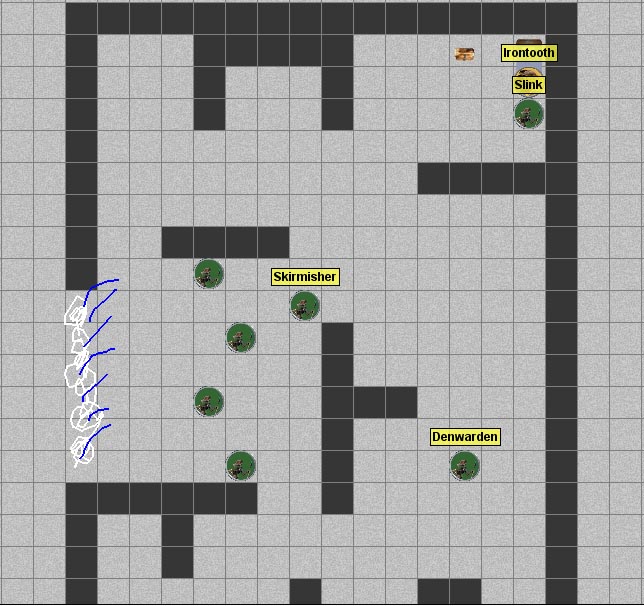
All together, this adds up to 650 XP, which is slightly above a fifth-level encounter for this party.  Hoo boy!  This could be tough.  The map is below (and the Gametable .grm file is at this link, as well as on the Downloads page with my other maps).

Irontooth Battle

The Irontooth battle, scaled for three players

Fortunately, the party’s tactics were sound.  The battle is set up in two waves, with a second group of enemies (including Irontooth) coming into the fray three rounds after the first wave.  The party finished off the first wave (four minions and a skirmisher) during round three, just in time for the second wave (Irontooth, the denwarden and the bloodied slink) to show up.  Had they still had parts of the first wave running around while they were trying to deal with the second, it could have gotten ugly.  As it stood, they did a good job of saving their daily powers and action points for the second wave, where things got challenging.  The Healing Word power that I had given to Lane’s druid, Kana, was used up early on, and everyone’s second winds were used, too, but they ultimately finished off Irontooth with single-digit hit point totals remaining.

My favorite part of this day’s session was the excitement when the treasure chest came into view.  Zach’s character seriously considered ignoring her allies in battle (all three characters are female, even though Zach is male) so that she could sneak over to the chest and try to pop it open during battle.  Cooler heads prevailed, and she decided to keep fighting and pick the lock on the chest later (no one thought to try using the key from Irontooth’s pouch, but the lockpicking went off without a hitch).

We’re going to try to get together on Friday nights, starting this coming week, with the whole group of five adventurers.  This time, they’re ready to take on Shadowfell Keep itself.

Lessons from my real-life DM

Even though I’m a D&D 4e blogger, I’m still relatively new to the game.  I’ve been playing since early 2010 in a game with my wife Barbara and our friends Nate, Bree and Kyle.  Nate is our DM, and based on my admittedly limited experience, I think he’s really good at it.  I plan to think about the things that Nate does that make our games so much fun, and try to take those lessons to heart in my own DMing.

First of all, I think Nate has taken a lesson from the fourth edition Dungeon Master’s Guide to heart – the goal of the Dungeon Master (in person or online) is to help everyone playing the game to have fun.  I’ve heard that earlier editions of D&D pitted the DM against the players in a contest to see who would “win,” where “winning” as the DM basically meant killing off the party.  In fourth edition, the focus is on fun.  If certain aspects of the game aren’t fun for your particular group of players, then try to avoid those aspects if at all possible.  Wiping them all out probably won’t be much fun for the party, for instance, so try to avoid that!

We’ve played for about five sessions now (just leveled up to level 3 – woo hoo!), and I can tell that Nate is trying hard to observe what we like and dislike when we play.  It helps that our group gels really well – we like each other outside of our D&D time, too, which is a big plus.  So even if something weren’t going well at the table, we would still have fun spending time together. Still, things have been going quite well at the table.

At the end of the session, Nate asked specifically if we felt like we had the right amount of combat in the session.  We played for about five hours, during which time we had some discussions of how we would disguise ourselves to get out of the city we were in, a tense encounter at the city gate to see if we could escape, a pair of back-to-back combat encounters in a forest, and some open-ended role-playing time in a small rebel camp. So, combat in the middle with non-combat at the beginning and end.

It was great!  Nate was careful to let us run with our suggestions, but still helping us look for flaws in our plans (such as the fact that some of our characters were on “Wanted” posters in the city we were escaping and would therefore probably want some disguises in order to get past the authorities at the city gate without a fight).  The fights were tough but fair (boy, spiders that can jump on you from 30 feet away are vicious!).  And the roleplaying at the end had some conversations with NPCs that led into our two magic users spending time helping a wizard examine a magical sword to figure out its properties while the other two characters had an entertaining (non-combat) time hunting in the woods.  There was something for everyone, both inside and outside of combat.  We even had an NPC of a much higher level fighting with us, but she didn’t completely take over combat or anything like that.

So, what lessons have I learned so far?

  • Watch your players to see what they like and don’t like.  This will probably be more challenging online, since I won’t be able to see their faces, but we should have audio chat.  I’ll have to listen carefully and ask questions.
  • Make sure everyone has something they can do, whether in combat or out.
  • Go with the players’ ideas for how to solve problems, but provide coaching as needed, especially for new players.
  • Don’t feel obligated to hand out loot if it doesn’t make sense to do so.  If your characters kill some wild animals (like those darn spiders) in the wilderness, they probably won’t have any treasure on them, and that’s okay.  It’s fine to give extra loot at some points and none at others – it all balances out.
  • Reward characters for creative thinking – even if the reward is just the chance to play out a crazy scenario, with no XP or gold.

I think I can use these lessons in my own games as I start DMing.  On that point, by the way, we have set up this coming Friday as our targeted first session for our online game.  We’ll be using Gametable for the map and dice rolling and Skype for audio chat.  For this first time, we plan to mainly try a technology check to make sure we can all hear each other and see the map, but I’m hoping we have time for at least a little bit of adventure!