Simultaneous skill / combat encounter: Burning grove

In the second part of my online party’s recent session (part 1 is here), they attempted to help a dragonborn sorcerer remove the magical fire from a dryad’s grove.  This was mainly a skill challenge, with some combat thrown in.
I decided to use lots of color when drawing the map in MapTool, and I’m happy with how it turned out.  My only minor regret is that I used a lot of objects rather than just drawing on the map (the trees and flames are objects, for instance) and that meant a long load time for my players (about 3 minutes for some of them).  Lesson learned: Don’t overload MapTool with too many objects (unless you don’t mind some loading time for the party, which might not be a big deal).  Also, given the way the encounter played out, I would want to move the dryad and her children from the far left side of the map to a spot that’s a bit closer to the center.

When the encounter began, the sorcerer went to the altar in the middle of the grove to begin the ritual.  The players gathered around him, and those with Arcana training attempted to assist.  After a couple of minutes the ritual started to have an effect.  The burning grass died down, and the dryad screamed and started running toward the lake in the lower right corner.  A couple of players went over to assist her and her children, but most stayed near the altar.

Shortly after that, catastrophe struck.  A rift opened near the far left side of the map, separating the children from their now-running mother.  The four big trees surrounding the altar came to life, with vines attacking the players and force barriers going between each pair of trees.  And then the ground directly beneath the altar collapsed, casting the sorcerer down into a cave below.

It was clear to the players that the first priority was rescuing the children – the sorcerer seemed to be unconscious but alive at the bottom of the cave below.  The characters outside the force barriers started to use skills to get to the children and calm them down while those inside started working on the trees.  I was curious to see what they would try, and they ended up using skill checks to try to disable the magic of the angry trees.  Nature and Arcana eventually worked (hard DCs), and a crit on the third tree disabled both it and the fourth one.

Now the whole party was trying to help the children, and they did all right (barely).  Since we were in initiative order, it was a little awkward having the children so far out to the left, since players used their turns double running just to get partway over to them, and then had to do lots of running to get back to the lake.  It was awkward, but I hand-waved some of the distance in the end.

Two of the characters felt like there wasn’t much they could do to help the children, so they started working on rescuing the fallen sorcerer.  One set up pitons and a rope in the ground (good dungeoneering check) and then tied the rope to herself while the other held the rope and lowered her down.  She made it okay, tied the rope to the sorcerer and then moved into hiding (she’s a tiefling warlock who recently multiclassed to rogue).  Unfortunately, as the other character began pulling the sorcerer up, some fungus creatures came out of the darkness and cut the rope.

My favorite part: This is where we ended the session.  I love ending on a cliffhanger. The dryad children have been rescued (though the mother died in the effort), but now the warlock is alone in the lower cave with just the unconscious sorcerer for company and some fungus creatures coming out of the darkness.  I’ve already changed this next encounter up from the published version, and I’m excited to try it out next week!

Playing a blind character

A recent thread on EN World got me thinking: What would it be like to play a blind character in a role playing game?  Could it be done?  Would it add anything from a role playing perspective?

Here is how I imagine the rules for a blind character.

  • Lacks normal vision
  • Has blindsight, representing super-sensitive hearing and to a lesser degree smell and touch. It’s also reasonable to assume that some magic is at work here in improving the other senses to offset the lack of sight (sixth sense).
  • No penalty to attack rolls, damage rolls or defenses (thanks to the other super senses)
  • Can’t detect anything that is silent and too far away to touch and smell (cannot serve as a lookout on a ship, for instance
  • Unaffected by the blinded condition
  • Immune to gaze attacks or any attack that requires the target to see something (certain illusions, though some illusions can fool other senses)
  • Crippled by the deafened condition (-10 to all attacks, -5 to all defenses)
  • Normal perception in general, though the DM may rule that some uses of the skill are purely or primarily sight-based (such as following tracks) and can impose penalties or rule certain things to be impossible
  • -2 penalty to insight in general (no ability to read facial expressions, but keen ability to hear inflection)
  • Speaks one bonus language, but cannot read or write any language

I could imagine a blind monk character, for instance, using his hands and feet not only to deal damage but also to better get a feel for where exactly the target is.  A blind cleric has lots of flavor potential.  What about a blind shaman, relying on a spirit companion to be her eyes? (Ooh, I like that idea a lot!)

I’m very interested to hear your thoughts on this.  Have you ever played or played alongside a blind character?  What would it be like both from a rules perspective and from a role playing perspective?  It seems that there are lots of opportunities for fascinating role playing with this type of character, and I’ll admit that I’m tempted to try this out in the next campaign I run or play in (for a home game, obviously, not public games).

Giving dungeon mastering advice

As my regular readers know, I’m pretty new as a dungeon master.  I only started playing Dungeons & Dragons in early 2010 and my first attempt at DMing was about six months ago.  I regularly make notes in my blog about the lessons I learn from other DMs that I play under.

It was, therefore, a little surprising when I was asked for MY advice from another DM.  This past Saturday I played a Living Forgotten Realms game at my friendly local game store, Enchanted Grounds.  It was a game for level 1-4 characters and I had planned to play a new cleric I had put together using Heroes of the Fallen Lands.  There were already two other healers at the table, though, so I instead played my trusty half-elf paladin, Rhogar, in his last 1-4 adventure (at the end of this session he had reached level 5).

The DM for this adventure was Andy, who had played in the first game I had run with my new projector setup about a month ago (I believe you can see Andy’s elbow on the left side of the picture on that post).  Andy is the one person I’ve met who has told me that he reads my blog, which was a very cool moment for me (Hi Andy!).

The adventure itself was a lot of fun.  Our party got off a ship in a genasi city and was beckoned by an elderly dragonborn to come over and talk to him and his elven companion.  The elf lady was the dragonborn’s ward, and she was very ill.  He was trying to take her to the realm of some elves who lived in some woods far to the south in the hope that they could cure her.  We agreed to help.

Andy ran this whole section really well – the roleplaying was great, and he got everyone around the table involved.  Rhogar decided that, being a noble paladin he couldn’t bear to make the poor elf woman walk all that way, so he rented a horse for her to ride.  Andy was great at improvising the existence of a stable, stablemaster and horse on the spot, even giving the stablemaster and horse some names. None of this made a lick of difference from a mechanics perspective, but it made the adventure come alive.

After about an hour of roleplaying, the party got into three combats.  The first two were tense, interesting affairs while the third was, frankly, a boring solo encounter (no fault of the DM).

At the end, Andy asked for feedback.  I’ve never been asked to give my thoughts on another DM before!  I told him the things I laid out above, and also suggested that he should feel free to modify combat if it makes sense to do so.  For instance, he could have had the solo monster have two initiative rolls if it wasn’t turning out to be much of a challenge, or have some more bad guys come in after a couple of rounds (a few more of those insects that grabbed and immobilized in an earlier encounter would have been vicious!).  But that’s subtle stuff, and a published adventure is supposed to take care of that sort of thing.

Most interesting to me, I realized that I actually felt fine giving dungeon mastering advice.  I didn’t feel like a fraud.  I certainly don’t have all the answers, and I will ALWAYS be looking for more advice on my own DMing, but I’m now a legitimate part of the dungeon mastering community and I have useful things to say.  That’s a good feeling!

MapTool macros: Tracking encounter/daily powers

Update 10/7/2010: I’ve written another post that expands and improves on this one.

Update 3/29/2011: I’ve updated the daily properties from D1-D10 to Daily1-Daily15.

Over the past few weeks as I’ve continued running my online campaign through the War of the Burning Sky saga, I’ve made some tweaks to my MapTool framework.  Part of this has been driven by one of my players, who has also been using MapTool in her own game and has had some good ideas for improving the player character tokens.

Specifically, she suggested adding buttons for every character ability, even if it didn’t involve rolling dice, just so the players would remember that those abilities existed.  She also added some notes to her character sheet to remind her of things like her damage resistance and so on.  Good thinking!  I plan to do this for the rest of the PC tokens.

I’ve starting making some other changes as well.  I’ve added a Saving Throw button for each character.  Yes, it’s generally just a d20 roll and we do have buttons for that, but one character has an artifact that gives him a +2 bonus to saving throws, so I figured we might as well have a button that includes any modifiers to saves.

I’ve added a set of buttons for ability checks (Strength check, Dexterity check, etc.).  These don’t come up as often as skill checks, but they do come up enough to make it worthwhile to add macros for them.

I’ve also decided that it’s time to code up the tracking of encounter and daily powers.  I’d love it if I had an easy way for a character to tell at a glance which powers hadn’t been used yet, but failing that I can at least add logic to let the player know, “Sorry, you’ve already used that power.”  Here’s how I’ve done it:

  • I’ve added properties E1 through E15 for each character (I can add more later if PCs have more than 15 encounter powers).  These have default values of 1.
  • I’ve also added Daily1 through Daily15 for dailies (default of 1) and S1 through S3 (default value of 2) for special twice-per-encounter powers (Healing Word, etc.).
  • Note that you can’t use D1, D2, etc. because MapTool will recognize those as dice rolls (like d6 and d20).
  • In each encounter/daily/special power macro I’ve added a bit of code that looks something like this:

[h, if(E1==0), CODE:
{[assert(1==0,add(“This power has already been expended.”),0)]
};{[h: E1=0]}
]

That code checks to see if the property for that power has been expended (equal to zero) and if so uses the ASSERT function with a false condition (1==0) to display a message and exit the macro.  If it hasn’t been expended, it sets the property to 0 (or reduces it by 1 in the case of twice-per-encounter powers).  Note that each encounter power uses a different property (E1, E2, etc.).

Finally, I’ve created a Short Rest macro that resets all of the E and S properties back to their default values.  I plan to eventually add a function to the Short Rest macro that lets the player specify how many surges they want to spend and restores that many hit points, but one thing at a time.  I’ll need to add an Extended Rest macro at some point as well, refreshing dailies, healing surges, etc.

What macros am I missing here?  Are there things that I should be adding for my PCs?  I’m feeling pretty good about the direction my campaign is going, and I’m having a great time with it so far!

Essentials thoughts: Heroes of the Fallen Lands

I haven’t posted in over a week, largely because I’ve been out of town for most of that time.  However, the time has not gone to waste from a D&D perspective, as I’ve spent time reading the new Dungeons and Dragons Essentials book, Heroes of the Fallen Lands.

This is really the big new book for Essentials – the one that people who fear 4.5 Edition are really afraid of.  This is where things are changing.

My opinion: I like it!

Here’s what you get in HotFL:

  • Improved support for five basic races (Dwarf, Elf, Eladrin, Halfling, Human)
  • New builds for four classes (Cleric, Fighter, Rogue, Wizard)
  • Some slightly tweaked rules for things like magic items

The fundamentals of D&D 4th Edition are still here, and I don’t see it as a new edition (or half edition). I see it as some rules tweaks and some new options.  It doesn’t feel more revolutionary than the second or third Player’s Handbooks or the Martial/Arcane/Primal Power books for the most part.

Race updates

Every race except human now has stat flexibility – one fixed ability gets a +2 bonus, but there’s a choice of two other abilities to get another +2 bonus.  For instance, the Dwarf still gets +2 Constitution, but instead of being locked into +2 Wisdom for the second boost, the Dwarf can choose either +2 Wisdom or +2 Strength.  Yes, it’s “power creep,” but I don’t care all that much.  I’m strangely feeling inspired to go against type anyway and build “the world’s buffest Wizard” with a big racial bonus to Strength or something like that.

The human still gets +2 to a single stat, but instead of a bonus at-will power the human gets a power that lets you retroactively add 4 to a failed roll to hit or to a failed saving throw.  Fine by me.

So races – no major changes.

Classes

Here is where some people seem to think Wizards of the Coast is making massive changes and that 4th Edition as we know it is gone.  I disagree.

There are five new builds presented in this book.  Two Fighters (the Slayer and the Knight), one Rogue (the Thief), one Cleric (the Warpriest) and one Wizard (the Mage).  The big changes are a departure from the common class structure (no longer does every class get the same lineup of at-will, encounter and daily powers as they level up – some get no dailies at all) and a breakdown of the link between class and role (the Slayer is a striker, but every other Fighter build is a defender).

These new builds are exactly that – new builds.  The Mage is not very different from other Wizard builds, nor is the Warpriest a huge departure from other Clerics.  The Slayer, Knight and Thief are undeniably different from earlier Fighters and Rogues because they focus on melee basic attacks and don’t get daily powers.  They don’t get at-will attack powers, either – they get either stances (for the Fighter builds) or tricks (special moves for the Thief).

I see the new Fighter and Rogue builds as, well, new builds.  They seem like they might even be fun for some players!  I imagine that I would personally get bored with the same few options forever as I played one of these characters up to level 20 or 30, but a player who wanted to keep things simple would probably greatly enjoy these builds.  The same goes for the Warpriest, just because you don’t have to make a lot of choices as you level up.  I personally LIKE making choices as I level up, but I respect that not everybody feels that way.

Rule changes, etc.

Magic items are now either common, uncommon or rare, and players by default can only buy common items (the others are awarded in treasure hauls as the DM sees fit).  Fine by me, as both a player and a DM.

Feats have been organized by what you want to do (have more toughness, be better at skills, wear cooler armor, etc.).  There are some feats here that I really like, such as Master at Arms (+1 to attacks with weapons, and you can use a minor action to simultaneously sheathe one weapon and draw another).  These feats work just fine with existing classes, and the new builds are allowed to take existing feats.

I’ll admit that I was confused by the table on page 344 of the book that talks about magic armor.  I haven’t played any characters above level 4 yet, so this hasn’t come into play, but apparently once you get to level 6 the inherent bonus of your armor gets better (in addition to the enhancement bonus).  I think this is a reference to masterwork armor, though I’ll admit I’m confused.  I thought plate armor was always +8 to AC, with magic plate armor adding something from 1 to 5 on top of that.  Apparently magic plate armor at level 6 is +9, and if it’s +1 armor that’s a total of +10 to AC.  I have so much to learn!

On another note, I love the “fluff” in this book – that is, the stuff that’s not pure rules “crunch”.  Races now get six full pages to help you understand what it’s like to BE a member of that race so that you can play it more effectively.  Classes get some ridiculously awesome artwork.  I’m not an artwork guy, so if I notice the art it must be pretty good.  I LOVE the elf rogue who shows up on the back cover and on page 170.  The elf knight on page 125 is way cool, too.  (I apparently have a thing for elf chicks.)  The halfling thief on page 172 is also badass (see, it’s not just elf chicks).  Good stuff.

Summary

I like Heroes of the Fallen Lands.  I could see myself playing around with some of these characters (somehow the Sun Warpriest seems like a lot of fun).  I could see using them to introduce new players to the game.  I can also see them existing merrily alongside the classes we know and love, with more options now available to those classes (feats, powers, racial abilities).  It’s good for the game, in my opinion, and I have no qualms about the direction of 4th Edition.  Essentials looks like fun to me!

TactiCon Day 2 (Friday)

My blogging of the TactiCon experience continues with day 2: Friday.  This was the first full day of the convention, and I learned that it doesn’t really hit its complete stride until Saturday.

I was up late last night, so I didn’t make it to the convention site until a little after 10:00 this morning.  That ended up working out just fine.  The vendor hall still wasn’t open yet (it turns out that it was opening at 3:00 PM on FRIDAY, not Thursday), so I went down to the RPG area to watch for a bit.  I watched a little bit of a Savage Worlds game, which looked like fun.  I also watched some D&D players whom I knew, playing an LFR game for 7th-11th level characters on a cool pirate ship battlemap with a full model of a ship for them to run around on.

I then went to the registration desk to sign up for an LFR game in the afternoon.  They had one open for the 2:00 PM session, which fit perfectly.  Since it was pretty quiet at registration at the time, I chatted with the lady there, explaining that this was my first convention and that I was looking for suggestions and advice.  She advised me to pick up a couple of generic tickets for future games (either board games or RPGs).

When I asked about miniature painting (I had seen a sign for this), she told me to try the free (!) paint and take activity.  You just sign up for a slot, and they’ll give you a free metal mini, use of their paints, and some tips on how to do it.  The next slot was right away, at 11:00, so I signed up and went right over to miniature painting.

The guy who helped me was a very cool gentleman named Chris.  He gave me a choice of three different metal minis (apparently they’re 95% lead and 5% tin, so it’s too much lead to call them pewter).  I picked the one with armor and a sword, as he seemed like a perfect fit to be Rohgar, my half-elf paladin for LFR games.

The basics of miniature painting, as Chris explained to me, are:

  • Shake your paint pots thoroughly
  • Take some paint out of the pot and onto your styrofoam plate palette using a brush
  • Add a little water and mix to thin the paint
  • Start by painting the interior layers (face, underarmor) and work your way out
  • Have fun!

I ended up with the following mini:

Rohgar is completely and totally awesome-looking now! No, he’s not perfect – you can see where I missed some spots.  But he looks really, really good.  It took me about 90 minutes for the whole process, and I’m surprised to say that I had a good time.  I could definitely see myself painting minis for any character I plan on playing regularly.  I wouldn’t do it for armies of monsters, of course, but for a few PCs, yes, I think I would.

After mini painting, I grabbed a burger in the hotel restaurant. I still had an hour to kill before my 2:00 LFR game, so I dropped into the board game area.  A couple of guys were looking for more players for a game called Fresco, which I had never tried before.  Always being up for a new game, I sat down and learned to play.

I haven’t talked about this much on my blog, but I love board games, especially “Euro games” or “German-style board games” or whatever you want to call them.  Fresco is apparently pretty new, and I like it a lot.  The niftiest part is the mechanic to begin each “day” in the game, where each player decides what time they want to wake up.  If you wake up early (5:00 or 6:00), you get the best selection at the market and first choice of the available parts of the fresco to restore in the cathedral, but you make your apprentices unhappy and one might refuse to work.  If you sleep in, you have fewer market choices and you go last, but it makes your apprentices happy and you may attract another apprentice to work for you.  I also love the mixing of paints to make more valuable works.  It’s a cool game, and I think I might try to pick up a copy for myself at some point.

At 2:00, my afternoon LFR game began.  This one was a lot of fun.  The DM let me play Rohgar as a third-level character even though he was technically 10 points shy of level 3.  This meant that I got to use his +2 Vicious Longsword and his Cloak of Resistance +2 that he’d been carrying around since his first and second sessions, unable to use them until he hit level 3.  Woo hoo! The session was CORE 1-3 Sense of Wonder, which involved being transported into the middle of a bar fight by a gnome who thought he was summoning a living construct called a Gondling.  We then helped the gnome locate a temple of Gond that had been lost beneath the sea and fought our way through the temple, past some vicious guard robots, eventually ending at a very cool little puzzle.  The puzzle involved each player having a vision (written on paper), then comparing visions to figure out the right order to do things in order to open a vault of treasure.  Way fun, and the DM was awesome and enthusiastic.

Also, Timothy and Sheryl, the couple from last night, were at this game as well.  Sheryl was still just watching, but we chatted again.

I then stopped by the exhibitor hall to get some minis. I picked up a few cheap, generic minis that I can use in case a player needs one, but I also got one just for my wife Barbara:

I don’t know exactly what this is supposed to be, but it’s a dual-sword wielding cat creature.  Barbara loves cats – whenever she plays in the Daggerfall/Morrowind/Oblivion universe of video games, she loves to play a Khajiit, and her first D&D 4th Edition character was a Shifter.  She doesn’t have a character like that at the moment, but I’ve already told her that if I run an in-person campaign that she plays in, we can house-rule a Khajiit type of race for her to play.

I popped out to grab some dinner, then came back in time for the 7:00 PM LFR sessions.  I was planning to use my generic ticket to jump into whatever was open, but it became clear that things were getting messy for the organizer, Linda.  I had anticipated that this might happen, so I had brought my projector rig and left it in the car.  I volunteered to run a session of CORM 1-1 The Black Knight of Arabel (the same one I had just run on Tuesday), and Linda gratefully accepted my offer.

A couple of my players helped me get the stuff from my car to the hotel room where we were playing, which was kind of them.  We ended up starting the game around 7:30, and because of the late start I decided to run the battles as written, without making them more difficult.  That ended up being a little bit of a mistake, as the party mowed down everything in their path.  They seemed to have a good time doing it, though, and the role playing was fun, so I’m not complaining.

The best part for me was that Timothy and Sheryl were there again – and Sheryl played in this game! She mostly asked Timothy to drive, but she rolled her own dice.  By the last encounter, where the party came upon the cult leader getting ready to sacrifice a baby on the altar, she made her own decision: Rather than fight or talk, she wanted to move up there and grab the baby.  She ended up needing some help from the wizard, who used Mage Hand to get the baby to her (technically the baby was probably too heavy, but the Rule of Cool applied here), and then they passed the poor kid back and forth like a football, but the good guys won the day.

I’m continuing to have a blast at TactiCon, and I’m looking forward to running two games tomorrow.  I’m hoping I can get Barbara to come at some point, as I’m sure she would love some of the stuff in the vendor hall.  We need to get her a dragonborn mini to paint for Zaaria, her Runepriest.

The projector setup is a success!

It’s late.  I have to go to work in the morning.  I don’t care, though – I’m excited, and I need to write about it!

This evening I put my projector setup into action for the first time.  I ran a Living Forgotten Realms session at the local store, Enchanted Grounds.  I had seven players turn up for a session of CORM 1-1 The Black Knight of Arabel.  I had played this module in the first LFR game I had ever experienced as a player, so I was pretty comfortable running it as a DM.

I arrived at the store about 40 minutes before the game’s scheduled start time so that I would have plenty of time to find a good table, set up the rig, adjust the projector’s focus and so on.  All of that went totally smoothly.  By the time 6:00 rolled around, I was ready to go.

This would be the first time that I was using MapTool for the monsters and the map but not for the player tokens – the players brought their own minis for that.  I had realized when putting the adventure together that, if I wanted to keep track of initiative within MapTool, I would need to have something to at least represent each player for that purpose.  So, I created a set of seven generic PC tokens with their own set of properties.  The image for each token was a number (1 through 7) which I assigned based on the players’ seating arrangement around the table.  The name of each token is the character name.  Their properties include the player’s name, their race and class, their defenses, their initiative modifier (for tiebreaking) and their passive Insight and Perception scores.  It was great for helping me remember everyone’s name, character name, and character type.  The defenses didn’t come up much, nor did the passive insight or perception, but it was nice to have in case I needed it.

The adventure began with a little back story of how the party came to be traveling to the town of Arabel – charged by the king in the capital city to investigate rumored Netherese activity involving shadow creatures and reports of a black knight.  They began by helping a man repair his wagon, when they were set upon by shadow creatures.

The first battle was quite easy for the party, even though I made the minions into two-hit minions.  They dispatched the shadow creatures with little fanfare, helped the wagon driver repair his vehicle, and set off after the dark rider they had spotten on a distant ridge.

At this point I turned off the projector as the party entered a skill challenge to track down the rider.  This was a well-written skill challenge, and the players role-played it well, too.  They ultimately came upon the rider in his camp and started disagreeing about whether to attack or talk.  I allowed a little talk from those who wanted to do so, but the “attack” camp grew restless, so I called for initiative.

The not-so-bright fighter in the party (good role-playing, not a dumb player) decided to charge Dark Skull, narrowly avoiding some traps.  Other players tried to convince Dark Skull to drop his weapon, and he said that he didn’t want to hurt anyone, but he wasn’t willing to drop his guard with the fighter standing next to him.  So, the parlaying character decided to bull rush the fighter out of the way.  Great plan – except that in her quest to get to the fighter, she ran over a pit trap!  Oops.

Dark Skull teleported into the shadows, and the cooler heads in the party were eventually able to start a dialogue that led to an alliance with the falsely-accused knight (the skull was just a mask). They decided to go back to Arabel to find out who was really behind the dark goings-on. Since we were going into role-playing, I turned the projector back off.

Since we were doing fine on time, I decided to  run a little bit of the Arabel skill challenge.  The party repaired a broken obelisk in the town square, then went to the tavern where the innocent “black knight’s” father worked.  The father had cursed his son, leading to his shadow powers, and so the party questioned the father.  They asked about his family, and the father didn’t mention any adult son but told them that his wife and infant son were at his house some distance away (I made this up on the spot).  The PCs decided to go to that house to question the wife.  They found the house to be dark and broke in – no one was home, but the door to the basement was locked.  They picked the lock – and found an empty basement.  Clearly the father had lied.

The group returned to the tavern to confront the father about the lie, and found that he had left, heading toward the town square.  Some streetwise checks confirmed that people had seen him go that way, with some young lovers (also made up on the spot) in the square pointing toward the theater as being the father’s destination.

Upon entering the theater, the party saw a bunch of cultists of Shar looking at the stage, where the father was making a speech and getting ready to sacrifice a baby.  Again, some of the party wanted to talk, but others charged into action – the battle was on!

This is an interestingly-designed encounter, with the players having the option of either convincing the crowd to disperse, in which case they fight the leader and some shadow creatures, or not convincing the crowd to disperse, in which case they fight the leader and the crowd.  Since the party had mowed down everything in their path, I decided to have them fight BOTH the crowd and the shadow creatures!  Happily, the shadow creatures rolled low for initiative, so their entrance from behind the party made for a nice little surprise.

Even with the two-front battle, the players were able to win the day.  They mowed down cultists with no trouble, and the shadow creatures simply didn’t deal enough damage to be a threat.  The most interesting part of the battle was in round four, where I had the leader give up on fighting off the party and start trying to sacrifice the baby.  He picked up the baby and got ready to slaughter it, so the players tried hard to stop him.  One of the physically weaker characters in the party leapt down from the balcony and bull rushed the leader to make him drop the baby.  Unfortunately, this left the baby next to the party wizard’s flaming sphere!

One of the fighters, who was prone at the base of the stage, made a DC 20 athletics check to pull herself up onto the stage from prone and charge over to bull rush the baby out of harm’s way, diving to the ground again to do so.  The cult leader naturally picked the baby back up again, getting ready for the slaughter, so the party wizard hit him with an attack that caused him to lose the ability to take opportunity actions.  There’s a little-known rule that says if you can’t take opportunity actions, you lose any grabs you were making.  The baby gets dropped again (fortunately, I ruled that it was wearing a tiny little Amulet of Feather Fall as part of the ritual), and ultimately the cult leader was wiped out.

The session was loads of fun, and the technology ran without a hitch.  The only minor issue is that even the 2,500 lumens aren’t quite bright enough in some cases – the altar on the stage was tough to see (black on brown).  The solution there is probably for me to think a little more about contrast when I put the maps together.

I’ll tweak a couple of things for the convention on Saturday, but for the most part I am ecstatic about this rig.  It’s loads of fun to run, and it makes the game go very smoothly.  Thank you to my players for coming out to give this a whirl – especially to Andy, who told me that he reads my blog.  That’s the first time I’ve ever met one of my readers without having known them in person first.  It was a pleasure gaming with you, Andy, and with everyone else, too!

P.S. If anyone wants the MapTool campaign file that I used for this game (with my updated tweaks added), it can be downloaded here.

Building a better portable projector rig

I originally put most of this information in an earlier post that described a similar mount that sat on my table.  This information is pretty much the same, except that it’s floor-mounted and the angle of the projector is much more adjustable in the updated version.

At long last, I have built a working, portable projector setup for playing D&D using MapTool to run the game.

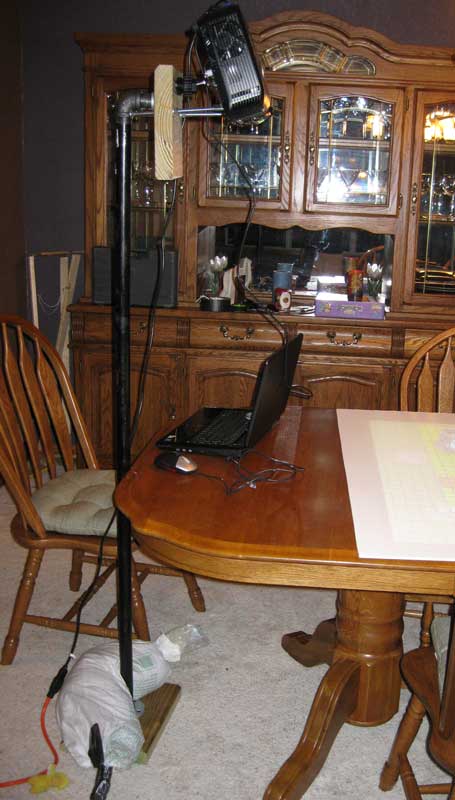
First, let’s see the finished rig in all its glory:

Maybe it’s not the most beautiful rig in the world, but by golly it works!

I’ll say right here that I’m a little surprised that I ended up going with a single-pole rig anchored with a sandbag.  I originally expected to build a big cube rig out of aluminum (like Sean Pecor’s), then thought I’d build a wooden tripod, but I settled on this design after receiving lots of great feedback here on the blog and on EN World.  It feels quite stable, too – heavy wood, heavy pipes and a heavy sandbag all combine to result in a rig that makes me feel comfortable that my projector is in no danger of falling.  I plan to carry the laptop, projector, cords/mouse and sandbag in an old roll-aboard suitcase and the rest of the rig in one piece in my other hand whenever I take this on the road.

Would you like to build something similar?  Here’s how to do it.

Parts

  • 1 heavy board at least 2 feet long.  Mine was a four-foot long 10 by 2 (actually 9.5″ by 1.5″) that I found in the scrap bin of Home Depot for 51 cents.  I believe it’s pressure-treated – it’s quite dense.  Cost: 51 cents.
  • 2 floor flanges for 1″ galvanized pipe. Cost: $6.38 each, $12.76 total
  • A five-foot length of 1″ diameter galvanized pipe (black), threaded at both ends (technically called a nipple). Cost: $16.12
  • A 90 degree elbow for 1″ galvanized pipe. Cost: $2.36
  • A two-inch long nipple for 1″ diameter galvanized pipe. Cost: $1.22
  • Eight wood screws, 1″ in length. Cost: I had these in my toolbox, but we’ll call it 25 cents.
  • Two carriage bolts, 3/8″ diameter, 8″ in length.  Cost: $1.49 each, $2.98 total.
  • Two fender washers and two hex nuts for the carriage bolts.  Cost: 13 cents apiece, 52 cents total.
  • A 60-pound  bag of tube sand. Cost: $3.99
  • Two pieces of 30″ by 20″ white foam board from Michael’s (I would have preferred a single bigger piece, but this is what they had). Cost: $1.50 each, $3.00 total.
  • Some duct tape. Cost: I’ll assume you have this on hand already.
  • A projector mount. I got mine via Amazon from a company called Projector Ceiling Mounts Direct. Cost: $26.40 (with shipping)
  • A projector.  I went with the ViewSonic PJD5152 and purchased it from Buy.com via Amazon. Cost: $463.99 (free shipping)
  • An extension cord and probably a splitter / surge protector. Cost: Already on hand.
  • A laptop – but I’ll assume you have that already.

Total cost:

  • Projector: $463.99
  • Rig: $70.11
  • Projector and rig together: $534.10

Tools

  • A table saw (or some other way of cutting the board – you could also probably get it pre-cut at the hardware store)
  • A drill with a screwdriver bit (you could technically get by with a regular screwdriver, but the drill makes it go faster

Assembly instructions

This version ended up being dead simple to put together, much easier than my tripod – and better, too.  You could knock this together in less than an hour if you had all of the parts ready to go.

  • Cut a 12″ length and a 7″ length from your long board using a table saw. The 12″ length will be the base of your rig and the 7″ piece will be the top plate that the mount connects to.
  • Screw one of the flanges to the middle of the 12″ board using four of the wood screws and your drill or screwdriver.
  • Screw the other flange to the middle of the 7″ board using the other four wood screws and your drill or screwdriver.
  • Screw the part of the projector mount that would ordinarily go into your ceiling onto the opposite side of the 7″ board from the flange.  I put mine high up on the far side, with the mounting screws just barely coming through the board, right next to the top of the flange.
  • Drill two 3/8″ diameter holes through the 7″ board, about 2.5″ down from the center of the projector mount and about 1″ in from each edge of the board (this is approximate, not exact).
  • Manually screw the five-foot pipe into the flange on the 12″ board.
  • Manually screw the 90 degree elbow onto the top of the five-foot pipe.
  • Manually screw the 2″ nipple onto the other end of the 90 degree elbow.
  • Take the 7″ board with the other flange and screw that board/flange assembly onto the other end of the 2″ nipple.  Tighten as necessary to get it pointed at the angle you want (I went with vertical).
  • Push the carriage bolts through the back of the 7″ board so that they extend forward about 5″ from the front of the board.
  • Push a washer onto each carriage bolt, then screw a nut onto each bolt to keep the carriage bolt from being able to be pushed back through the board.
  • Wrap some duct tape around the tip of each carriage bolt.
  • Put the rig on the floor next to where you will sit, resting against the edge of the table.
  • Empty out about half of the sand from your sandbag and twist tie / tie / duct tape up the opened end.
  • Wrap the sandbag around the base of the rig, sitting on the base board.  Put more of the weight away from the edge of the table (opposite of where the projector will be).
  • Assemble the rest of the mount per its instructions.  You already have one piece attached to the far side of the 7″ board, and the other piece will be attached to the projector itself.
  • Tighten the projector onto the mount as best you can. If your mount is like mine, it will want to move.
  • Figure out the exact angle you want the projector to be held at, and adjust the nuts on the carriage bolts to hold the projector at that angle.
  • Put the foam boards on the table beneath and in front of the projector.

At this point, your rig is completely set up.  All that’s left now is to hook up the cables, make any necessary adjustments (either to the projector’s angle, to the keystone of the image, to the lens focus/zoom, etc.) and start running your game!

Running the game

  • Create your maps / monsters / etc. in MapTool
  • Start MapTool on your laptop and load up the appropriate campaign
  • Start a server in MapTool
  • Open a second instance of MapTool
  • In that second instance, connect to the first one as a client (it will be in the LAN tab on the connection menu)
  • Hook the laptop to the projector
  • Set your display to the Extend Desktop option (setting the resolutions on each monitor appropriately).  The laptop should the primary (left) monitor, with the projector being the secondary (right) monitor.
  • Drag the second instance of MapTool onto the projector (drag it off to the right)
  • In the second instance, hit Ctrl+Alt+Enter to put it in fullscreen mode
  • Adjust the zoom level on both versions so that your squares are 1″ on a side.  The simplest way to do this is to just adjust it on the main MapTool instance and then use Ctrl+F to force the second instance to the same view as the main instance.
  • Run the game as you normally would online!
  • Extra tip: If the image resolution of your 1″ monsters isn’t great on the table, you can temporarily make a token Colossal so that the players can clearly see the artwork, then shrink it back to size (I use macros for this).

That’s all there is to it!  I haven’t gotten to run a real game with this yet, but it will at the very least get some use at TactiCon here in Denver over Labor Day weekend.  I’m excited to try it out!

Balanced-power parties are ideal

This post was inspired by my response to Robert J. Schwalb’s blog post about the Killer DM within.  A quick aside: I found Robert’s blog via a link on Sarah Darkmagic – a fellow RPG Blogger Network member whose blog I regularly follow.  I love the way RPG Bloggers leads me to so many interesting items online.

Some dungeon masters / game masters hate power gamers.  These are the players who try to find every possible advantage from any available material when putting their character together.  If there’s an overpowered angle to take on a character, they’ll find and use it.  This is sometimes referred to as “character optimization” or “CharOp”.  Those who don’t approve might call it “being a munchkin” or “twinking”.  This is the character who can easily kill monsters well above their own their level without breaking a sweat.

Robert talks about the Killer DM having the potential to emerge when the DM is frustrated with the players and the way they’re playing the game.  I think DMs in general are not fans of power gamers who min-max to the hilt.

Having thought this issue through, I’ve concluded that the problem isn’t exactly power gamers per se – you can always ramp up the difficulty to make it a challenge for them.  The problem is when you have characters of vastly different power levels in the same party.

If everyone in the party is super-powerful for their level, then the DM’s job isn’t too hard – you use higher-level encounters, give monsters extra abilities that will make them more challenging, and so on.  The problem is when one or two players are super-powerful but the others are of a normal power level.  In that situation, ramping up the difficulty to challenge the power gamers will make the monsters just plain deadly to the rest of the party.

The same problem can occur in reverse if you have a party of mostly average-power characters and one or two characters who have terrible stats for combat (the weak but charismatic fighter, for instance).  Those under-powered characters are not going to be able to fight interesting battles alongside their more powerful brethren and will be reduced to either standing in the back or getting themselves slaughtered.

In my opinion, the key to a fun gaming environment is to have a party of similarly-powered characters.  They don’t have to be all the same power level, but they should be close.  In that situation, the DM can create encounters that challenge everyone but that everyone can contribute to.  That’s what we want as dungeon masters.

I’m happy to say that my online campaign feels like the party is pretty well balanced from a power perspective.  When it comes to combat, everyone can contribute.  If we ever got to the point that one character was simply outshining all of the others, I would talk to that player about ways to bring the character in line, because otherwise combats will be too easy or too deadly for some part of the party.  A balanced-power party is a happy party.

Are you in the RPG closet?

Here’s a question for the role-playing game community: Do you hide your hobby from your non-gamer friends / colleagues?

Friends who play games – well, obviously they know that you play D&D or Pathfinder or whatever might be your RPG of choice since you probably play alongside them.  Close family members (those who live with you) will almost certainly know as well.  But what about friends or family members whom you don’t see regularly?  What about colleagues at school or at work?

I work for a large financial services company, and I’m a well-respected, somewhat senior person.  I manage a team of nine employees.  Personally, I’ve never discussed my RPG hobby with any of my colleagues.  It’s entirely possible that some of them play RPGs, though I doubt it.  Would it ruin my career to talk about it?  Probably not, though I’m sure it might affect some of their opinions of me.  I already get gentle ribbing about the fact that I’m in a bowling league, and no non-bowler has the mistaken impression that bowling involves devil worship (well, at least I don’t think so).

I try to be a very open, honest person, which makes me feel a little bad about myself for not talking to colleagues about my gaming.  I’m not that close to these people – I’m not friends with them on Facebook, for instance.  But I would definitely feel weird knowing that they thought of me as a guy who plays D&D, let alone a guy who blogs about it.

What’s your experience?  Do your co-workers know you enjoy role-playing games, particularly if you work in an industry that might look unfavorably on such a hobby? Is it wrong to essentially hide your hobby from casual acquaintances like these?