Signing up to run a convention game

Since I had such a good time running a Living Forgotten Realms game at my local store this past weekend, I decided to answer the call when the organizer of LFR games for a local convention, TactiCon, asked the group of LFR players and DMs from my store if anyone was interested in running an LFR game or two (or ten) at the convention over Labor Day weekend.I’ve never been to a gaming convention before, and information about TactiCon is surprisingly difficult to find online.  However, I was lucky to find a hard-copy brochure for the convention at my friendly local game store.  It looks like a fun way to spend a weekend, frankly.  There will be tons of D&D games, as well as other RPGs like Pathfinder.  There are also lots of board games, which I happen to love, too.  I’m guessing this might be a place where I could get some minis – even though I’ll be using my homemade tokens for bad guys when I run games, I’d like to have my own minis for use when I’m a player rather than a DM.

The particular LFR game I signed up to run is CORM 1-1.  I picked it because of the time it’s scheduled (Saturday morning) and the fact that it’s a low-level adventure (I’m not sure I want to dive into higher-level stuff at a convention).  As it turns out, CORM 1-1 is “The Black Knight of Arabel,” which is the first LFR game I had ever played!  I’ve only played in three LFR games, and now I will have run two of those same games.  What are the odds?

In any case, I’m looking for advice from my blog audience.  How does a convention game compare to a game in your local store?  Are there particular things I should look out for?  And as a first-time convention-goer (even though it’s a small convention), what things should I especially be looking to do when I’m there?

War of the Burning Sky – First session

This past Friday evening I ran my online group through our first session of EN World’s War of the Burning Sky campaign.  It did not go as well as our session from the previous week, where I had run them through a Living Forgotten Realms adventure, and it’s my fault: I just wasn’t as prepared as I should have been, and it showed.

The session started off well, with the players talking about some back story for their characters and possible connections with one another and with the campaign setting.  I really enjoyed this part of the session, and it’s given me some good ideas for the future.

Then we got into the actual adventure itself (WARNING: SPOILERS AHEAD).  Some of this was okay and some… less so.  The party begins by meeting a woman named Torrent in a tavern that has been closed by the city guards because the owner is a magic user and there’s a coming crackdown on magic (“The Scourge”).  Torrent is there to bring the party into “The Resistance.”  Great, no problem.

V. Shane's awesome depiction of Torrent from the War of the Burning Sky

As they finish chatting, they’re ambushed by bounty hunters.  Now, this is laid out as a pretty exciting encounter in the published adventure, and I totally biffed it.  There’s a warning of something coming, with the sound of creaking floorboards overhead in what is supposed to be an empty building.  Then some bounty hunters come barging in the front door, with the goal of forcing the party out the side door. (I was totally unable to accomplish this.)

Then a bomb hits the building and flames burst out all over the place.  Then the ceiling starts collapsing in places.  This would have been a good way to force the players out of the building and into the alley, but I failed to play it that way.  They basically ignored the chaos and beat the crap out of the bounty hunters.  I decided to have the leader of the bounty hunters (who wisely stayed outside) tell his men to retreat, but the party kept beating them on the way out (and really, who can blame them?).

We then had an interaction with the lead bounty hunter, Kathor, which, as I played it, didn’t make any sense.  Kathor is supposed to be ambivalent about being a bounty hunter, and that came across okay, but it was tough for me to reasonably play it so that the players would accept his withdrawal without attacking him further.  We worked it out so that the players are trying to recruit him into the resistance (a cool idea on the party’s part), but I admit that I didn’t handle this encounter very well.

We next played a few vignettes as the party made their way through the now-burning city toward their rendezvous with a gnome who is supposed to have information that they’re to take out of the city.  These little scenes were a bit out of place, but the party role-played them well.

Then we had to abruptly cut off the game, as one of the players got called into work unexpectedly.  I was okay with this, frankly, as it will give me more time to prepare for the next session.

After much reflection, I’ve decided that I have no interest in running a pre-packaged campaign through to completion.  A pre-packaged adventure, sure, but not a whole campaign.  I need to be able to wing it on the fly and change NPC motivations, all sorts of crazy things, and that’s tough with a published campaign.  So, I’ll be using the published campaign for inspiration and nothing more.  For one thing, I’m interested in getting the party into an underground area of some sort for some cool battles, and I don’t see anything like that in the near future for this campaign.  Easy solution: Change it!

My lessons from this time around are:

  • BE PREPARED!  If you’re not prepared as the DM, things aren’t going to go well.
  • Maintain flexibility.  Unless you’re the kind of DM who can run a party closely to a script, don’t hew too closely to a published adventure path.  You need to be able to adapt on the fly.
  • When you’re given cool material (like the burning, collapsing building that the party is fighting inside) make the most of it!  Describe it vividly, and let it affect the characters in whatever way seems most appropriate to you.

Next session is going to be better, I can already tell.  I’ve already made some big changes to the next combat encounter, which will take the adventure mildly off the published path.  I’m anxious to start working with my player characters’ backgrounds, too, and I have some interesting ideas on how to do that.

Running my first in-person Living Forgotten Realms game

Today I officially became not only an online dungeon master but also an in-person dungeon master.  I finally ran a Living Forgotten Realms game at my friendly local game store, Enchanted Grounds (spoiler alert: I ended up killing one of the PCs).  I started preparing for this game (and talking about it on the blog) almost a month ago, and I already ran this same adventure for my online group last week, so it’s fair to say that I was well-prepared!

The module was WATE1-1: Heirloom, a Living Forgotten Realms adventure for a party of four to six players of levels one to four.  There will be some spoilers for this particular adventure ahead, just so you know.

The game was scheduled to start at 9:00 AM.  I got to the store around 8:45 to get ready – and then realized at 8:50 that I had forgotten the handouts for the players (they explain the laws of Waterdeep, show a map of Waterdeep, and show a list of stolen items that was provided to the City Watch in the story).  Fortunately, I live within walking distance of home, so it took me only two minutes to drive back, two minutes two print the handouts and two minutes to get back to the store.

We were fortunate to be allowed to play on Enchanted Grounds’ fancy new gaming table, which has an inset in the middle for the battle map and a special pull-out tray with a built-in screen for the game master.  There were four players at game time, and two more were on their way but running late.  We waited about 25 minutes before starting – and naturally the two latecomers showed up just as we got going.  No harm done!

Since this blog is meant to be educational, I think it’s worth talking about what I did to prepare for running this adventure:

  • Read the adventure at least twice, paying special attention to the point of the story and, on later read-throughs, the details of combat tactics from the enemies
  • Create the maps in MapTool, convert them to posters with PosteRazor, print them out in color and tape them together
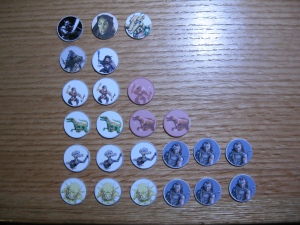
  • Get monster minis together – I used self-made tokens.  I wish I had also brought some generic non-combatant NPC tokens, but that was a minor oversight.Tokens
  • Get some way of keeping track of conditions such as bloodied, slowed, marked, etc.  I went with little rubber bands from Target that are intended to be hair bands for girls.  I believe my wife Barbara found a big container of them for $3.  I sorted them by color and stored them on twist-ties.
  • Get dice.  Lots of dice.  No, a few more than that.  Yeah, that’s the ticket! (Note the awesome d12s that have Roman numerals for 1 to 4 printed three times – actually rollable d4s!  I got them from Dicepool.) 
  • Write the name of each type of monster on a half index card and roll initiative for it.  Write that number on the half index card.
  • Get blank half index cards for each player character.  Write the character’s name (along with race and class, maybe the player’s name and a description of the mini so you know who it is – all optional, but nice) at the top of the card.  As the players roll initiative for a battle, write the character’s initiative on the card, crossing out any old initiative number that’s on it.  You can then order the cards (PCs and bad guys) by initiative and use this to keep track of who’s up and who’s next – plus it’s easy if someone delays or readies an action to put them in a new position.
  • Get a blank piece of paper for each battle.  Write the name of each monster on a line, treating multiple monsters of the same type separately (so Guard Drake 1 has a line, as does Guard Drake 2).  Write in parentheses next to the monster its bloodied value, followed by a colon and the starting hit points.  As the monster takes damage, cross off the rightmost number and replace it with the new HP total.  Check it against the bloodied value to see if the monster is bloodied yet.
  • When you’re at the table, write down each player’s name, their character’s name, their race and class, their passive Insight and Perception scores and their initiative modifier

With that, we were off and running.  The adventure begins with a long skill challenge to find the thief who stole the title heirloom.  As with my online game, I never said that we were in a skill challenge.  Instead I said, “Okay, what do you want to do now?”  Someone decided to ask around the pub for information on where they might be able to find stolen goods – “Give me a Streetwise roll.”  That pointed them to another tavern, where they looked around to see if they could find anyone matching the description of the information broker they had been given – “All right, Perception.”  And so on.

In the middle of the long skill challenge, we had a quick-hit combat encounter with some drunken sailors.  There was some fun role playing, as one of the PCs tried to hit on the damsel in distress (she wasn’t interested, and I played her as such).  There was some great bluffing of the City Watch, too – “Honest, officers, these men just fell down drunk.  We didn’t attack them…”

Once the thief was located in his lair, the battle became more interesting.  I had ramped up the difficulty level of the battle a little bit, based on past experience, and I’m glad I did.  Lots of players ended up severely bloodied, but nobody dropped.  Our assassin got a little cocky after teleporting in behind a bandit and basically destroying him in one shot, so he ended up trying to take on a couple of halfling thieves by himself.  Bad idea – those guys love to get combat advantage and deal extra damage!

The players did defeat the thief and successfully interrogated him about the stolen heirloom.  He told them where to find the person who hired him to steal it.  I then asked the players what they wanted to do with the thief and his gang.  After a short discussion, they decided to execute them.  I had a bloodthirsty table!  But so it goes.  Had this been a home game, I would have made sure that there would be consequences from this in the future, but for a one-shot I decided to just move on.

The final battle against the gnome factor and his allies in an inn room was pretty cool.  Our assassin and our monk were stealthy about getting into position, seeing some gnomes in their room at the end of a hall and successfully hiding from the gnomes.  Our fighter tried to be stealthy but failed, making too much noise while coming up the steps.  The gnomes looked up, and our bard, thinking quickly, walked up the stairs and past the hallway, whistling merrily – so I had him make a Bluff check, which he totally rocked.  Thus, with surprise preserved, the party was able to charge down the hall in a surprise round before the battle began.

Our strikers jumped right into the thick of things, dealing tons of damage but leaving themselves exposed – especially the monk.  The gnomes spread the hurt around a little bit, but the two dumb guard drakes attacked the closest thing that was threatening their master, which was our monk.  The monk did get an opportunity attack on one drake as the drake moved into position between the monk and the gnomes, but then both drakes took big bites out of the monk.  Guard drakes, as it turns out, do tons of damage when they’re near allies, and the two big chomps put the monk at exactly his negative bloodied value.  He was dead – that is, dead dead, not just “I’m lying on the ground but I’ll be fine later” dead.  I felt a little bad, but that’s what happens when a relatively squishy striker charges into battle without waiting for defender support (a lesson I learned myself the first time I played an avenger).

Pretty soon the gnomes were all bloodied, facing our wizard’s Flaming Sphere, and several of them were invisible due to their fade away power.  When the gnome leader’s turn came up, with his invisibility in place, I had him open the window of the room, fey step down to the street below and start running.  Of course, all the player characters could see was a window opening.  They were left with a tough choice – attack the empty space where they had last seen the gnome leader, or try to go after him in case he ran.

The bard attacked the empty square and rolled well enough that I told him that he didn’t feel like there was anything there to hit.  So the wizard decided to run back down the stairs and into the alley leading to the front of the inn – where he spotted the gnome!  Meanwhile, back in the room, the fighter and psion took care of the guard drakes, the other gnomes jumped out the window (one killing himself) and the bard decided to take a flying leap after everyone.  He made his Acrobatics check, landed on his feet, saw the gnome leader and pegged him with two arrows (smart use of an action point).  Mission accomplished!

This was a fun way to spend a Saturday morning, and I know the players had fun, too.  Interestingly, the person whose player I killed, Jason, had played this adventure once before (in the same party as me when I had played it), and during the course of the adventure he said, “Wow, this is way cooler than the last time!”  That’s what I love to hear.  Even though his character died, he still role-played the things that his spirit was doing, cheering on the rest of the party.  The two players at the table who were new to fourth edition had a good time and learned a lot about how the game works.  Fun was had by all.

I’m learning that I really like being a dungeon master, whether in person or online.  I’ve also learned that I need to feel prepared in order to do well. (In my next post I’ll talk about my experience running my online group through the beginning of the War of the Burning Sky while not being as prepared as I’d like.) I think I’d like to do some more DMing for Living Forgotten Realms in the future.

War of the Burning Sky – the online campaign

After last Friday’s successful inaugural session with my new online D&D group, we did split the eight-player group in two.  Five of the players are remaining in the game with me as DM, continuing at level 1.  We started last week by running a one-shot Living Forgotten Realms adventure, which was fun and all, but I don’t really want to stay in the Realms for the rest of the campaign (mainly because I don’t know Forgotten Realms very well).

I was planning to go with a homebrew adventure that I had written eight years ago under 3.0 rules, but I abandoned that idea when I discovered that the plot hook for my adventure is exactly the same as the plot hook for last week’s adventure – the party is hired by a noble to recover a family heirloom that was stolen.  Seriously, the SAME THING!  I also realized that the setup was the best part of my own adventure, and yet that was the one part that would really need to be changed.

War of the Burning Sky logoIn searching for another campaign idea, I came across the War of the Burning Sky.  This is a campaign published by the people at EN World and free to any “community supporter” on the site (that is, a subscriber).  I had read good things about the campaign, and glancing at the materials myself, it looked pretty interesting. I proposed it to the party, and they were fine with the idea.

And so our story begins: OnlineDM’s online game delves into…

WAR OF THE BURNING SKY!

Stay tuned for recaps of how it all goes.  And if anyone has run this campaign before and has advice for me, I’d love to hear it!

MapTool – Improved macros and properties

I’ve written before about some of my basic MapTool macros and the properties that I use in my own campaign.  I’ve also mentioned that there are some dedicated people out there who have written campaign frameworks that are ready-made for Fourth Edition (though I’m having more fun creating my own).

Now that I’ve played through a session with more players (eight!) and another player who already knew a lot about MapTool and had some tips for me, I’ve changed around my basic macros and properties.

First, the download links:

So, what’s new?

Properties

I’ve added some new properties since my first pass, and changed some others around

  • I’ve made the defenses all appear on one line on the character sheet pop-up (saves space and is easier to read)
  • I show hit points as “Current/Maximum + Temp” all on one line (so it might look like 22/34 + 0)
  • I broke down and added a He/She pronoun property
  • I added an Armor Penalty property so that default skills would be easier to calculate (you still have to add racial/class bonuses and training manually)
  • I got rid of the Melee / Ranged properties and went with Weapon 1 / Weapon 2 / Weapon 3 (which will work in case I have a dual-melee wielder who also has a ranged weapon available)
  • For monster properties, I added a flag for recharge powers that starts at 1 and turns to zero after the power’s first use
  • Also for monsters I added a line that will let me add text to the monster’s character sheet listing any trained skills

No huge changes there – just a few little things that make things nicer.  As an example, take a look at a character sheet with my old properties versus new:

Old character sheet

New character sheet

Macros

My macros are just overall better now, in lots of little ways.

  • First, I discovered that I don’t have to use the getProperty function every time I want to get the value of a property in a macro – I can just use the name of the property!  So, instead of [h: HP=getProperty(“HitPoints”)] and then using HP as a variable, I can just use HitPoints as a variable in my macro without having to get its value.  This makes my skill check macros in particular a lot simpler: Acrobatics = <b>[d20+Acrobatics]</b>
  • I switched to the new properties for weapons, of course.
  • I took into account the fact that on a crit a magic weapon deals an extra die of damage PER PLUS.  Easy enough – the bonus damage is now [CritBonus=roll(Enh,CritDamageDie)] (where Enh is the weapon or implement’s enhancement bonus – this used to just be 1 in my old macros)
  • I edited the structure of my attack macros so that all of the lines I need to edit are right at the top (in general – some attacks need more customization).  This means that I use a variable for the name of the attack, another variable for the name of the defense that the attack is going after (AC, Reflex, etc.) and another variable for the text that accompanies the damage (such as “damage, and the target is slowed (save ends).”)  This makes it much more efficient to set up new character attacks, be they PCs or monsters.
  • I learned to use the input() function to make the boxes that pop up to ask a player how many hit points they gained or how many targets they’re attacking a little bit nicer looking.  I also use the abort() function to let a player back out of one of these powers without getting an error message.
  • Most excitingly, I’ve changed the initiative macro to first of all let each player roll their own initiative, and second to automatically add them to MapTool’s built-in initiative tracker.  It’s not as slick as the D&D 4e Combat Tracker (which I need to talk about in a future post), but it’s so convenient to have it right there in MapTool.

The more I use MapTool, the better I get at it.  Now I just need to actually set up my next adventure for this Friday night!

Online campaign – What a rush!

It’s amazing that I have the energy to write tonight, given that I just spent four and a half hours running a D&D adventure online for EIGHT PLAYERS, but it was such a rush.  I can’t believe how well it all went!  Seven of the players were already logged in before the scheduled start time, and the eighth ran about 10-15 minutes late (no big deal).

Starting Screen

We started off with everyone being able to see their tokens on a small map (with an image of the map of Waterdeep on the page), and I explained how MapTool worked.  As a player, the only things they really needed to know were how to move their token (click and drag), how to move around the map (right click and drag; zoom with the mouse wheel) and how to deal with their macros (just click them).  That went pretty easily.

We also spent a little time talking about the future of the group.  We’re going to split in two – one with me as the DM playing at level 1 and one with another person from the group as the DM, playing at some higher level in order to get to paragon tier faster.  But since I had put everything together for this evening with the plan of having eight players, we would still play the adventure together.  (It was the Living Forgotten Realm module that I’ll be running in my local store next Saturday – WATE1-1 Heirloom.)

I should also point out that, in addition to having MapTool open with everyone impersonating their characters in order to talk in-character (way cool), we also had Skype open for voice chat.  Let me give a huge shout-out to Skype – this software is awesome.  We had excellent call quality with eight active lines (two of the players were together at one computer), no lag – it was just fantastic.

Anyway, I used audio to communicate with my players most of the time, and they used a mixture of audio and text.  The adventure started off with a lengthy skill challenge to track down a thief who had stolen a family heirloom (hence the title of the module, “Heirloom”).  Mixed in the middle was a quickie combat encounter with some drunken sailors, which ended in one action – the party’s invoker walking up and unleashing an encounter power that just about wiped them out (whereupon the sailors that were still up surrendered and staggered away).

At the end of the skill challenge, the party confronted the thief and his cronies in their underground lair.  This battle was much more interesting, with some good movement, creative use of marks, and SO many conditions to keep track of!  It’s easier in MapTool than in real life – I can’t imagine running this encounter with eight PCs around a real table.

We took a five-minute break before diving into the final encounter, where the party faced the person who had hired the thief to steal the heirloom.  The party did a good job of achieving surprise, and it became clear that I could either have the bad guys fight smart – keeping their guard drakes in front of the door to the room and making it hard for the party to do anything – or have them fight fun – letting the drakes shift back into the room so the melee fighters had something interesting to do.  I went with fun, and I’m glad I did.

The best part of the evening was the very end of this encounter.  I had some bad guys, who were hidden at the time, go out the window of the room they were in, trying to escape.  Hilarity ensued as the party tried to go after them.  Lots of falling out windows, landing on people who had already fallen (dealing improvised damage – why not?), and so on.

Looking back, it was clear that the encounters were not all that challenging for the party, since no one ever ended up making death saving throws.  But you know what?  For a party of eight, that’s okay.  The encounters were long enough already, and making them tougher would have made them take longer.

The most important thing was that everyone legitimately seemed to have a great time.  A couple of people who were planning to go play in the high-level game reached out to me to say that they were having so much fun that they were considering staying low-level.  That’s really gratifying to hear – “I’m having so much fun that I want to keep playing in your game.”  Is there a better feeling as a DM?  Not to mention the fact that one of the players is an Englishman playing in his first-ever tabletop RPG, and he played with us from 1:00 AM to 5:30 AM his time.  How’s that for dedication!

It will be a little sad to break up the group, but I honestly don’t have the energy for an eight-PC campaign.  I can handle four or five, but beyond that I think it’s just a little too much.  Still, just to run a game this big one time was worthwhile.  It was, quite frankly, an unqualified success, and I can’t imagine it having gone any better.  This is what I live for as an online dungeon master!

Online D&D game – Final prep for first session

I wish I had time to put up as in-depth a post as I would like, but I spent far longer than I planned to last night getting everything ready for this evening’s session of my online D&D game.  I’ll at least summarize what was involved.

  • Creating the encounter maps in MapTool (I ended up re-doing them all on one map so that the players wouldn’t have to flip between multiple maps in the campaign)
  • Updating the properties for the campaign per the suggestion of one of my more MapTool-experienced players (pretty minor changes)
  • Creating tokens for all of the bad guys, including their stats and macros for their powers
  • Creating tokens for all of the players (well, except the two who will be bringing their own), including THEIR stats and power macros
  • And of course making sure that I’ll know what I’m doing when I actually run the adventure
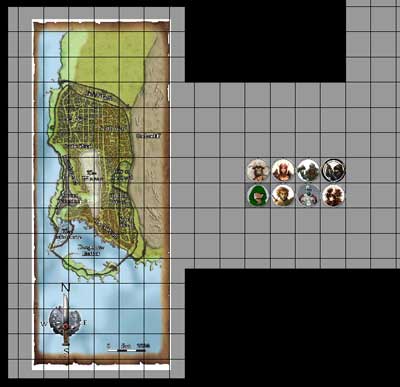
PC Tokens

Top row: Alayne, Thorfin, Faebs. Bottom row: Landon, Fudrick, Jaks

All of this ended up taking somewhere close to 10 hours over the past few days – and that was for an adventure that was already pre-written and for which I had previously created encounter maps and enemy token images!  I shudder to think how much time I’ll have to put in once I start creating my own adventures.

On the bright side, I’ll no longer have to change properties or create PC tokens (or at least not very often), and the more I create monster tokens the more efficient I get at it (using templates for them, for instance).  I’m guessing that the prep work for a typical future session within MapTool (once I’ve already decided what the encounters will look like, what bad guys to use, etc.) will probably take about three hours instead of ten.  Just a guess, though.

Now all that’s left to do is get the group together and run the game!  It sounds so easy when I write it like that…

Online campaign – The characters take shape

What a rush!  Sunday morning I was asked to DM an online game of D&D.  I put up a post on EN World with the details.  By Tuesday evening, not only did I have eight players signed up and committed to playing on Friday evening, but I even had full characters for seven of them and a firm character concept from the eighth!  I intentionally recruited more than five players, figuring that it would be likely that a few might not be able to make it, but so far this is a committed bunch.  I’m so proud!

Order of the Stick - one of my favorite web comics

Order of the Stick - one of my favorite web comics

My character creation guidelines were pretty open-ended.  Anything from the published books (except Eberron, which I don’t know very well at all) was fair game, but nothing from Dragon Magazine.  I had some push back from a couple of players on the Dragon Magazine issue, but I held firm on that one (though I didn’t care too much if they picked a background from Dragon for flavor rather than mechanical purposes).  Here’s what we’ve got:

  • Jaks, a good-aligned Minotaur Druid who is currently worshiping a chaotic evil diety (I’m guessing that’s just an oversight)
  • Gamal, a lawful good Deva Invoker who was found in the woods by…
  • Rynaki, a lawful good Half-Elf Paladin who’s romantically involved with Gamal
  • Fudrick Tumblebelly, a highly intelligent Gnome Warlord (how awesome is that?)
  • Faebs Rawdel, an ambiguously-gendered Human Swordmage/Wizard hybrid
  • Thorfin Bronzebeard, a stout Dwarven Fighter – specifically, a temp-HP gaining Battlerager
  • Alayne, an eternally cheerful Tiefling Warlock who was raised by Eladrin parents, and who desperately wants to be an Eladrin herself
  • An as-yet-unnamed Bard, most likely wearing plate armor

It’s a very cool party, and the players have clearly taken my comments about wanting their characters to have character to heart.  We’ve got good party balance, too.  I’ve decided that, to make my life a little easier, we’ll start off by running the LFR module that I’ll be running in real life on July 24: WATE1-1 Heirloom.  It’s not an amazing module, but it’s a nice one-shot to give everyone a chance to get to know their own characters and everyone else’s.

There are two obvious issues that I’ll need to deal with, though.  First, we have eight PCs.  For the one-shot I can deal with it, but it’s going to be unwieldy for the long run.  Second, the majority of the players want to run the game at higher level, getting to paragon tier as fast as possible.

The second problem may give me the solution to the first – split the party!  (No, never split the party…)  Since I’ve gotten such an overwhelming outpouring of interest for this game, I think the best approach might be to run two separate games.  One game will be run by me with those players who want to start at level 1 and work our way up.  The other might be run by one of the players in the group who’s also an experienced MapTool DM and overall a much more experienced D&D player than I am.

We’ll still get the whole group together for the Friday game so that we can play together and talk this out.  But I think the right answer is two separate games.  We would need to recruit a few more players if we go that route, but I don’t think that will be a problem.

The lessons I’ve learned so far:

  • Players can be crazy enthusiastic – use that enthusiasm!
  • Be firm with your rules as a DM.  If you’re not comfortable with certain content, kindly but firmly say no.
  • DM for players that you’re comfortable with.  If you’re not ready to run a certain type of game, then don’t.  Find players that want to play the type of game that you want to run.

Online game recruiting

As I mentioned in my last post, I’ve started an online D&D Fourth Edition game, complete with recruiting players online (as opposed to my current game that started with an in-person game and morphed online due to distance between players and DM).  I thought my experience might be useful for anyone else who wants to start a game online, so I’m sharing it here in “real time.”

The game began with another poster on EN World, Palacer, putting up a post announcing that he really wants to play more D&D and is interested in an online game.  Several others chimed in to say that they wanted the same thing, and I said that I was also interested in either playing or DMing.  Well, no one else stepped up to DM, so I was recruited!

I put up a post in the thread laying out the overview of the game:

  • Sign-ups were now open
  • I was planning on a 5-PC campaign, starting off with more focus on combat but incorporating more role playing over time
  • Interested players should put a post in the thread and send me an email
  • Players should include their EN World handle, the name they would like to go by in the game, their preference for starting level (level 1 versus level 6), their available times to play and their thoughts on what characters they would like to play

Seven people followed the instructions, putting posts on the forum and sending me emails.  At the end of the day I put up another post saying that I would leave sign-ups open for one more day and then close them.

This evening I had seven players – well, eight if you count a couple that may be playing one character or two.  I sent an email to the group with more details:

  • We’ll get together for our first session this Friday evening
  • We’ll be on Skype and MapTool – I shared my contact information for both of those
  • I laid out character creation guidelines (no Eberron or Dragon Magazine, standard starting gold, actual characters preferred over min-maxed beasts)
  • I asked everyone to start sharing their characters in email and to send me their Character Builder files (partly so I could program up some MapTool macros for them)
  • Also, we’re going to play a session at level 1, then jump to 4, then probably to 7.  The players generally want to get to higher levels more quickly, but some players (and I) are pretty new and want to start off slowly.

So far so good!  I’ve got seven players and we’ve found a time that, in theory at least, will work for all of us.  Next step: Getting together all at the same time!  Oh, and I need to devise a campaign (little details…).  I’m thinking this may be the time to update my campaign that I discovered from years ago, at least as a good starting point.

If you have any advice on this new adventure, I’d love to hear it in the comments.

Online D&D from scratch

I knew I would eventually get to this point, given the focus of my blog, but I wasn’t sure exactly how or when it would happen.  Well, it’s here.

I’m starting a D&D campaign online from scratch.

As you probably know, I’ve been running an online D&D game for a few months now, but that game started with some friends at a wedding in Florida.  We played together in person for an evening, and since we wanted to keep the game going despite the fact that we were far apart, we started playing online.

Now I’ll be starting a game entirely online, including the recruiting process.

Another poster on EN World (Dan, who goes by the handle Palacer) started a thread yesterday, basically saying that he’s hungry to play some more D&D and was interested in an online game.  Several other people on the thread said that they felt the same way, and I chimed in to say that I would also be interested in playing or DMing.  Dan reached out to me and said, “Great – DM this game!”

All right, I’m in!  I’ve posted on that thread, saying that I’m happy to serve as DM.  We’ll use MapTool and Skype, since I know and love those programs for D&D.

I plan to use this blog in part to talk about the whole process of creating an online game.  I fully expect that the biggest challenge will be organizing the players – getting everyone to commit to the game and to show up regularly and on time.  I’ll do my best to keep everything organized.

Part of my plan is to recruit extra players.  It’s quite likely that there will be at least one or two players who want to play but then can’t for whatever reason.  Backups are a good thing!  I’ve also sent invitations to a few people whom I know personally but who don’t live near me, since this would be a good way for us to game together.

If anyone reading the blog is interested in playing, check out the thread on EN World and chime in!  Leaving a comment here on the blog is fine, too, or drop me a line at my gmail.com account – the address is OnlineDungeonMaster.

And if anyone has any advice for me on this new adventure, please let me know in the comments.