Quick-hit recap

I took a little time off from blogging over the holidays, but my D&D life continued.  Here are some quick-hit thoughts from the past couple of weeks.

  • My brother-in-law and his wife became huge D&D fans during their visit.  He played Sunday through Friday, every day, and she played Sunday, Monday, Wednesday and Friday.  Now we have to figure out a schedule for an online game since they’re in Texas and we’re in Colorado.
  • We rolled up Gamma World characters with the family and had a good time doing so, but didn’t get a chance to actually play the game yet.  Too bad – it seems like goofy fun.
  • I ran two Living Forgotten Realms games at my local game store, one of which was my first try at a MyRealms adventure (one I wrote myself).  It went well and had some exciting combat, and I asked for player feedback afterward.  Since we finished with an hour to spare, they suggested that I include more role playing time at the beginning.  Done!
  • My regular Friday night online game took two weeks off and got back together for gaming last night.  It was good to get the band back together.  They’re deep in a swamp and spent last night fighting witches and skeletons.  I’m a little worried because we had a four-hour session and spent almost all of it on two combats – I need to speed those up.  I’m happy, though, that they reacted quickly and strongly to the new NPC I introduced – I think I’ve done well at role-playing her, and some of them love her and some of them hate her.  Perfect!
  • I’m participating in a forum-based “story playtest” of the next campaign saga from EN World, called ZEITGEIST.  Basically, the writer spells out a given situation, we tell him how our characters would react, and he narrates what happens and what comes next.  This is my first play-by-post experience, and I think it’s totally cool.  I love being able to really get into character with the rest of the group, and I could see myself doing some more play-by-post in the future. Also, the ZEITGEIST story is really cool so far.
  • I’m all signed up for Genghis Con, the February convention here in the Denver area.  I’m running three LFR games (two sessions of my MyRealms and one of another module I’ve run before) and I’ve signed up to play in three RPG sessions, none of which are D&D 4e.  That’s intentional.  My only RPG experience is with this one game, and the Con seems like a perfect time to see what other games are like.  I’ll be trying Savage World, Call of Cthulhu and GURPS.
  • My regular in-person game gets back together this afternoon after the holiday break.  I guess that means I’d better stop blogging and start prepping!

Creating D&D converts

Ah, the Christmas season.  That magical time of year when friends and family gather together and give the D&D fans in their lives the chance to talk about what a fun game this is and to turn them into brand-new gamers.

My wife’s brother and his family are staying with us for two weeks over the holidays.  My wife and I talked about D&D several times in the first few days of their visit, and they were interested in hearing more.

I received the Castle Ravenloft board game for Christmas, and my brother-in-law and I played it a couple of times .  Castle Ravenloft is a pretty good introduction to the concepts of D&D 4th Edition:

  • You have a standard and move action on your turn, with the option to turn the standard into a second move
  • You roll a d20, adding a modifier and comparing it to an armor class
  • There are D&D classes with the appropriate roles and flavors
  • There are D&D monsters with reasonable approximations of their feels

My sister-in-law joined in a five-player Castle Ravenloft game on the evening of Christmas Day, and while she was a little overwhelmed, she seemed to enjoy it.

So, the day after Christmas I showed them the online Character Builder (figuring that Essentials characters would be better for beginners) and helped them roll up their very first RPG characters.  My brother-in-law went with an elf hunter ranger named Homer, while my sister-in-law created a half-elf warpriest named Stasi.  My wife rolled up the sister of her beloved swordmage (another swordmage named Sora), and everyone was anxious to try out their new toys.

Sunday evening, the day after Christmas, we all sat down at the gaming table to really introduce my family to D&D.  I gave my in-laws a choice of three different low-level Living Forgotten Realms that I had prepared on the computer (using MapTool and my projector setup to run the game), and they chose to play a Luruar adventure in which they would be helping people at a magical college shore up some problems underground (LURU 2-3 Forgotten Crypts, Hidden Dangers, which I’ll be running at my friendly local game store this evening).  While my wife finished putting her character together, I ran my in-laws through a simple encounter with some orc minions, just so they got a feel for how battle works.

And then we were off!  We ran through the entire LFR adventure, with me scaling it down for 3 PCs on the fly.  Apparently I did a lousy job with the scaling, as I managed to kill off my brother-in-law’s character in the first battle (only the second time I’ve killed a PC).  All three of the bad guys in the battle had the ability to deal ongoing damage, and all three players had a horrible time with their saving throws.

The party decided that they wanted to take the dead character out of the catacombs and get him resurrected (rather than either give up or create a new character).  I introduced a cleric at the magical college who would resurrect him in exchange for a promise that they would work off the debt for the resurrection later.  The living PCs accepted the deal, but used some good diplomacy to persuade the cleric to give them a discount because the dead PC was working for the same organization as the cleric.  Good stuff!

Back into the catacombs, and the party made it through a skill challenge to get to the lair of the big bad guy.  They realized that the room was trapped, and they killed off the monster from the first battle that had caused them so much trouble before fleeing (a Kobold Rat Master, quickly renamed Rat Bastard).  They then retreated and took a short rest before coming back for the last two bad guys.  I had those characters move to a different part of the catacombs, and I’m glad I did – the original room for the final fight is pretty boring for the PCs if the trap is in effect.

They had such a good time on Sunday, that they asked what was next for the party on Monday!  They made it clear that they were really interested in the setting and wanted to do some more adventuring there, so I took a half day off work on Monday to whip up a brand-new adventure for them, which we ran Monday night.

This new adventure was a much better balance for the three-PC party.  They fought zombies, tracked some wraiths, bypassed a skeletal dragon (though they were sorely tempted to fight it), chased some skeletons through a series of rooms, and ultimately came to the crypt of a ghost who was using some portals to channel necrotic energy and bring more wisp wraiths into the world.  I’m quite proud of this encounter – it worked out even better than I had hoped.  I’ll write about it in more detail sometime – maybe I’ll write up the whole adventure as a PDF.

Anyway, I’ve created two new D&D players!  Now the trick will be to figure out how to keep their gamer fires burning.  We’ll probably play a little Gamma World before they head home, and maybe find time for one more D&D adventure (though I won’t have time to write a whole new one from scratch).  Maybe we’ll play using MapTool after they go home – who knows?  It’s been a fun experience so far, and I hope we get to play more in the future.

My players are smarter than I am – lucky me!

As a relatively new dungeon master, I take the approach that I still have much to learn.  This education can even come at the hands of my players.

Now, I’m not talking about rules knowledge or information about D&D canon – I might have some gaps there, but those are no big deal.  I’m talking about knowledge of what makes an adventure fun.  When I get a great idea from my players, I’m proud to say that I quash my ego and run with the idea (or I try to).

This came up most recently on Saturday, when I was running my in-person campaign through my home brew world.  The adventurers are currently exploring an underground complex that they’ve learned is populated with duergar.  I’m actually taking the Second Edition module “The Gates of Firestorm Peak” as a source of inspiration here.

The first time the party encountered the duergar, it was in a guard room.  The room had a 20-foot ceiling and was about 30 feet square.  Running right across the middle of the chamber was a 10-foot wall made of rocks held together with some kind of mortar, and liberally spiked with shards of glass, pointy sticks, etc.  It could be climbed over without cutting one’s self to ribbons, though it wouldn’t be easy.  There was also a door hidden in the wall, though the latch was trapped.

The party found the door but not the trap, and combat began when our monk tried to open the door and found his hand nearly taken off by a bear trap.  At this point, the four duergar guards on the far side of the wall Enlarged themselves to become 12 feet tall (something that I gather was much more common in 2nd Edition than 4e, but I ran with it).  Now they could swing their warhammers or toss their throwing hammers over the wall.

In the first round of combat, the PCs threw some ranged attacks at the duergar while the two melee characters positioned themselves closer to the wall, perhaps in an attempt to try a climb or jump or another shot at the door in the next round.  One of my players said something interesting at the end of this round:

“Man, I hope they don’t push the wall over on us.”

Hmm… they weren’t going to, but only because I hadn’t thought of it before!  But now that I had three gigantic dark dwarves lined up along the non-spiky side of the wall, ready to take their turn… heave!

I had the duergar make some strength checks to push on the wall, which I was glad I had described as being somewhat makeshift.  No problem – over it goes!  I had the debris make attacks against the two PCs who were near the wall, going against Reflex (they could try to dodge out of the way), and I hit both of them.  I decided that this should deal some pretty significant damage (I believe I went with 3d6+7 for these 6th-level characters) and knock the PCs prone.  It also created a zone of difficult terrain where the wall fell.

I wrestled a bit with whether to tell the players that I was doing this on the fly thanks to their suggestion but ultimately decided not to bother.  On the one hand, they might have gotten a good feeling from having come up with a creative idea that I used.  On the other hand, I wouldn’t want them to hold back from sharing this kind of idea in the future!  So, I let them believe that this was all part of my grand plan.  Of course, if they read this post that illusion is gone, but I’ll live. 🙂

What do you think? Do you ever incorporate your players’ ideas for what terrible things might befall them on the fly?  If so, do you credit them for thinking of it, or act like it was all part of the plan?

MapTool – Stupidly complex multi-attack macro

I haven’t posted any MapTool macros in a while, but I just finished writing one that ended up being so stupidly complex that I just had to share it with the world.

First a disclaimer: Yes, I am aware that there are wonderful MapTool frameworks out there that will help automate everything and make it so that I barely need to touch any macros.  I write my own macros just for the fun of it because I’m nerdy like that.  I share them here on my blog because I know there are some other nerdy people out there who might be able to use some of my learnings in their own macros.

Okay, here’s the situation.  There’s a tiefling wizard coming up in a battle for my Friday night War of the Burning Sky campaign.  It’s not a big boss or anything like that, just an ordinary bad guy.  This creature has several different attack powers, as you might expect with a wizard.  The one particular attack power that I’m about to show you is called Dancing Lightning

  • Dancing Lightning involves three attacks (separate attack rolls, separate damage rolls) against three different creatures.
  • This is a recharge power, recharging on a 6.
  • As a tiefling, the creature gets a +1 bonus to attack rolls against bloodied targets.
  • The wizard has a magic staff with a daily power that she can use whenever she uses Dancing Lightning.  If she uses the daily, she deals some bonus damage to creatures in a close blast 3 (which might be some of the same creatures targeted by the attack, or it might not).

Now, I could handle this with separate macros to track just the recharging or just the daily power, and I could decide not to worry about the +1 to attack rolls against bloodied targets.  But instead I decided to go all-in and make this one macro handle everything.

First, the recharge bit:

[h: RechargeTarget=6]
[h: RechargeRoll=d6]
[if(R1!=1), CODE:
 {[if(RechargeRoll<RechargeTarget), CODE:
 {[g: assert(1==0,add("Recharge roll = ", RechargeRoll, ". The power fails to recharge."),0)]
 };{}]
 };{[setProperty("R1",0)]}
]

This is my standard recharge code.  It sets the target number for recharging at 6.  It rolls a d6 and stores the result as RechargeRoll.  It then checks a property on the token called R1 (which is equal to 1 when the battle begins and is set to zero after the power has been used).  If R1 is not equal to 1 (that is, it’s zero because the power has already been used at least once), then the macro checks to see if the recharge roll was at least 6.  If not, it uses the ASSERT function to give an error message (no recharge) and the macro ends.  If the recharge roll is 6, then the macro moves on.  Finally, if R1 was equal to 1 (that is, if the power hadn’t been used yet this battle), the macro sets it to zero so that it won’t work next time unless it recharges.

Next, the standard attack macro setup stuff:

[h: AttackName="Dancing Lightning"]
[h: AttackBonus=14]
[h: Defense="Reflex"]
[h: NumDice=2]
[h: DamageDie=6]
[h: DamageBonus=5]
[h: DamageString="lightning damage."]
<b>[AttackName]</b><br>

Here I set up the name of the attack to be displayed, the attack bonus, the defense that is being attacked, the number of damage dice I’m going to roll, the size of the damage die, the number I’m adding to the damage dice and the text that I want to display after the damage number (in this case, “lightning damage”).  The last line displays the name of the attack in the chat window in bold type and then inserts a line break.  Simple stuff.  I only bother using these variables because for most attacks I just set these things at the top of my code and then I’m done.

Now we get into the stuff for the first actual attack and damage roll:

[h: x=input("FoeBloody|No,Yes|Is the first target bloodied?|RADIO|VALUE=STRING")]
[h: abort(x)]
[h: AttackBonus=if(FoeBloody=="Yes",AttackBonus+1,AttackBonus)]
[h: DamageRoll=roll(NumDice,DamageDie)]
[h: d20roll=d20]
[h: AttackRoll=d20roll+AttackBonus]
[h: MaxDamage=NumDice*DamageDie+DamageBonus]
[h: RegularDamage=DamageRoll+DamageBonus]

The first line above will result in me getting a pop-up dialog box that asks if the first target is bloodied.  The second line will end the macro if I click “Cancel” in that pop-up.  The third line checks to see if I said the first target was bloodied; if so, it adds 1 to the attack bonus (the tiefling ability).After that, the macro does a damage roll (2d6 in this case). It does a d20 roll for the attack, adding the attack bonus and calling it AttackRoll.  It calculates the maximum possible damage (in case of a crit) as well as the regular damage (from the damage roll plus the bonus).  Again, pretty simple.

Next, I display the results of the first attack in the chat window:

Attack 1: [d20roll] + [AttackBonus] = <b>[AttackRoll]</b> versus [Defense]<br>
[if(d20roll==20), CODE:
 {<font color=Red>--CRITICAL HIT--</font><br>
 Hit 1: [NumDice*DamageDie] + [DamageBonus] = <b>[MaxDamage]</b> [DamageString]
 };
 {Hit 1: [DamageRoll] + [DamageBonus] = <b>[RegularDamage]</b> [DamageString]}
]

The first line shows something like: “Attack 1: 7 + 14 = 21 versus Reflex”  Then I check to see if there was a critical hit.  If so, I display the maximum damage (along with a crit message); otherwise, I show the damage that was rolled for this attack.  Again, standard stuff from my regular attack macros.

After this, I repeat those last two sections (starting with the FoeBloody piece) for the second and third attacks (changing the language to “second target,” “Attack 2,” “Hit 2,” and so on).  I put a couple of line breaks in between as well.

Finally, there’s the piece of code to deal with whether I want to use the bonus daily damage in a close blast 3 or not.  Generally I’ll just use it at the first opportunity, of course – this is a recharge 6 power, which means it’s highly unlikely that I’ll get a second chance to use it.  But hey, for the sake of completeness, I wanted the option to be built in to the macro.

[if(E2==1), CODE:
 {[h: x=input("UseDaily|Yes,No|Use the daily close blast 3 power now?|RADIO|VALUE=STRING")]
 [h: abort(x)]
 [if(UseDaily=="Yes"),CODE:
 {[h: E2=0]
 <br><br><i>Quarterstaff of Storms</i>: Each enemy in a close blast 3 takes an additional [d8] lightning and thunder damage.
 }; {}
 ]
 };
 {}
]

This one is very messy to look at, mainly because it uses nested IF statements (an IF within an IF).  It first looks at a property of the wizard token called E2 (this is for her second encounter power – the first is Infernal Wrath).  If E2 equals one, that means that I haven’t already used this daily yet, in which case the code moves on to ask me if I want to use it this time.  It does so with another pop-up dialog box:

Now, if I do choose to use the daily power, the macro sets E2 equal to zero (to show that the power has been used up).  It then inserts two more line breaks, displays the name of the daily power in italics and then says what happens to the enemies in the blast (including the damage roll).  Note that if E2 were equal to zero (meaning that the daily item power had already been used), then the rest of the code is skipped over.

When I run the power, the output in the chat window looks like this:

And the finished macro in all its glory is as follows:

[h: RechargeTarget=6]
[h: RechargeRoll=d6]
[if(R1!=1), CODE:
 {[if(RechargeRoll<RechargeTarget), CODE:
 {[g: assert(1==0,add("Recharge roll = ", RechargeRoll, ". The power fails to recharge."),0)]
 };{}]
 };{[setProperty("R1",0)]}
]

[h: AttackName="Dancing Lightning"]
[h: AttackBonus=14]
[h: Defense="Reflex"]
[h: NumDice=2]
[h: DamageDie=6]
[h: DamageBonus=5]
[h: DamageString="lightning damage."]

<b>[AttackName]</b><br>

[h: x=input("FoeBloody|No,Yes|Is the first target bloodied?|RADIO|VALUE=STRING")]
[h: abort(x)]
[h: AttackBonus=if(FoeBloody=="Yes",AttackBonus+1,AttackBonus)]
[h: DamageRoll=roll(NumDice,DamageDie)]
[h: d20roll=d20]
[h: AttackRoll=d20roll+AttackBonus]
[h: MaxDamage=NumDice*DamageDie+DamageBonus]
[h: RegularDamage=DamageRoll+DamageBonus]

Attack 1: [d20roll] + [AttackBonus] = <b>[AttackRoll]</b> versus [Defense]<br>
[if(d20roll==20), CODE:
 {<font color=Red>--CRITICAL HIT--</font><br>
 Hit 1: [NumDice*DamageDie] + [DamageBonus] = <b>[MaxDamage]</b> [DamageString]
 };
 {Hit 1: [DamageRoll] + [DamageBonus] = <b>[RegularDamage]</b> [DamageString]}
]

[h: "Second Attack"]
[h: x=input("FoeBloody|No,Yes|Is the second target bloodied?|RADIO|VALUE=STRING")]
[h: abort(x)]
[h: AttackBonus=if(FoeBloody=="Yes",AttackBonus+1,AttackBonus)]
[h: DamageRoll=roll(NumDice,DamageDie)]
[h: d20roll=d20]
[h: AttackRoll=d20roll+AttackBonus]
[h: MaxDamage=NumDice*DamageDie+DamageBonus]
[h: RegularDamage=DamageRoll+DamageBonus]
<br><br>
Attack 2: [d20roll] + [AttackBonus] = <b>[AttackRoll]</b> versus [Defense]<br>
[if(d20roll==20), CODE:
 {<font color=Red>--CRITICAL HIT--</font><br>
 Hit 2: [NumDice*DamageDie] + [DamageBonus] = <b>[MaxDamage]</b> [DamageString]
 };
 {Hit 2: [DamageRoll] + [DamageBonus] = <b>[RegularDamage]</b> [DamageString]}
]


[h: "Third Attack"]
[h: x=input("FoeBloody|No,Yes|Is the third target bloodied?|RADIO|VALUE=STRING")]
[h: abort(x)]
[h: AttackBonus=if(FoeBloody=="Yes",AttackBonus+1,AttackBonus)]
[h: DamageRoll=roll(NumDice,DamageDie)]
[h: d20roll=d20]
[h: AttackRoll=d20roll+AttackBonus]
[h: MaxDamage=NumDice*DamageDie+DamageBonus]
[h: RegularDamage=DamageRoll+DamageBonus]
<br><br>
Attack 3: [d20roll] + [AttackBonus] = <b>[AttackRoll]</b> versus [Defense]<br>
[if(d20roll==20), CODE:
 {<font color=Red>--CRITICAL HIT--</font><br>
 Hit 3: [NumDice*DamageDie] + [DamageBonus] = <b>[MaxDamage]</b> [DamageString]
 };
 {Hit 3: [DamageRoll] + [DamageBonus] = <b>[RegularDamage]</b> [DamageString]}
]

[if(E2==1), CODE:
 {[h: x=input("UseDaily|Yes,No|Use the daily close blast 3 power now?|RADIO|VALUE=STRING")]
 [h: abort(x)]
 [if(UseDaily=="Yes"),CODE:
 {[h: E2=0]
 <br><br><i>Quarterstaff of Storms</i>: Each enemy in a close blast 3 takes an additional [d8] lightning and thunder damage.
 }; {}
 ]
 };
 {}
]
4e Home Encounters review – Sessions 1 and 2

I was able to kill two testing birds with one stone Monday night, as I tried out the D&D Virtual Table for the first time in playing the 4e Home Encounters adventures for the first time.  I will say right off the bat that there are some spoilers ahead, so if you don’t want to know what’s in the encounters, read no further!First, I’m pleased with the production values in the 4e Home Encounters PDFs.  I like that the authors made the effort to create nice page headers and page numbers, a title page and a regional map.  It definitely adds to the experience of using these adventures.  I’m disappointed that they used images instead of Rich Text for the monster stat blocks – that makes it harder for me to copy and paste information into my online tools for running the game – but that’s a minor issue.  The maps that have started coming out are good additions, too, and will be a big help for anyone who wants to run the encounters in a program like MapTool (though not the Virtual Table, which doesn’t allow for map importing – grr).

Next, I think the authors hit the amount of background information just about right.  They give you enough to tell the players where they are, how they got there, and what’s going on in the world, but not so much that they have to go searching for the action.  The action comes to them, and I think that’s the right approach for this type of adventure.

Once the players have accepted their quest, trouble finds them in the woods in the form of some wolves and a beastmaster orc.  The party I ran through this encounter had only four PCs, and I assume that the adventure is scaled for five, but the players said they wanted the challenge of the full-scale encounter.  (Note that the adventure doesn’t actually include scaling instructions for parties with more or fewer than five PCs – something that they should probably address).  That was a reasonable call, as they handled the wolves pretty easily.

I liked the wolves’ knockdown ability and the fact that they deal extra damage to prone creatures.  I wasn’t crazy about the fact that the trees on the map didn’t really have much impact on the battle (they provide some cover and concealment, but no hindrance to movement or anything like that).  It made it easier to run, sure, but I generally like terrain to make more of a difference.

After the encounter, the party finds a mysterious object in a tree that was surrounded by frost.  The players asked me if the frost was melting since the object that was causing the frost was described as non-functional.  Good question.  I said yes.  I would have liked to have had the answer in the adventure itself, but no biggie – DMs are supposed to ad lib.

The players were having fun and wanted to move on, so we went to encounter number two.  This one starts with a uniquely structured skill challenge.  The party has to get close to an orc camp without alerting the orcs to their presence.  This is handled in stages, with the party building up a Stealth score and the orcs building up an Alertness score.  I like the idea, but I missed the part that told me when I was supposed to move from one section of the challenge to the next (it’s after each PC has a chance to make a skill check, which makes sense).  In any case, the party ended up drawing too much attention to themselves, so they failed the skill challenge.

I forgot to give the orcs the initiative bonus that they were supposed to have from the PCs failing the skill challenge and I ended up not even adding the bonus damage they were supposed to get either because they were COMPLETELY OBLITERATING the PCs without any extra help.  Again, it was scaled for five PCs and we had only four, but that wasn’t the issue.

The battle contains three orc warriors and two orc warlocks.  The warriors are reasonably tough melee critters – nothing too amazing.  The warlocks, though… wow.  They each have a minor action (recharge) that lets them give enemies in an area burst 2 within 10 vulnerability 5 to cold and to necrotic damage until the end of the next turn.  They also have an encounter power that’s an area burst 3 (yes, burst 3) within 10 that 2d8+7 cold and necrotic damage on a hit and weakens the target (save ends).  Here’s how the encounter went:

  • Warriors win initiative.  They charge in to three of the PCs and swing at them, hitting two and doing some cleave damage.  Ouch, but not a huge deal – no one is bloodied.
  • Warlocks go next.  The first one does his minor action on three of the PCs to make them vulnerable to cold and necrotic, hitting two of them.  He follows up with his encounter power to blast all four PCs with cold and necrotic damage.  He hits three of them, two of which are vulnerable.  The vulnerable PCs take 2d8+17 damage (because they’re vulnerable 5 cold and vulnerable 5 necrotic, and this attack is both, they take 10 extra damage).  Ow.  I didn’t even bother with the weakened (save ends) from that attack.
  • The second warlock repeats the area burst 3 attack (not even bothering to try making the two non-vulnerable PCs vulnerable first).  He hits three of them, and two drop unconscious (including the party’s healer).
  • Now the PCs get to go…

Maybe it was just that my virtual dice were hot, but these warlocks completely wrecked the party.  I pulled my punches the rest of the way, having one warrior flee (thus scaling down the battle belatedly for four PCs), not having the warlocks use their best remaining power (choosing to slow rather than deal ongoing damage), not trying to make the PCs vulnerable again, etc.  With some easier enemy tactics and DM fiat ruling that there were some healing potions in the PCs’ packs, the party pulled through.

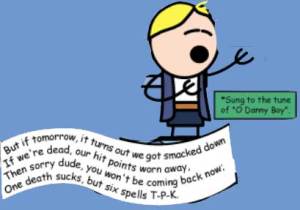
Most horrifyingly, had the PCs decided to take an extended rest before coming into this encounter, the adventure calls for there to be a THIRD warlock, plus an elite orc leader.  I believe that spells TPK. The adventure itself is slightly unclear on how many bad guys there are supposed to be.  It does specifically say to remove the leader and one warlock if the party didn’t take an extended rest, and the map shows that there are originally three warlocks (so with no extended rest there would be two left).  However, the opening of the battle describes there being only TWO warlocks and the leader, plus the warriors.  If this battle was supposed to only have one warlock in the event that the players didn’t take an extended rest, that would be more fair.  So perhaps it’s just a disconnect between the description and the map.

The aftermath of the second battle had some more interesting role playing and investigating, with the party getting more clues about what’s going on and what’s coming next.  I think that section was very well done.

I’m slightly disappointed in the way the monsters are presented in the adventures, both the fact that the monster blocks are images rather than text and the fact that they’re pretty sparse (no ability scores, trained skills or equipment are listed), but that’s a pretty minor quibble.  For a volunteer effort, 4e Home Encounters is amazingly professional-looking.  And maybe I was just too mean as a DM, trying to wipe out my table… but man, were those warlocks scary!  In the end, that might be a good thing.  We don’t want our players getting TOO comfortable at the game table.  Mwoo hah hah!

Virtual Table – first actual play experience

As planned, I was able to get a game going this evening on the beta version of the D&D Virtual Table.  I’ll start by saying that we had a fun little adventure, partly thanks to the program and partly in spite of it.

The good stuff

The best part of the evening was that I was able to get a game together almost entirely in a pick-up manner.  One of my regular Friday night MapTool game players was able to show up (thanks, Max!) but the other players were folks who were either browsing the open games or the beta message boards, looking for a game.  So, it’s clear that the Virtual Table does enable something like a pick-up game of D&D, which is pretty cool.

The built-in audio support is a good idea, too.  It’s nice to be able to talk to one another without having to deal with two different program (a la MapTool and Skype).  I’ll have more to say on this later, though.

Using the table was pretty straightforward.  As a shared battle map, the Virtual Table works.  Everyone can see their tokens and everyone else’s tokens and move their own tokens around with no trouble.  If you wanted to just have paper character sheets in front of you and roll physical dice and call out the results, you could do that very easily (though that would be a bit of a wasted opportunity).

There were even some things that I’d say Virtual Table handles a little better than MapTool.  Initiative was easy – click one button to add the party, add each monster, let everyone click the button for their own initiative roll… it all worked smoothly and just the way you would expect it to.

I was pleasantly surprised to see how well shared editing worked.  If a player was editing their token, I could see the edits as they saved them.  I could apparently also edit the token at the same time (though we didn’t experiment too much to see what would happen if we were making conflicting edits).

The not-so-good

We had connection problems in this game.  I was lucky to have one player who has apparently played in a ton of Virtual Table games already, and he was able to clarify the best way to do certain things and help with troubleshooting.  He helped another player who was lagging badly, especially on the audio side, try to figure out the the problem with his connection (he was using a Mac, which apparently is more likely to cause audio problems for some reason).  However, the problem never really got solved and the Mac player had to drop off and rejoin a whole bunch of times.  Even the experienced player started having lag issues by the end (though the other two of the four players had no problems with lag or audio at any point). I don’t know if it’s a server issue or a problem with individual players’ computers (or mine), but it was troublesome.

Setting up player character tokens is a pain in the butt, too.  Each power has to be manually programmed, and it’s not at all intuitive to use.  It’s not customizable, either.  You can program in dice expressions (like 2d6+4) but you can’t have text be displayed after them automatically (such as “fire damage, and ongoing 5 fire damage (save ends).”)  There are kludgy workarounds for this, but they’re a pain.

Manipulating hit points is fairly intuitive, but it requires a lot of mouse clicks. I like being able to click one button for damage, type a number and hit Enter.  It doesn’t work that easily in the Virtual Table.

Adding conditions was even more of a pain.  There are built-in symbols for being Bloodied and Marked, which is a good start.  You can add other conditions by typing them in manually, in which case a little exclamation point will appear over the token, and you can hover over the exclamation point to see what you’ve typed for the condition (slowed, -2 to AC, ongoing damage, whatever).  And to get to this menu, you have to go into the “Adjust hit points” menu.  Ugh.

Another thing: Bloodied is not automatic.  This baffles me, frankly, and I’m sure they’ll correct it eventually.  It’s pretty straightforward to tell if a token is bloodied or not and I think that status should pop right up.

Overall impressions

I had a good time playing tonight, technical difficulties not withstanding.  Virtual Table is in beta and must be treated as such.  I’m sure Wizards of the Coast is watching the feedback as it comes in and will make improvements over time.  Once those improvements start flowing, and especially once the automatic import of characters, monsters and maps is incorporated, Virtual Table is probably going to be a lot of fun.  Until then, though, I have to look at it as a tool under development, not anything that I would use to replace MapTool right now.

Virtual Table issues so far

Since getting my invitation to the Dungeons and Dragons Virtual Table beta a few days ago, I’ve had a chance to dig into the program a little bit more.  I’ve put together two encounters, and I plan to run one or both of them Monday evening at 7:00 PM Mountain Time (so if anyone is interested, feel free to join the game – look for 4e Home Encounters).  Keeping in mind that I’m spoiled by all of the features of MapTool, there are the issues I’ve discovered.

The obvious limitation at the moment is on the map creation side of things.  The Virtual Table has a few Dungeon Tiles to choose from, and I think it’s pretty clear that they plan to make Dungeon Tiles the main mapping tool in the future.  I won’t be surprised if they charge DMs to get access to new Dungeon Tile sets or something like that, but that might be overly pessimistic on my part.  The current Dungeon Tiles that are available are all for underground maps, and the maps I’m making right now are wilderness maps, so the tiles are useless for me at the moment.  The drawing tools that are available are… well, think “crayon drawing” and you’re on the right track.  I’m sure this will get better eventually, but it’s pretty painful right now.

The panels cannot be resized, which is a pain.  In MapTool, you can resize all of the various windows however you wish.  In Virtual Table you can either have the panel on the right side of the screen displayed or hidden, but not stretched or condensed.  That’s a big pain when you’re trying to select from multiple monsters in that panel that have similar names (Blackwinter Wolf, Blackwinter Wolf Pack Leader… they look very similar when their names are truncated).  Yes, you can get around it by abbreviating names, but it’s still a pain.

There’s no way to manipulate multiple tokens at once.  For instance, I’d like to be able to start with a map where all of the monsters are invisible (note: you CAN make monsters invisible, which is a good feature) and then highlight all of them and make them all visible at once, rather than having to click on each individual token and navigate through its menu to make that one token visible.  If the battlefield has a bunch of minions on it, this is just a pain in the butt.

On a related note, a useful MapTool feature that the Virtual Table currently lacks is a “View as player” option for the DM to look at the map.  When I’m drawing a map and I’ve set certain features to be visible to the players and others to be invisible, it’s VERY helpful to have a way for me to see what the map will look like to the players.  My Friday night players can tell you stories about the times that I’ve talked about the window that the bad guys are jumping out of or the wall of fire that’s coming toward them, only to find out that said window and wall of fire were invisible to my players!  Oops.  Not having a way to check that will make these issues crop up more frequently in the Virtual Table.  This is especially true since making parts of the map visible or invisible doesn’t discernably change anything that I’ve been able to see in the DM view.

Selecting a token is also a little strange.  You can click on a token and move it around and adjust its hit points, but its powers don’t show up on the right side unless you right click on the token and choose “View Token Detail” or select the token name from the monster drop-down.  This is something that should be automatic on a double-click or even a single-click.  Click the token, and its details should appear in the right panel (attacks, notes, etc.).

I like the fact that editing one copy of a token edits all of them.  If I add a new power to a token of which there are already five on the map and then save that change, all five of those tokens have the new power.  However, I believe it is impossible to edit a token’s image once you’ve created it.  I’m sure they’ll change this someday, but it’s a pain for now.

Finally, given that I like to run games in-person using MapTool and my projector, I would REALLY like a full-screen mode that I can run in a second window of the Virtual Table to put onto the table for the players to see.  There’s no full-screen mode right now, and even if there were I’m pretty sure I would need a second D&D Insider subscription in order to be able to run both the DM version of the campaign and the player version at the same time.  Obviously this is not the targeted use for the Virtual Table, but it would still be nice to have.  I’d also need to be able to run it without being connected to the internet (such as at a convention), which is probably never going to happen.

Overall impressions

So far, I’m impressed that there don’t seem to be many bugs per se in the Virtual Table.  Its features are limited, but the features that are in the tool all seem to work properly.  The features are SO limited, though, that playing with this program compared to something like MapTool is just a huge pain.  I’m going to keep playing with it just so I can get to know the tool, but there’s no way that I’m going to switch any of my regular games to it any time soon.

The killer features that the Virtual Table will probably be able to offer eventually are:

  • Automated character and monster importing from DDI tools
  • Full selection of Dungeon Tiles for quick map construction
  • An integrated lobby to find a game

Until these features come about, though, there’s no reason to use Virtual Table over MapTool except for curiosity and a desire to make the program better.  For those of you who don’t have beta invites yet and worry that you’re missing out – you’re not, unless you just like playtesting.  MapTool and its ilk are far better for now.  But the Virtual Table has potential to surpass them someday if those killer features get added.

In the mean time, I will keep playing with the program and posting updates here.  Actually running a game will be enlightening, I’m sure!

Finishing the Fire Forest (maps included)

Last night, my weekly online D&D 4e party finished the Fire Forest adventure, which is the second adventure in the War of the Burning Sky Series.  We only had four of the five players (sorry you couldn’t make it, Jaks!) but we played on for the climactic final encounters.

SPOILERS AHEAD

I haven’t written about each week of this adventure as I had the previous one, so I thought it would be good to recap our experiences.  The Fire Forest starts off with a couple of encounters with creatures of the forest that have been affected by the everlasting flames.  Amusingly, the very first encounter has two different fiery creatures fighting one another… with no way to hurt each other!  All of their attacks deal fire damage, and they’re immune to fire.  Oops.  Anyway, these encounters are good for giving the party a flavor of the Fire Forest, but that’s about all.

A devil, hired by the empire that is chasing the party, pops up a few times to harass and taunt the players before disappearing.  He ended up be an interesting little NPC to play with, but the party did finally get a shot to finish him off (I gave him a 50/50 shot of fighting for one more round or teleporting away – the dice said that he chose to fight, and die).The party met a dragonborn sorcerer who was researching the forest fire and attempting a ritual to put out the fire in a dryad’s grove.  The party went into some caverns to collect some mushrooms and flint that the sorcerer needed for the ritual and ended up fighting some fungus creatures.  They also found some treasures here, including a magical badge on the body of an eladrin knight.  There was a book that was discovered and discarded by the none-too-intellectual shaman in the party (I was amused by this later when we talked about it out of character).  The party helped the sorcerer put out the burning grove, though he was swallowed by the earth and surrounded by more fungus creatures that the adventurers went down to fight off.  This was a combined combat encounter and skill challenge, and I think it went pretty well.

Leaving the sorcerer to recuperate from his wounds, the party continued deeper into the forest and was contacted by a creature calling itself Indomitability, asking the party to silence some singing elves at a lake whose song was keeping him trapped in the forest.  The party agreed to help the creature (sort of).

Next up was a bridge crossing a wide river, with a tower in the middle of the bridge.  A magical mace trap made it hard to get into the tower, but the PCs found a way and discovered some background information about the forest in a journal, plus some mysterious seeds.

Map of the stone bridge with the tower - gridded

Gridless version of the stone bridge with tower map


On the far side of the bridge lay a ruined elf village, crawling with more fiery forest creatures.  This was another forgettable battle that, in retrospect, I probably should have skipped over.  The village did reveal some flavorful little treasures, such as a necklace of ivory leaves that would let the wearer understand and speak Elvish – but only Elvish.  Cute.

Near the village was a shrine in the shape of a willow tree, with a ghast and some skeletons living around it.  After fighting off the ghast, the party met an eladrin spirit in the shrine and finally was able to put together more of the back story of the Fire Forest.  This led them to head down the river toward the village of the seela (the magical winged elves of the forest).  It was on this journey that they encountered and finished off the devil.  They also found one of the winged elves back at the bridge, being attacked by some of the other elves.  Curiouser and curiouser.

Tiljann, the seela

At the seela village, the party did some investigating and learned about the main dryad of the forest, Timbre, who had walled herself off in her grove.  They also learned of the lake nymph, Gwenvere, who had transformed into a hag and had stolen a relic of the elf hero who had been Timbre’s love.  The party found the hag and recovered the relic, which they used to get close to the dryad.  A skill challenge with the dryad ensued, which the party succeeded on, and she agreed to help them.

Gwenvere, the lake hag

Timbre, the Fire Forest dryad

This brought us to the final session, wherein the party needed to head to the bottom of a lake to fight the creature Indomitability, trapped in the form of a flaming stag.  They rowed out in two boats and were beset by aquatic ogres. The ogres succeeded in sinking one boat, but the party was able to get back to shore.

After a short rest on shore, three of the party members piled into one boat, one swam, and one walked along the lake bed with the help of some magic boots.  The boot-wearer was the one to draw the sword out of fiery stag, which allowed Indomitability to be fought.  The interesting thing here is that the boot-wearer is a hybrid swordmage-wizard and followed up drawing the sword with casting a Web to try to immobilize the beast on the lake bed.  Unfortunately, the party’s fighter was also caught in the Web.

Indomitability

Indomitability tossed the fighter deeper into the web and then used a power that would leave the fighter dominated if he failed a saving throw- which he did.  The fighter failed, I believe, six saves in a row to continually be dominated, all while the battle was moving toward shore and the fighter was left with nothing interesting to do, even against his allies.  I felt bad about the way that turned out.

Once the stag got to shore, it started trampling all over the place, leaving fire in its wake.  It took a lot of opportunity attacks but dealt a lot of damage in the process, killing some of the seela.  I felt good about the range of the battle – it wasn’t held all in one little area.  I also used some of the Monster Vault dragon rules for Indomitability, giving him an extra attack at 10+his initiative roll and making it easier for him to shake off conditions that would leave him helpless.  Those made him much more interesting as a solo.

In the end, the fighter in the party did shake off the domination and got to the battle just in time to deal the killing blow.  That was quite satisfying for all concerned!

Now the party is finally able to leave the Fire Forest and continue on its quest southward, toward the town of Seaquen.  I believe we’ve now played either 14 or 15 sessions together.  I’m so happy with this online game – I’ve got a great group of players.

Virtual Table – first experience

Well, it seems that Thursday, December 9, was the day that Wizards of the Coast decided to really open up the Virtual Table to lots and lots of interested players.  I got my invitation, as did a whole bunch of other people I talked to.  So, I’m not a special snowflake, but at least I get to try this out!

I spent probably about two hours playing with the Virtual Table today, and I immediately had a goal in mind: Set up the first 4e Home Encounters adventure!  I had already built this encounter in MapTool, so all I had to do was re-create it in the Virtual Table.

The login process with the beta invite is a little unusual.  I received a welcome email with links to FAQs, five “passes” that I could use to play in Virtual Table games, and a link to the beta group on the WotC home page.  From that group, I had to find a link to a forum post that had the actual link to the beta itself.  From THAT link, I got a pop-up that asked for a user name and password.  Sheesh, what a lot of work!

Once I was in, things got a little easier.  I could browse open campaigns with short descriptions and indications of how many seats were open.  But I didn’t have time to play – I wanted to try setting up my own game.  Thus, I used the New Campaign button.

When you create a new campaign in Virtual Table, you start by editing its name, campaign system (which edition of the game you’re using), campaign world (core world, Forgotten Realms, etc.) and campaign format (ongoing campaign or one-shot).  I like the nod to older editions of D&D, though I’m not particularly experienced with them myself.

After you edit the info, you click the Launch button.  At this point, a Java program loads up and you are left in the map editor window.  All I’ve done so far is draw a map and create monster tokens.

It took a little bit of fooling around with the controls, but I was ultimately able to draw a rudimentary map for the first 4e Home Encounter.  Dungeon Tiles weren’t going to be an option because the beta currently has only tiles for, well, dungeons.  This first encounter takes place in the wilderness, so all of that stone wasn’t going to be helpful.  This meant that I had to draw on the virtual battle mat – old school!

The tools available for drawing are very simple.  Think Microsoft Paint with fewer options.  You can draw freehand lines, straight lines, empty ovals, filled ovals, empty rectangles and filled rectangles.  You can adjust the thickness of your lines to narrow, medium or thick.  You have a choice of six colors for your lines and shapes – red, yellow, black, blue, brown, or green.  You also have a choice of backgrounds – Battle Mat, Sand, Dirt or Grass.

Yes, I know that this is just a beta, and I’m guessing the drawing tools will be improved later.  But in a strange way, I kind of like the limited choices right now.  It feels more like drawing on an actual battle mat, and it makes it so that I’m not focused on making the map look awesome – I’m just making it look serviceable for my players.  Drawing the map did not take long at all – maybe 10 minutes once I understood the controls.

The final step for me was creating the monsters.  You begin by picking the monster image token that you want.  The selection here is limited for now, too, but I was able to pick a wolf and an orc, and I used a drake instead of an alternate wolf picture (there are two different kinds of wolves in this encounter).  Once you have the picture, you name the token and enter its max hit points and defenses.  You can also enter in notes.  Finally, you create powers.

Now this is an area where the creation is easy but the results currently stink.  You can create a “power” and within that you can create various die rolls associated with that power.  To run the die rolls, you have to click each button separately.  So, if the wolf has a Bite power, you create the power and any notes you want to see alongside it, then a die roll button that will display “Bite versus AC” and then the result of 1d20+10 or whatever.  You can also create a separate die roll button that you can call “Bite damage” that will display “Bite damage” and then the result of the damage roll.  When you want your wolf to attack a PC, you click the “Bite versus AC” button, ask if it hits, and if so you can click the “Bite damage” button.  It’s nowhere near as flexible as MapTool, of course, but it works.

I’m going into oral surgery Friday morning (I’ve scheduled this post to go up later in the day on Friday), but I’m hoping to run this encounter a time or two, perhaps over the weekend.  I’ve also put a post on EN World to say that I’m going to run it Monday evening at 7:00 PM Mountain time for anyone who wants to play, just to give the program a test drive.  Feel free to drop me a line via email or in the comments if you’re interested in playing with me (assuming you have a beta invitation yourself, of course).  Let’s see how this runs!

Review – Brother Ptolemy and the Hidden Kingdom

I had the pleasure to review Brother Ptolemy and the Hidden Kingdom before it was published, and seeing the final version makes me feel happy that the project is done and proud that I was able to help in a small way.

This new book from Nevermet Press is what they call an “adventure setting.”  It’s more than just a published adventure, though a full adventure is included in the book.  However, it’s not a full campaign setting, either.  It’s a deep look at one piece of the world, which could be any world at all.  This type of book seems aimed to inspire dungeon masters to include the city of Corwyn and its surroundings and inhabitants and events into the DM’s own campaign world.  And given that the adventure in it is aimed at 5th-level characters, it’s easy to envision a DM starting a game in a rather undefined world of their own creation and giving the player characters a reason to travel to Cormyr after they’ve had the chance to have some other adventures.

As a product, it’s a useful and creative idea.  I like to DM in my own world, so I wouldn’t want to use Dark Sun or Forgotten Realms or Eberron, as they are complete, fleshed-out worlds (though I could pick a small part of one of them for my world).  The lands within Brother Ptolemy have the potential to fit in many different campaign worlds, potentially including my own at some point.

The book is available in either a PDF or a hard copy.  The hard copy is nice – it’s a digest-sized book (the same as the D&D Essentials books) with a soft cover and nice artwork.   The front cover is appropriately dark and creepy.

Warning: SPOILERS AHEAD.  I am about to discuss the world of Brother Ptolemy and some of the back story, which I think is important for a useful review.  This review is aimed at Dungeon Masters who might use the book, however, and a player who reads it might learn more than they really want to know, thus spoiling some of the surprise.  You’ve been warned.

At the heart of this book is the “monk,” Brother Ptolemy, and his band of followers, the titular Hidden Kingdom.  The book opens with the back story of how an immortality-obsessed Duke found himself becoming an immortal and ultimately undead creature, eventually becoming the masked Brother Ptolemy.  The scene in which the Duke figures out what has happened to him – he is immortal, despite the fact that his body is effectively dead – is beautifully written and gives the DM great insight into why the Hidden Kingdom exists and what it offers its followers.  Knowing the inside story makes the Kingdom’s offers of “freedom from hunger, pain and fear” work on a deeper and more disturbing level.

What I love about this characterization of the Hidden Kingdom is its depth.  This is not simply a band of undead creatures determined to wantonly destroy the living.  There is reason behind the madness, and it comes from the horrible realization that one is alive inside a dead body, with no hope for escape.  Combined with a little insanity and the ability to pass this condition on to others via a ritual, a cult is born.  The cult’s MO of performing charitable works in a city in order to gain trust and converts is brilliant and horrifying.  These are great villains with tons of potential.

Chapter 2 of the book introduces a plague called the Red Harvest.  Naturally, the Hidden Kingdom is behind the plague, and its effect on an area is horrifying and effective as a recruiting tool (people turn to the Kingdom out of fear of the Red Harvest).  If I were to use this adventure setting in a broader campaign, I think it would use rumors of the Red Harvest as the hook.  The adventurers could come to the region after hearing horror stories from time to time, deciding to come to help out.

Chapter 3 covers the city-state of Corwyn, where the adventure takes place.  There’s a map that shows where Corwyn is in the broader region and a bit of back story on the town; fairly standard D&D fare, for the most part.

Chapter 4 contains the adventure itself.  This is the meat of the book, and it’s a bit different from most of the D&D 4e adventures I’ve read and run.  It basically takes place in three stages: investigating in Cormyr, exploring the Von Brandt Manor, and facing the music back in Cormyr.

The investigation section has a few skill challenges with combats interspersed here and there.  The PCs will have the chance to meet some well-designed NPCs and even potentially bring one with them to the second section.  I should mention that this section also has a reference to a group called Soul’s End that really appealed to me; I could see trying to give Soul’s End a bigger role in a campaign in this region.

The biggest part of chapter 4 is the exploration of Von Brandt Manor.  This begins with a lake crossing (and what lake crossing would be complete without a creepy lake monster?) and continues with a rather free-form exploration of the house.  This section feels old-school to me.  Rather than have encounters pre-planned in certain rooms, there’s a House Events Table that the DM rolls on whenever the party enters a new area.  Depending on the results of that roll, the party could discover information, items, or enemies.  This is different from the 4e philosophy that I’m used to, and I admit that I would probably add more structure and less randomness if I ran the adventure, but this book certainly lets you do that if you wish.

After the Manor section, the action returns to town with what is technically a skill challenge but is really a free-form roleplaying section with some structure.  The PCs are put on trial for their actions at the Manor, and many outcomes are possible.  If you have a party that’s not into role-playing very much, you might not use this section.  But if you have good role-players, this part is rich with possibilities!

Chapters 5 and 6 include items and rituals to help flesh out the world of the Hidden Kingdom.  The book concludes with some ideas for possible adventure hooks (including the Red Harvest).

Overall, I think Brother Ptolemy and the Hidden Kingdom is a well-made adventure setting for a group that’s looking for something a little bit creepy.  There’s plenty of background information and detail on the world, and the adventure itself is a good mixture of creative skill challenges and interesting combats.  If you want some “creeping menace” in your world, you might want to incorporate the Hidden Kingdom.