Simultaneous skill / combat encounter: Burning grove

In the second part of my online party’s recent session (part 1 is here), they attempted to help a dragonborn sorcerer remove the magical fire from a dryad’s grove.  This was mainly a skill challenge, with some combat thrown in.
I decided to use lots of color when drawing the map in MapTool, and I’m happy with how it turned out.  My only minor regret is that I used a lot of objects rather than just drawing on the map (the trees and flames are objects, for instance) and that meant a long load time for my players (about 3 minutes for some of them).  Lesson learned: Don’t overload MapTool with too many objects (unless you don’t mind some loading time for the party, which might not be a big deal).  Also, given the way the encounter played out, I would want to move the dryad and her children from the far left side of the map to a spot that’s a bit closer to the center.

When the encounter began, the sorcerer went to the altar in the middle of the grove to begin the ritual.  The players gathered around him, and those with Arcana training attempted to assist.  After a couple of minutes the ritual started to have an effect.  The burning grass died down, and the dryad screamed and started running toward the lake in the lower right corner.  A couple of players went over to assist her and her children, but most stayed near the altar.

Shortly after that, catastrophe struck.  A rift opened near the far left side of the map, separating the children from their now-running mother.  The four big trees surrounding the altar came to life, with vines attacking the players and force barriers going between each pair of trees.  And then the ground directly beneath the altar collapsed, casting the sorcerer down into a cave below.

It was clear to the players that the first priority was rescuing the children – the sorcerer seemed to be unconscious but alive at the bottom of the cave below.  The characters outside the force barriers started to use skills to get to the children and calm them down while those inside started working on the trees.  I was curious to see what they would try, and they ended up using skill checks to try to disable the magic of the angry trees.  Nature and Arcana eventually worked (hard DCs), and a crit on the third tree disabled both it and the fourth one.

Now the whole party was trying to help the children, and they did all right (barely).  Since we were in initiative order, it was a little awkward having the children so far out to the left, since players used their turns double running just to get partway over to them, and then had to do lots of running to get back to the lake.  It was awkward, but I hand-waved some of the distance in the end.

Two of the characters felt like there wasn’t much they could do to help the children, so they started working on rescuing the fallen sorcerer.  One set up pitons and a rope in the ground (good dungeoneering check) and then tied the rope to herself while the other held the rope and lowered her down.  She made it okay, tied the rope to the sorcerer and then moved into hiding (she’s a tiefling warlock who recently multiclassed to rogue).  Unfortunately, as the other character began pulling the sorcerer up, some fungus creatures came out of the darkness and cut the rope.

My favorite part: This is where we ended the session.  I love ending on a cliffhanger. The dryad children have been rescued (though the mother died in the effort), but now the warlock is alone in the lower cave with just the unconscious sorcerer for company and some fungus creatures coming out of the darkness.  I’ve already changed this next encounter up from the published version, and I’m excited to try it out next week!

Fungus and determined fighters

My online party ventured into its ninth session in the War of the Burning Sky campaign last night.  This session involved two skill challenges and really just one combat (though as you’ll see the dedicated fighter in the party tried to stretch that one out).

Deep in an eternally-burning forest, the party comes across a dragonborn sorceror who is studying the magical fire and trying to develop a ritual to put it out.  He asks the adventurers to go to a nearby cave to get reagents for the ritual – mushrooms and flint.

Upon entering the cave, the party is greeted by screeching, howling, screaming noises coming from the small chamber at the bottom left corner of the map.  The fighter nervously tiptoes in and finds that it’s coming from a small hole in a corner.  There’s a gem in the hole, and the fighter breaks a bone off a nearby skeleton and pokes the gem.  Nothing happens.  Eventually the swordmage detects magic and figures out that it’s an Eye of Alarm ritual that’s never been deactivated, so she takes the gem and throws it out of the cave, causing the noise to stop.  Cool roleplaying here.

  • DM Lesson: When there’s a very loud noise, play it up.  Make the characters think about it.  Can they communicate effectively?  Might it temporarily deafen them?

The mushrooms were clearly down in the chamber below, so three members of the party took the downward-sloping bridge at the top of the map while the others just climbed down.  The mushroom and flint hunt was on, and cooperation was the word of the day as the party worked together to try to get the needed reagents.  They noticed a misty tunnel in the upper left corner that seemed to get more active whenever they tried and failed to get the reagents.  The skill challenge ultimately failed, which meant that monsters (fungus creatures) came out of the misty tunnel in a surprise round.

This got a little bit interesting for me as a DM.  My players have generally mowed down most unmodified battles, so I had taken to upping the difficulty of most combat encounters.  I did that here, too, adding a couple of monsters.  After one round, I realized that this battle was way too tough – players were getting badly bloodied, and the monsters were barely scratched (they can essentially share hit points by shifting damage taken to one another).  I made some modifications on the fly:

  • I intentionally “forgot” to use the regeneration ability that several of the bad guys had
  • I nearly halved all of their hit points

This made for a kind of weird battle in the end.  Initially the monsters were nearly indestructable because of their high HP and their damage splitting ability.  Once I lowered the HP (and decided not to use the regeneration), they all dropped in a hurry.  Clearly my on-the-fly adjustments need some work!  But the players seemed to have fun bashing the mushrooms into oblivion, so all’s well that ends well.

The best part was the end of the battle, when all of the monsters were dead.  Before taking even a short rest, the fighter wanted to explore the misty cave.  Okay, that’s his call.  He walks into total concealment and sees some orbs that appear to be the source of the mist.  He almost stumbles into a pit (heavy mist obscured it) but makes the athletics check to catch himself.  He finds a ledge that he can walk around, and while standing on it gets knocked into the pit by attacks from mushroom creatures that he can’t see.  The swordmage then charges in to help, fails her athletics check and falls into the pit on top of the fighter.

  • DM Lesson: When one character falls on top of another, split the falling damage between the two of them (it seemed like fun).

So we have our two defenders prone at the bottom of a pit, with mushroom creatures on the far side attacking them.  The creatures have made it clear that they simply don’t want any intruders and that retreat is an option.  But no, the defenders start attacking (ineffectually) from the pit.  Our druid came in to help, lowering a rope to the pit-bound PCs, and only very reluctantly did they decide to climb out and rest.

After the short rest… the fighter charged back in!  He was immediately attacked at range by things he couldn’t see, and only when it became clear that the rest of the party was not helping did he finally back out.  Honestly, I see this as great roleplaying – that fighter is stubborn and refuses to back away from a fight!

Another great bit of roleplaying came when our shaman discovered an old book while searching for flint.  He flipped through it a little bit and then discarded it on the ground, since he’s not much of a book kind of guy.  He never mentioned it to the rest of the party, and it was only at the end of the session that we realized the book was still lying on the ground in the mushroom cave.  Heh.  Good thing it’s not too important!

The second skill challenge, involving the ritual to extinguish a dryad’s burning grove, will be covered in the next post.

MapTool macros: Improved tracking of encounter/daily powers

I’ve been having fun playing with my MapTool campaign file recently.  One of my latest improvements is to add actual tracking for encounter powers and daily powers so that the players can know which powers they’ve used and which are still available.

In an earlier post I described my addition of code to the encounter and daily power macros that would give the player an error message if they tried to use a power that had already been used.  The code is basically as follows:

[h, if(E1==0), CODE:
{[assert(1==0,add(“This power has already been expended.”),0)]
};{[h: E1=0]}
]

Each macro will need its own E1, E2, E3, Daily1, Daily2, Daily3, etc. property to modify and check.  This is nice, but the player only figures out that they can’t use the power again if they try to do so.  What would be even better? A visual cue to show the player that the power is gone.

Enter the MetaMacro!  I didn’t learn until recently that MapTool macros can change the macro button itself.  One of the simplest things to change is the background color of the button.  I want the button to turn dark gray after a power is used up, so:

[h: setMacroProps(getMacroButtonIndex(), “color=darkgray”) ]

This piece of code uses the setMacroProps function to set the color property to “darkgray”.  The setMacroProps function takes two arguments: the index number of the macro whose button you want to change, and then a string that says what property you want to change and what you want the new value to be.

I didn’t know that each macro on a token has an index number, but it’s true.  I’m not sure how they’re assigned (perhaps the order in which you create them).  Fortunately, there’s a function you can use to get MapTool to tell you the index number of the macro you’re currently running.  That’s the getMacroButtonIndex() function that you see above.  It takes no arguments, and it just gives you the index number of the button.  Perfect!

Witchfire has been expended; Otherwind Stride is still available

Next, I had to write some code to turn the buttons back to their original color when the character takes a short rest (encounter powers only) or an extended rest (both encounter and daily powers).  This ended up being quite a bit trickier, but I finally figured it out.

[h, foreach(currentMacroName, getMacros()), CODE:
{
[h, foreach(currentMacroIndex, getMacroIndexes(currentMacroName)), CODE:
{
[h: myProps=getMacroProps(currentMacroIndex)]
[h: currentButtonColor=getStrProp(myProps, “color”)]
[h: currentFontColor=getStrProp(myProps, “fontColor”)]
[h: encounterPower=if(currentFontColor==”red” || currentFontColor==”purple”, 1, 0)]
[h: changeThisButton=if(currentButtonColor==”darkgray” && encounterPower==1, 1, 0)]
[h, if(changeThisButton==1): setMacroProps(currentMacroIndex, “color=default”) ]
}]
}]

Okay, what’s going on here? This piece of code loops through every macro on the token (that’s the first line), gets the index number for that macro (that’s the third line, counting the curly bracket as line 2), then checks to see if that macro needs to have its color changed.  That involves getting a string containing all of the properties for the macro (getMacroProps(currentMacroIndex)) and extracting the button color and font color for that macro.

In my campaign, the buttons for attack macros and special abilities use the default color for their background and a color-coded system for the text (green for at-will powers, red for encounter powers, purple for twice-per-encounter powers and blue for daily powers).  The short rest macro only resets encounter and twice-per-encounter powers, so it checks to see if the button is currently dark gray (expended) and the font is red or purple.  If so, it changes the color back to the default.  Otherwise, such as with a daily power, it leaves the button alone.

The same piece of code for extended rests looks like this:

[h, foreach(currentMacroName, getMacros()), CODE:
{
[h, foreach(currentMacroIndex, getMacroIndexes(currentMacroName)), CODE:
{
[h: myProps=getMacroProps(currentMacroIndex)]
[h: currentButtonColor=getStrProp(myProps, “color”)]
[h: currentFontColor=getStrProp(myProps, “fontColor”)]
[h: encounterOrDaily=if(currentFontColor==”red” || currentFontColor==”blue” || currentFontColor==”purple”, 1, 0)]
[h: changeThisButton=if(currentButtonColor==”darkgray” && encounterOrDaily==1, 1, 0)]
[h, if(changeThisButton==1): setMacroProps(currentMacroIndex, “color=default”) ]
}]
}]

Pretty much the same thing, except now it looks for fonts that are red, purple OR blue.

By the way, I’m aware that there are complete campaign frameworks out there, such as Rumble’s, and I’ve talked about them in an earlier post.  They’re great and very cool and they do everything that my code does and more.  But I write macros for the joy of it, and I love to learn about the language of MapTool.  My posts are intended to help other do-it-yourselfers out there who want to write their own code because they enjoy it.  If this isn’t for you, I highly recommend using a pre-packaged campaign framework – they’re quite slick!

In future posts I’ll talk more about my Short Rest and Extended Rest macros, and the concurrent improvements I’ve made to the healing macro.  Please let me know if there are particular macros that you’d like to hear about!

Giving dungeon mastering advice

As my regular readers know, I’m pretty new as a dungeon master.  I only started playing Dungeons & Dragons in early 2010 and my first attempt at DMing was about six months ago.  I regularly make notes in my blog about the lessons I learn from other DMs that I play under.

It was, therefore, a little surprising when I was asked for MY advice from another DM.  This past Saturday I played a Living Forgotten Realms game at my friendly local game store, Enchanted Grounds.  It was a game for level 1-4 characters and I had planned to play a new cleric I had put together using Heroes of the Fallen Lands.  There were already two other healers at the table, though, so I instead played my trusty half-elf paladin, Rhogar, in his last 1-4 adventure (at the end of this session he had reached level 5).

The DM for this adventure was Andy, who had played in the first game I had run with my new projector setup about a month ago (I believe you can see Andy’s elbow on the left side of the picture on that post).  Andy is the one person I’ve met who has told me that he reads my blog, which was a very cool moment for me (Hi Andy!).

The adventure itself was a lot of fun.  Our party got off a ship in a genasi city and was beckoned by an elderly dragonborn to come over and talk to him and his elven companion.  The elf lady was the dragonborn’s ward, and she was very ill.  He was trying to take her to the realm of some elves who lived in some woods far to the south in the hope that they could cure her.  We agreed to help.

Andy ran this whole section really well – the roleplaying was great, and he got everyone around the table involved.  Rhogar decided that, being a noble paladin he couldn’t bear to make the poor elf woman walk all that way, so he rented a horse for her to ride.  Andy was great at improvising the existence of a stable, stablemaster and horse on the spot, even giving the stablemaster and horse some names. None of this made a lick of difference from a mechanics perspective, but it made the adventure come alive.

After about an hour of roleplaying, the party got into three combats.  The first two were tense, interesting affairs while the third was, frankly, a boring solo encounter (no fault of the DM).

At the end, Andy asked for feedback.  I’ve never been asked to give my thoughts on another DM before!  I told him the things I laid out above, and also suggested that he should feel free to modify combat if it makes sense to do so.  For instance, he could have had the solo monster have two initiative rolls if it wasn’t turning out to be much of a challenge, or have some more bad guys come in after a couple of rounds (a few more of those insects that grabbed and immobilized in an earlier encounter would have been vicious!).  But that’s subtle stuff, and a published adventure is supposed to take care of that sort of thing.

Most interesting to me, I realized that I actually felt fine giving dungeon mastering advice.  I didn’t feel like a fraud.  I certainly don’t have all the answers, and I will ALWAYS be looking for more advice on my own DMing, but I’m now a legitimate part of the dungeon mastering community and I have useful things to say.  That’s a good feeling!

MapTool macros: Tracking encounter/daily powers

Update 10/7/2010: I’ve written another post that expands and improves on this one.

Update 3/29/2011: I’ve updated the daily properties from D1-D10 to Daily1-Daily15.

Over the past few weeks as I’ve continued running my online campaign through the War of the Burning Sky saga, I’ve made some tweaks to my MapTool framework.  Part of this has been driven by one of my players, who has also been using MapTool in her own game and has had some good ideas for improving the player character tokens.

Specifically, she suggested adding buttons for every character ability, even if it didn’t involve rolling dice, just so the players would remember that those abilities existed.  She also added some notes to her character sheet to remind her of things like her damage resistance and so on.  Good thinking!  I plan to do this for the rest of the PC tokens.

I’ve starting making some other changes as well.  I’ve added a Saving Throw button for each character.  Yes, it’s generally just a d20 roll and we do have buttons for that, but one character has an artifact that gives him a +2 bonus to saving throws, so I figured we might as well have a button that includes any modifiers to saves.

I’ve added a set of buttons for ability checks (Strength check, Dexterity check, etc.).  These don’t come up as often as skill checks, but they do come up enough to make it worthwhile to add macros for them.

I’ve also decided that it’s time to code up the tracking of encounter and daily powers.  I’d love it if I had an easy way for a character to tell at a glance which powers hadn’t been used yet, but failing that I can at least add logic to let the player know, “Sorry, you’ve already used that power.”  Here’s how I’ve done it:

  • I’ve added properties E1 through E15 for each character (I can add more later if PCs have more than 15 encounter powers).  These have default values of 1.
  • I’ve also added Daily1 through Daily15 for dailies (default of 1) and S1 through S3 (default value of 2) for special twice-per-encounter powers (Healing Word, etc.).
  • Note that you can’t use D1, D2, etc. because MapTool will recognize those as dice rolls (like d6 and d20).
  • In each encounter/daily/special power macro I’ve added a bit of code that looks something like this:

[h, if(E1==0), CODE:
{[assert(1==0,add(“This power has already been expended.”),0)]
};{[h: E1=0]}
]

That code checks to see if the property for that power has been expended (equal to zero) and if so uses the ASSERT function with a false condition (1==0) to display a message and exit the macro.  If it hasn’t been expended, it sets the property to 0 (or reduces it by 1 in the case of twice-per-encounter powers).  Note that each encounter power uses a different property (E1, E2, etc.).

Finally, I’ve created a Short Rest macro that resets all of the E and S properties back to their default values.  I plan to eventually add a function to the Short Rest macro that lets the player specify how many surges they want to spend and restores that many hit points, but one thing at a time.  I’ll need to add an Extended Rest macro at some point as well, refreshing dailies, healing surges, etc.

What macros am I missing here?  Are there things that I should be adding for my PCs?  I’m feeling pretty good about the direction my campaign is going, and I’m having a great time with it so far!

War of the Burning Sky Session 8

My online group gathered for its eighth session in the War of the Burning Sky campaign yesterday evening.  Eight sessions for a group of strangers spread across the US plus one person in London – that’s pretty impressive.  I honestly expected when I first gathered folks for an online campaign that people would flake out, drop out, not show up, etc.  But my players are flat-out awesome, and I love them.

The session began with the party having recently entered the Fire Forest.  They had easily defeated some fiery bats, and now found themselves faced with a precarious-looking bridge.The bridge had clearly collapsed in one area, with the wreckage of a wagon visible in the canyon 60 feet below.
None of the players had enough Dungeoneering skill to identify the weak points, so Fudrick the gnome shaman started heading across.  He soon learned that if all of the weak points were stepped on and the monsters living beneath the bridge were revealed, it would look like this:

Fudrick’s reflexes weren’t quick enough to jump out of the way of the collapsing stones, and he fell 60 feet, taking 33 damage. His maximum hit points were only 37.  Ouch.

The bat swarms sleeping under the bridge were alerted by this, but I granted everyone in the party a full round of initiative before adding the bats.  Some of the characters started working together to tie two ropes together to lower to poor Fudrick.  Others moved forward to attack.  Jaks, the minotaur druid, used perception to identify two more fragile squares.  However, on the next round when the swarms moved in, Jaks hit with an attack that let him shift – and he shifted right onto one of those weakened squares!  Down he went, falling unconscious.

It looked grim for a while, but the healers in the party got Jaks up on his feet and out of the canyon while the defenders handled the swarms.  It made for a pretty exciting fight!

Next, the party was confronted by a hell hound who dropped a bone at their feet.  The bone had a message saying that they should “leave the case” (a case of military secrets they were trying to get through the forest) and take the bone if they wanted to escape with their lives.  They quickly discovered a loophole – the message didn’t say the plans had to be IN the case!  This let them avoid combat with the hell hound and his fiery wolf friends and also gave them some quest XP to boot – not bad!After that, the party was confronted by the devil who had written the message on the bone.  He wasn’t happy about the empty case and he attacked, but the PCs beat him up easily before he teleported away.

We ended the session after the gang met a dragonborn sorceror who was researching the magic of the fire forest and agreed to help him collect some mushrooms so that he could complete a ritual to quench the fire in a nearby glade with a dryad.  I hadn’t prepared the next encounter area, so we called it a night a little early.

I definitely am enjoying the fire forest adventure in this campaign.  It allows for a lot of branching and meaningful player decisions.  Most of those choices will come later, but there are some even now.  It helps to have such a great group of players!

Essentials thoughts: Heroes of the Fallen Lands

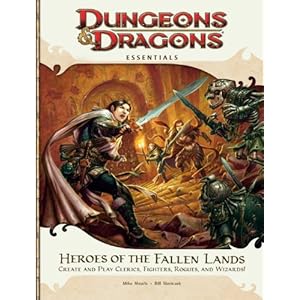
I haven’t posted in over a week, largely because I’ve been out of town for most of that time.  However, the time has not gone to waste from a D&D perspective, as I’ve spent time reading the new Dungeons and Dragons Essentials book, Heroes of the Fallen Lands.

This is really the big new book for Essentials – the one that people who fear 4.5 Edition are really afraid of.  This is where things are changing.

My opinion: I like it!

Here’s what you get in HotFL:

  • Improved support for five basic races (Dwarf, Elf, Eladrin, Halfling, Human)
  • New builds for four classes (Cleric, Fighter, Rogue, Wizard)
  • Some slightly tweaked rules for things like magic items

The fundamentals of D&D 4th Edition are still here, and I don’t see it as a new edition (or half edition). I see it as some rules tweaks and some new options.  It doesn’t feel more revolutionary than the second or third Player’s Handbooks or the Martial/Arcane/Primal Power books for the most part.

Race updates

Every race except human now has stat flexibility – one fixed ability gets a +2 bonus, but there’s a choice of two other abilities to get another +2 bonus.  For instance, the Dwarf still gets +2 Constitution, but instead of being locked into +2 Wisdom for the second boost, the Dwarf can choose either +2 Wisdom or +2 Strength.  Yes, it’s “power creep,” but I don’t care all that much.  I’m strangely feeling inspired to go against type anyway and build “the world’s buffest Wizard” with a big racial bonus to Strength or something like that.

The human still gets +2 to a single stat, but instead of a bonus at-will power the human gets a power that lets you retroactively add 4 to a failed roll to hit or to a failed saving throw.  Fine by me.

So races – no major changes.

Classes

Here is where some people seem to think Wizards of the Coast is making massive changes and that 4th Edition as we know it is gone.  I disagree.

There are five new builds presented in this book.  Two Fighters (the Slayer and the Knight), one Rogue (the Thief), one Cleric (the Warpriest) and one Wizard (the Mage).  The big changes are a departure from the common class structure (no longer does every class get the same lineup of at-will, encounter and daily powers as they level up – some get no dailies at all) and a breakdown of the link between class and role (the Slayer is a striker, but every other Fighter build is a defender).

These new builds are exactly that – new builds.  The Mage is not very different from other Wizard builds, nor is the Warpriest a huge departure from other Clerics.  The Slayer, Knight and Thief are undeniably different from earlier Fighters and Rogues because they focus on melee basic attacks and don’t get daily powers.  They don’t get at-will attack powers, either – they get either stances (for the Fighter builds) or tricks (special moves for the Thief).

I see the new Fighter and Rogue builds as, well, new builds.  They seem like they might even be fun for some players!  I imagine that I would personally get bored with the same few options forever as I played one of these characters up to level 20 or 30, but a player who wanted to keep things simple would probably greatly enjoy these builds.  The same goes for the Warpriest, just because you don’t have to make a lot of choices as you level up.  I personally LIKE making choices as I level up, but I respect that not everybody feels that way.

Rule changes, etc.

Magic items are now either common, uncommon or rare, and players by default can only buy common items (the others are awarded in treasure hauls as the DM sees fit).  Fine by me, as both a player and a DM.

Feats have been organized by what you want to do (have more toughness, be better at skills, wear cooler armor, etc.).  There are some feats here that I really like, such as Master at Arms (+1 to attacks with weapons, and you can use a minor action to simultaneously sheathe one weapon and draw another).  These feats work just fine with existing classes, and the new builds are allowed to take existing feats.

I’ll admit that I was confused by the table on page 344 of the book that talks about magic armor.  I haven’t played any characters above level 4 yet, so this hasn’t come into play, but apparently once you get to level 6 the inherent bonus of your armor gets better (in addition to the enhancement bonus).  I think this is a reference to masterwork armor, though I’ll admit I’m confused.  I thought plate armor was always +8 to AC, with magic plate armor adding something from 1 to 5 on top of that.  Apparently magic plate armor at level 6 is +9, and if it’s +1 armor that’s a total of +10 to AC.  I have so much to learn!

On another note, I love the “fluff” in this book – that is, the stuff that’s not pure rules “crunch”.  Races now get six full pages to help you understand what it’s like to BE a member of that race so that you can play it more effectively.  Classes get some ridiculously awesome artwork.  I’m not an artwork guy, so if I notice the art it must be pretty good.  I LOVE the elf rogue who shows up on the back cover and on page 170.  The elf knight on page 125 is way cool, too.  (I apparently have a thing for elf chicks.)  The halfling thief on page 172 is also badass (see, it’s not just elf chicks).  Good stuff.

Summary

I like Heroes of the Fallen Lands.  I could see myself playing around with some of these characters (somehow the Sun Warpriest seems like a lot of fun).  I could see using them to introduce new players to the game.  I can also see them existing merrily alongside the classes we know and love, with more options now available to those classes (feats, powers, racial abilities).  It’s good for the game, in my opinion, and I have no qualms about the direction of 4th Edition.  Essentials looks like fun to me!

D&D Essentials Game Day

I played in one of the D&D 4e Essentials Game Day sessions this morning at my Friendly Local Game Store and thought it might be of interest to my readers.

I had actually signed up for a Living Forgotten Realms game for this morning, but when I learned a few weeks back that today was the Game Day I wanted to switch to the Game Day adventure.  Unfortunately there were barely enough people signed up for LFR to make a playable table, so I felt bad dropping out.  Fortunately, when I got there everyone at the LFR table (including the DM) wished they were playing the Game Day adventure, so we just changed tables.

I chose Ander, the halfling thief, as my player character.  He has two move action “tricks”, one of which lets him shift two squares and adds “knock prone” to his basic melee attack for the turn and the other of which lets him move his speed -2 and walk up walls during the move.  The second one was cool, but I never found a place to make it work.  The shift 2 was nice, of course, though the only time I ever used it and hit it was against a large dragon, which was too big for my small halfling to knock prone.

SPOILERS AHEAD

The adventure itself involved a minimum of backstory and a maximum of butt kicking.  The setup was that we were hired to escort a dwarf sage and his cursed skull to Sunderpeak Temple where the skull could be destroyed by the priests.  There was a bit of discussion about the trip from Fallcrest to Winterhaven and from there to the temple, but once we found the temple in ruins the battle was on.

We first saw two orc archers and their two guard drakes and engaged them in battle.  Partway through the first round the other thief in the party noticed a bandit off to the side and engaged him.  A second bandit revealed himself later on.

The combat was fast and furious, with the characters and the monsters hitting often and hard.  Ander often hit for about 15 damage (d4 + 6 + 2d6 sneak attack + once per encounter an extra d6 for backstab), and there were many hits by PCs for over 20 damage.  Those are some awesome melee basics!

The monsters gave as good as they got, with the orc archers using an at-will area burst 1 attack to dish out a whole bunch of arrow damage to a lot of us at once and the guard drakes doing what guard drakes always do when they’re near their allies (chomping hard).  We did win the day, with most of the party ending up bloodied, one PC dropping unconscious and the warpriest using both of his healing words.

The best moment for me was when one of the wounded bandits tried to run away, and Ander followed him from across the room.  I had enough speed to move and charge, but since I couldn’t actually see exactly where he had gone I wasn’t allowed to charge.  So, I double moved and then action pointed to stab the crap out of the bandit (he was running, so granting me combat advantage), completely overkilling him.  It was disturbingly satisfying.  I decided that Ander was a rather dark character for a hero, a bit like Belkar Bitterleaf from Order of the Stick (though not actually evil – just violent).

The next encounter involved a big orc and his forty million kobold minions (plus two slingers).  The mage took the lead in blowing away minions – Ander didn’t really get to do much in the battle.  I liked the way the two kobold slingers determined their special ammunition by randomly rolling for it.

From there we went down some stairs and into a room filled with orcs – another blasted archer, several minions that dealt 12 damage on a successful charge, and couple of orcs that were harder to kill.  The room was also filled with magic runes that could do bad things to you if you walked across them, but we managed to avoid them.  I think it would have been cool if the bad guys had some abilities to let them push us into the runes, but c’est la vie.

Apparently there was another option here which would have taken us through a room full of undead, but we picked door number 1 with the orcs.

The final encounter found us facing a room with more charging orc minions, a couple of tougher orcs… and a black dragon.  The dragon was SCARY, which was awesome.  He started off with a darkness attack that left all but one character penalized until the end of the encounter with -2 to their attacks and vulnerable 5 acid.  He then action pointed to breathe acid at those same five characters.  Um, ouch?  It hit for 10 (15 with vulnerability) and 5 ongoing (10 with vulnerability).  The darkness effect lasted until the end of the encounter, or until a successful heal check was made on the character as a standard action (unknown DC).  Rough.

This was a very, very hard battle.  Our mage dropped quickly and failed two death saves.  The other thief dropped and failed one death save.  Ander got close to death but the bad guys had some low rolls and missed him.  We did ultimately win, and it felt like a victory we had to EARN.  I liked that.

Ultimately, I was happy with the character and had fun with the adventure.  The thief has no dailies, but I didn’t miss them.  I never felt like I had nothing to do, even though my only options were really to stab something with a dagger or to throw a dagger at something.  I was very focused on getting combat advantage, and the “shift 2” power was helpful for that, as was charging.

The game still felt like 4th Edition Dungeons and Dragons, though I’ll admit that it felt like it was a little bit on steroids!  A LOT of damage was dealt on both sides.  We made it through four serious combats in about three and a half hours with some breaks and plenty of chatting – a pretty good pace for a six-PC party by 4th Edition standards.

I think I’ll personally prefer playing more complex characters most of the time – I like my Avenger and my Paladin, thank you very much – but to mix it up with an Essentials build is fine by me.  I think new players and players of earlier editions will enjoy these builds.  They still feel like 4th Edition, and they still feel like D&D.  Options are good, and my bloodthirsty little halfling was a cool option.

Getting back to running my online game

I took last Friday off from running my online game in the War of the Burning Sky campaign so that I could attend TactiCon here in Denver.  The convention was great both for running and playing games, but I’m ready to get back to my ongoing campaign with my online players in the War of the Burning Sky world.

The last session was a weird one. We only had four of the five players, so I mostly ran them through a Living Forgotten Realms module that I had prepared for TactiCon. I didn’t want to advance the story from Adventure 1 to Adventure 2 without the full party being present.  Also, they needed a little more experience for leveling up to move into Adventure 2.  We’ll likely begin tomorrow by running the final encounter from the one-shot game and then resume the main quest.

I’ve had time to prepare for the next section, and I’m glad for it.  The second adventure in the War of the Burning Sky is complicated.  There are a lot of NPCs, and the adventure is written with great flexibility – the party could meet various characters in lots of different orders and take lots of different actions, which could lead to lots of different encounters.  The railroading is diminished.  This is great for the players, but tough for the dungeon master.

The problem isn’t so much that I have to be prepared for lots of different eventualities. It’s more that I need to UNDERSTAND what the various possibilities are well in advance so that I can make them available to the party whenever it’s appropriate.  I’ve read through the entire second adventure once now (all 93 pages of it) and I’d like to read it a second time before we play it if possible.  The campaign is starting to grow on me, and I think my enthusiasm will translate well for the players.  Here’s hoping!

P.S. I’m also excited to say that Bree, the DM for the ongoing in-person campaign I play in, is ready to start running adventures again, and we’re going to meet on Sunday for some gaming.  Huzzah!

TactiCon Days 3 and 4 (Saturday and Sunday)

The big weekend days of TactiCon were so big and busy that it took me until Monday to be able to write about them!  Thank goodness for the Labor Day holiday.

Here’s the “Too Long, Didn’t Read” summary:

  • Both of the games I ran on Saturday went great – the projector was a big hit.
  • I played in a very cool custom adventure Saturday night with a novice DM – another good experience.
  • I played in one game on Sunday, which was marred by the most annoying player in the world.
  • I got great reviews from my players and walked away with a free D&D book for my time.
  • I’m looking forward to running and playing more games at the next convention in February.

Saturday: Running the first game

Saturday was the day that I was signed up to actually run two games, though I had run an impromptu one the previous night when the need arose.  I got to the venue right at the scheduled 9:00 AM start time, which meant that I was later than a DM should be.  I arrived at the room where I would be running the game, and my players were already there.  I felt a little bit bad for running late, but no one seemed to mind.

The morning session was a repeat of the game I had already run the previous evening at TactiCon and earlier in the week at my friendly local game store: CORM 1-1 The Black Knight of Arabel.  My party of six players was actually a little underpowered compared to most of the parties I’ve played Living Forgotten Realms with, and it was kind of refreshing!  There was one brand-new D&D player (I love that so much!) and several characters that weren’t optimized to the hilt.  It was still a balanced party, though, so there wasn’t a problem.

This party was the first one I’ve seen that decided to go into Arabel after the initial shadow attack, rather than going after the dark rider on a distant hill.  This meant that I got to run the in-town skill challenge for once, and I had fun with it.  The party took on the optional combat challenge in the brewer’s basement to recover the broken obelisk – a better battle than I was expecting.  The final battle was run pretty much as scripted – I didn’t ramp up the difficulty at all, and it was still a good challenge for the party.  They, like the last party to go through that encounter, played “Grab the Baby from the Evil Cultist”, with the party bard eventually putting the baby in a balcony to keep it out of harm’s way.  Interestingly, this party never met the titular Black Knight of Arabel and finished the whole adventure having learned nothing about him.  Weird, but it worked out okay.

I had an hour between games, so I dashed to the hotel restaurant to get a burger to go.  The service was slow, and I was a little bit nervous leaving my laptop and projector set up in the hotel room with no one around, but when I got back everything was just as I had left it.

Saturday: Running the second game

My afternoon game was with a more experienced party, and we were playing the adventure that I was less sure about from a fun perspective: TYMA 2-1 Old Enemies Arise.  The first battle is the hardest one of the adventure, and I basically told the party as much during the battle so that they wouldn’t be too afraid to use daily powers as needed.  This party lacked a true defender, so the warlord played that role and found himself the target of a savage beating, ending the battle with only two healing surges remaining.  The group decided to take an extended rest in town, and since that made sense within the story I decided to allow it.

I ignored most of the scripted skill challenge because it just didn’t make any sense.  The party is supposed to talk to two different farmers outside of the skill challenge to get information about the kobold attacks.  Then they’re supposed to go BACK to town to start the skill challenge of gathering clues about where the attack is coming from, even though they already know at this point.  And this is supposed to require four successful checks.  Stupid.

So, once they knew that the attacks were coming from the west, I moved into a simpler tracking challenge, followed by some checks to narrow down which cave the kobolds were in.

The first cave combat is one that I ran for my online group a week before, and it was only so-so that first time.  I changed it.

  • As written, there are five trapped squares, and whenever any square is triggered, spears pop up from all five squares. This is boring – once the trap has gone off once, the players will just walk around all of the trapped squares, making the trap mostly irrelevant.
  • I upped the number of trapped squares to ten.
  • I also made it so that each square triggers independently, leading to an awesome minefield experience as the PCs tiptoe across the cave.
  • Finally, I gave the trap savant something to do – his crossbow bolt now pushes the target one square on a hit.

This encounter ended up being a lot of fun.  One character charges in and is hit by a trap.  The rest of the players tiptoe carefully, hoping to avoid the traps.  The decoys jeer at the players, trying to pull them onto traps and to hit them with their swords.  The savant shoots bolts from afar, trying to push players onto traps.  The final encounter after that one wasn’t super-interesting, in part because the dailies all came out, but everyone seemed to have a good time overall.

Saturday evening: Playing in the special event

In the evening, the LFR game was a special one written for the Con called In the Blink of an Eye.  All of the tables of all levels were playing in the same setting, but in different parts of it.  Our group scouted for a way to sneak into a castle and ended up going in the royal family’s emergency escape tunnel.  We were attacked by iron snakes that came out of the walls, retreated when bloodied, and reappeared later.  It made for a surprisingly cool fight.

We then dealt with a trapped corridor using skills, at which point we were at the stopping point for the adventure with time to spare.  The DM decided to make climbing some stairs into an athletics check, at which my heavily-armored paladin failed again and again, taking a little damage each time before finally succeeding.  He is now known as Rohgar Stairslayer.

It was fun to play at the table of a new DM.  She knew the rules well enough but was lacking a little in confidence.  I could see a lot of myself from a few months ago in her – a very interesting process.

After the stopping point, a 16th level rogue from another table was sent to join our party (I’m still not sure why) and we fought a hydra.  It was a 6th level solo, but with unloading of dailies we finished it in two rounds (without the high-level rogue having to do anything significant).  I’ve heard complaints about solos, and I understand them now.

Sunday

On Sunday I decided to sleep in, so I only made it in time for one LFR game.  The DM was one I had played under before at Enchanted Grounds, and he had lots of 3D props for the table (trees, bushes, rocks, etc.) which were pretty cool.  I liked the module, too – AGLA 1-1 Lost Temple of the Fey Gods.  The experience, however, was heavily marred by the presence of one player who was totally mechanics-focused and asked endless questions trying to push the envelope (Can I hide here? Can I see around this corner? Will I get anything useful if I use Arcana now? Could we put away our torch, blinding the rest of the party, so I can use low-light vision?).  He was horribly irritating to play with, and I pitied the DM for having to deal with him.  Had I been running the game, I think I would have paused the game, pulled him aside, and explained that he needed to just play rather than trying to squeeze every non-existent advantage out of the game and sucking the fun out of the table.  If he couldn’t do that, I would have removed him from the game.

Wrap-up

At the end of the convention, there was a little ceremony to thank the DMs.  Everyone was given a choice of various RPG products (I picked up the Forgotten Realms Campaign Guide – I figure I should probably take a look at it) and was recognized for their work.  There’s another somewhat bigger convention in February, Genghis Con, which I’m now looking forward to!

Overall, I had a great time at TactiCon.

  • I did get minis for Rohgar and Kern (though nothing for Zaaria) as well as a couple of miscellaneous minis for players to use at my table.
  • I ran three games and got fantastic evaluations – seventeen perfect scores and one score of 9 out of 10.  I’ll take that!
  • The projector setup worked beautifully and the players loved it.
  • I played a bunch of LFR and got Rohgar to level 4 – woo hoo, I can play in H2 adventures now!
  • I discovered a cool board game, Fresco, which I think I might pick up for myself.

I did not get to play any non-LFR RPGs, but I think I’ll remedy that at Genghis Con in February by just signing up for a slot in advance and diving in, most likely into Savage Worlds.  I’d also like to run a few more sessions if possible – maybe 4 or 5 next time.  It should be awesome!