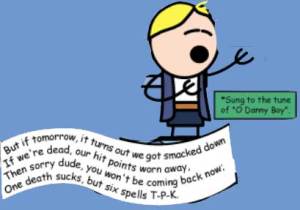
Length of 4e combat – Decision time, not calculation time

Geek Ken has a post over at This is My Game today talking about an idea for speeding up combat. He suggests doing away with rolling dice for damage and instead having fixed damage for each attack with some variety for crits, near-crits and barely-hits. The variety sounds like fun, but as I commented on that post, I don’t think the time it takes to roll and add up damage adds much to the problem of long combats.

What slows down combat is the time it takes to make decisions.

When I first started my Friday night online campaign in August 2010 with first-level characters, combat seemed to move at a pretty good pace. Lately, I’ve noticed that we’ve had some battles that have taken two hours to finish.

What has changed? The PCs are now eighth level rather than first level, and they have a lot more powers to choose from each turn. They have more interrupts on one another’s turns. They have magic item abilities to think about.

It’s probably also true that I haven’t had quite as much time to prepare for sessions as I did back in August, so maybe I’m fumbling around a little more on the bad guys’ turns. But I think I fumbled around back then, too, because I was a new DM. The time it takes me to run the monsters’ turns now is probably similar to what it was back then.

One of the reasons I’m so confident that it’s about decision-making time rather than mechanical time to roll and add dice is that we use MapTool macros that automatically handle the rolling and adding. When the fighter decides to use Crushing Surge, he clicks one button and the attack roll and damage roll show up for all to see, with the math done. Even if he’s rolling 12 dice for damage, it takes no longer than a single die.

What to do about this? Well, I don’t really know. Suggestions to streamline the math of combat won’t help me, since the computer is handling that part. Could I raise monster damage and lower monster hit points/defenses? That’s a possibility. I can have monsters flee or surrender when the fight is clearly lost (and I do that where appropriate).

In the end, it takes time for players to decide what they want to do on their turn. I have great players, and they pay attention and keep their heads in the game. They just have a lot of options at their disposal, and they enjoy the process of making the best decision on their turn. That’s the fun of a game that’s tactics-heavy, and I don’t want to take that away from the players. But it sure does take a long time!

Fortune cards – Second impressions

I played in a Living Forgotten Realms game this morning at my friendly local game store. One of the guys who works there (a person I consider a friend) had a stack of the cards for players to look at. He knew that I wasn’t all that excited about the cards, and he was eager to tell me that I was wrong – the cards were AWESOME, in his opinion.

I looked through the stack of about 50 cards (some of which were duplicates, of course). Verdict: I’m still not impressed.

The cards seem to give minor bonuses to attack or defense or have a minor effect on the board. I think that’s the appropriate power level, since they’re pure add-ons to the powers that player characters already have. If they were super-powerful, the game would be warped and the DM would have to increase the challenge level of encounters significantly in order to make things interesting.

However, with these minor bonuses, it just feels like too much extra stuff to keep track of without enough benefit. On your turn, you now have your full array of normal powers PLUS one more card in your hand to keep track of. That card changes every turn (generally speaking, as I understand the rules of Fortune Cards), so you never get to the point that you’re totally familiar with your character’s abilities. Heck, I kept forgetting that my elf hunter ranger had Elven Accuracy this morning, and that power is always there! Fortune Cards would be one more thing that I would be likely to forget about (and then kick myself later).

Overall, I don’t think the cards add anything meaningful to the game. It’s another layer of complication on a game that, in my opinion, has enough complication already, thank you very much. If you want more twists in your game and bonus powers to give out to players, then Fortune Cards might be a great fit for you. For me – not so much. And that’s even ignoring the whole cost and rarity aspects (which bum me out, too).

By the way, Wizards of the Coast has cleared things up a little bit (in my opinion) about what organized play events will require the cards. They’re starting a new series of events in September that sound similar to the competitive Dungeon Delve events that have been held at several conventions. These are really tough adventures that you’re not expected to be able to just win. It’s strongly implied that Fortune Cards will be required for these events.

Some players will probably love this. If you’re a big-time tactical gamer and want to survive the hardest possible encounters with your min-maxed character, this is right up your alley, and building a powerful deck of Fortune Cards will help. That’s not my cup of tea, but I know some players will love it.

Disease – Delirium Fever

Edit: Thanks to a suggestion from Kingreaper on EN World, I’ve edited the Intermediate State so that hit points can go up to the PC’s surge value rather than being capped at 1.

Two areas where I wish there were more official Dungeons and Dragons Fourth Edition content are traps and diseases. To help remedy that, I’m sharing a disease that I put together for my home game: Delirium Fever.

Delirium Fever

  • Description: The patient is afflicted with a high fever accompanied by profuse sweating and weakness. As the disease progresses, the patient may fall into unconsciousness with periodic bouts of delirious wakefulness, babbling incoherently. Left untreated, Delirium Fever can be fatal.
  • Level: 6
  • Exposure: Via the venom of giant spiders (either at range via spitting, in melee via a bite, or after a hit from a weapon with spider venom on it)
  • Progression: Saving throw to avoid infection after initial exposure. Endurance DC16 to maintain, Endurance DC 21 to improve.
  • Initial state: The patient is weakened, and their hit points cannot go above their bloodied value (temporary hit points can still be gained as normal).  Improvement from this state represents the disease being cured.
  • Intermediate state: The patient is weakened and slowed, and their hit points cannot go above their healing surge value.
  • Advanced state: The patient is unconscious, with occasional bouts of waking delirium.
  • Final state: The patient dies.

In my game, the party encountered this disease when they ran into some duergar.  The duergar use giant spiders as mounts, and the venom of these spiders exposes the target of the attack to delirium fever (based on a secondary attack against fortitude). The party came upon a mining camp where some NPC dwarves had been attacked underground by duergar. The survivors came down with delirium fever.  The PCs went underground to rescue a dwarf prisoner and to try to get some spider venom in order to craft an antidote to the disease. In the process, one of the PCs ended up contracting the disease after a number of spider bites.

I was pretty happy with the role of the disease in my game, so feel free to use it in yours!

Bonus points – reward your players for awesomeness

I like it when players in my D&D games do awesome things. Being an economist by training, I know that incentives matter. Therefore, if I want my players to do more awesome things in our games, I should give them an incentive to do so.

Enter Bonus Points.

Whenever a player in one of my games does something that, in my opinion, is awesome, I will give them a bonus point. They can save these points over time or spend them as they get them.

The rules for bonus points are simple (and open to DM reinterpretation on the fly). A player can spend a bonus point at any time (no action required) to add one to a die they’ve just rolled or to subtract one from a die that was just rolled against them.  Common uses of bonus points include:

  • Turning a miss into a hit
  • Turning a 19 on the die into a critical hit
  • Turning a 19 on a death save into the spending of a healing surge
  • Turning a failed skill check into a success
  • Making an attack that just hit you miss instead

If a player wants to do something that would stretch the rules a little too much, I might also allow them to spend a bonus point to make it work.

For my online game, bonus points are just another property on the PC’s token.  Players have a button on their tokens to spend bonus points, and I manually add them as needed.

For my in-person games, I created tokens following NewbieDM’s method (even using his bonus point images) of gluing printed one-inch circles of photo paper onto metal fender washers.

So, what earns a player a bonus point?  Whatever I feel deserves an extra reward.  Some situations in which I’ve given out bonus points include:

  • A party of new players completing a quest (just to make them feel good about their accomplishment and to get some point tokens in their hands)
  • A PC approaching a room full of archers behind arrow slits by teleporting through the slits into their midst, all by his lonesome
  • A PC avoiding the bottleneck of climbing down the narrow stairs into the bandits’ hideout by doing a Dungeoneering check to look for loose floorboards and then hacking a new entrance to the underground lair through the floor of the room above
  • A PC deciding to play Robin Hood when confronted with an NPC who was price-gouging poor refugees, thus derailing the adventure for a while as I put together an impromptu map of the NPC’s home with guards and a treasure chamber (this escapade was worth two bonus points!)
  • A PC surrounded by bad guys telling the wizard in the party to go ahead and shoot the whole area – he’d be fine! – at which point the wizard promptly critted that PC while missing all of the enemies

Basically, whenever my players do something cool that breaks from the standard mold of, “Let’s see, my optimal tactical position is here so that I can use this particular power and try to push the bad guy into a flank…” I want to reward them.  Creative behavior, in or out of combat, makes the game more fun for everybody.

I’ve started doing this in my Living Forgotten Realms games, too, now that the Rewards Cards are gone (and the Fortune Cards aren’t out yet).  It’s a little extra something for creative thinking.  So simple, and yet it really improves the fun at the table.

Bonus points are a house rule I highly recommend.  I know I’m not the first person to use them, but I don’t care – they rock!

Fortune cards – I plan to ignore them

Since it’s the current big uproar in the D&D community, I thought I would give my two cents’ worth on the Fortune Cards news:

I plan to ignore them.

Yes, Wizards of the Coast seems to be trying to make more money by adding a collectible card game element to Dungeons and Dragons.  I understand why they’re doing it.  It doesn’t sound like much fun to me, so I plan to leave them out of my games.  Players will not be allowed to use them in games that I run.  I only DM right now so I’m not a player in a regular game at the moment, but if I were, I would vote to exclude them (and I’m pretty sure the people I play with would do the same).

I’m a little bummed about the part of the announcement that says, “For some Wizards Play Network programs aimed at experienced players, Fortune Card purchase will be a requirement to participate.”  They say that this will not apply to D&D Encounters (although this page talks extensively about Fortune Cards with Encounters, which confuses me), so I’m left to wonder what they mean.  I know that they required the purchase of Gamma World boosters for the Gamma World Game Day (which I did not participate in); is the plan to require Fortune Cards for future Game Days?  What about Living Forgotten Realms?

I’d be especially bummed if you had to use Fortune Cards to play LFR, especially since it seems that LFR is sort of run by the community now rather than by WotC.  I like LFR, and if I HAVE to buy Fortune Cards in order to play, then I’m not playing.  I’m just not interested in the cards.  Maybe someone will give me a stack of commons that I can put on the table and then not use.

Anyway, for people who don’t care about Organized Play (which is most D&D players, since most of us play home games), you can freely ignore Fortune Cards.  The two they’ve shown so far don’t seem that interesting anyway.

Is this a money-grab by WotC?  Yep.  They’re a business and are trying to maximize profits.  Is it distasteful?  Sure, but I don’t mind ignoring it.  I like D&D 4e without Fortune Cards, and no one can require me to add them to my home games if I don’t like them, so I won’t add them.

Quick-hit recap

I took a little time off from blogging over the holidays, but my D&D life continued.  Here are some quick-hit thoughts from the past couple of weeks.

  • My brother-in-law and his wife became huge D&D fans during their visit.  He played Sunday through Friday, every day, and she played Sunday, Monday, Wednesday and Friday.  Now we have to figure out a schedule for an online game since they’re in Texas and we’re in Colorado.
  • We rolled up Gamma World characters with the family and had a good time doing so, but didn’t get a chance to actually play the game yet.  Too bad – it seems like goofy fun.
  • I ran two Living Forgotten Realms games at my local game store, one of which was my first try at a MyRealms adventure (one I wrote myself).  It went well and had some exciting combat, and I asked for player feedback afterward.  Since we finished with an hour to spare, they suggested that I include more role playing time at the beginning.  Done!
  • My regular Friday night online game took two weeks off and got back together for gaming last night.  It was good to get the band back together.  They’re deep in a swamp and spent last night fighting witches and skeletons.  I’m a little worried because we had a four-hour session and spent almost all of it on two combats – I need to speed those up.  I’m happy, though, that they reacted quickly and strongly to the new NPC I introduced – I think I’ve done well at role-playing her, and some of them love her and some of them hate her.  Perfect!
  • I’m participating in a forum-based “story playtest” of the next campaign saga from EN World, called ZEITGEIST.  Basically, the writer spells out a given situation, we tell him how our characters would react, and he narrates what happens and what comes next.  This is my first play-by-post experience, and I think it’s totally cool.  I love being able to really get into character with the rest of the group, and I could see myself doing some more play-by-post in the future. Also, the ZEITGEIST story is really cool so far.
  • I’m all signed up for Genghis Con, the February convention here in the Denver area.  I’m running three LFR games (two sessions of my MyRealms and one of another module I’ve run before) and I’ve signed up to play in three RPG sessions, none of which are D&D 4e.  That’s intentional.  My only RPG experience is with this one game, and the Con seems like a perfect time to see what other games are like.  I’ll be trying Savage World, Call of Cthulhu and GURPS.
  • My regular in-person game gets back together this afternoon after the holiday break.  I guess that means I’d better stop blogging and start prepping!

Creating D&D converts

Ah, the Christmas season.  That magical time of year when friends and family gather together and give the D&D fans in their lives the chance to talk about what a fun game this is and to turn them into brand-new gamers.

My wife’s brother and his family are staying with us for two weeks over the holidays.  My wife and I talked about D&D several times in the first few days of their visit, and they were interested in hearing more.

I received the Castle Ravenloft board game for Christmas, and my brother-in-law and I played it a couple of times .  Castle Ravenloft is a pretty good introduction to the concepts of D&D 4th Edition:

  • You have a standard and move action on your turn, with the option to turn the standard into a second move
  • You roll a d20, adding a modifier and comparing it to an armor class
  • There are D&D classes with the appropriate roles and flavors
  • There are D&D monsters with reasonable approximations of their feels

My sister-in-law joined in a five-player Castle Ravenloft game on the evening of Christmas Day, and while she was a little overwhelmed, she seemed to enjoy it.

So, the day after Christmas I showed them the online Character Builder (figuring that Essentials characters would be better for beginners) and helped them roll up their very first RPG characters.  My brother-in-law went with an elf hunter ranger named Homer, while my sister-in-law created a half-elf warpriest named Stasi.  My wife rolled up the sister of her beloved swordmage (another swordmage named Sora), and everyone was anxious to try out their new toys.

Sunday evening, the day after Christmas, we all sat down at the gaming table to really introduce my family to D&D.  I gave my in-laws a choice of three different low-level Living Forgotten Realms that I had prepared on the computer (using MapTool and my projector setup to run the game), and they chose to play a Luruar adventure in which they would be helping people at a magical college shore up some problems underground (LURU 2-3 Forgotten Crypts, Hidden Dangers, which I’ll be running at my friendly local game store this evening).  While my wife finished putting her character together, I ran my in-laws through a simple encounter with some orc minions, just so they got a feel for how battle works.

And then we were off!  We ran through the entire LFR adventure, with me scaling it down for 3 PCs on the fly.  Apparently I did a lousy job with the scaling, as I managed to kill off my brother-in-law’s character in the first battle (only the second time I’ve killed a PC).  All three of the bad guys in the battle had the ability to deal ongoing damage, and all three players had a horrible time with their saving throws.

The party decided that they wanted to take the dead character out of the catacombs and get him resurrected (rather than either give up or create a new character).  I introduced a cleric at the magical college who would resurrect him in exchange for a promise that they would work off the debt for the resurrection later.  The living PCs accepted the deal, but used some good diplomacy to persuade the cleric to give them a discount because the dead PC was working for the same organization as the cleric.  Good stuff!

Back into the catacombs, and the party made it through a skill challenge to get to the lair of the big bad guy.  They realized that the room was trapped, and they killed off the monster from the first battle that had caused them so much trouble before fleeing (a Kobold Rat Master, quickly renamed Rat Bastard).  They then retreated and took a short rest before coming back for the last two bad guys.  I had those characters move to a different part of the catacombs, and I’m glad I did – the original room for the final fight is pretty boring for the PCs if the trap is in effect.

They had such a good time on Sunday, that they asked what was next for the party on Monday!  They made it clear that they were really interested in the setting and wanted to do some more adventuring there, so I took a half day off work on Monday to whip up a brand-new adventure for them, which we ran Monday night.

This new adventure was a much better balance for the three-PC party.  They fought zombies, tracked some wraiths, bypassed a skeletal dragon (though they were sorely tempted to fight it), chased some skeletons through a series of rooms, and ultimately came to the crypt of a ghost who was using some portals to channel necrotic energy and bring more wisp wraiths into the world.  I’m quite proud of this encounter – it worked out even better than I had hoped.  I’ll write about it in more detail sometime – maybe I’ll write up the whole adventure as a PDF.

Anyway, I’ve created two new D&D players!  Now the trick will be to figure out how to keep their gamer fires burning.  We’ll probably play a little Gamma World before they head home, and maybe find time for one more D&D adventure (though I won’t have time to write a whole new one from scratch).  Maybe we’ll play using MapTool after they go home – who knows?  It’s been a fun experience so far, and I hope we get to play more in the future.

My players are smarter than I am – lucky me!

As a relatively new dungeon master, I take the approach that I still have much to learn.  This education can even come at the hands of my players.

Now, I’m not talking about rules knowledge or information about D&D canon – I might have some gaps there, but those are no big deal.  I’m talking about knowledge of what makes an adventure fun.  When I get a great idea from my players, I’m proud to say that I quash my ego and run with the idea (or I try to).

This came up most recently on Saturday, when I was running my in-person campaign through my home brew world.  The adventurers are currently exploring an underground complex that they’ve learned is populated with duergar.  I’m actually taking the Second Edition module “The Gates of Firestorm Peak” as a source of inspiration here.

The first time the party encountered the duergar, it was in a guard room.  The room had a 20-foot ceiling and was about 30 feet square.  Running right across the middle of the chamber was a 10-foot wall made of rocks held together with some kind of mortar, and liberally spiked with shards of glass, pointy sticks, etc.  It could be climbed over without cutting one’s self to ribbons, though it wouldn’t be easy.  There was also a door hidden in the wall, though the latch was trapped.

The party found the door but not the trap, and combat began when our monk tried to open the door and found his hand nearly taken off by a bear trap.  At this point, the four duergar guards on the far side of the wall Enlarged themselves to become 12 feet tall (something that I gather was much more common in 2nd Edition than 4e, but I ran with it).  Now they could swing their warhammers or toss their throwing hammers over the wall.

In the first round of combat, the PCs threw some ranged attacks at the duergar while the two melee characters positioned themselves closer to the wall, perhaps in an attempt to try a climb or jump or another shot at the door in the next round.  One of my players said something interesting at the end of this round:

“Man, I hope they don’t push the wall over on us.”

Hmm… they weren’t going to, but only because I hadn’t thought of it before!  But now that I had three gigantic dark dwarves lined up along the non-spiky side of the wall, ready to take their turn… heave!

I had the duergar make some strength checks to push on the wall, which I was glad I had described as being somewhat makeshift.  No problem – over it goes!  I had the debris make attacks against the two PCs who were near the wall, going against Reflex (they could try to dodge out of the way), and I hit both of them.  I decided that this should deal some pretty significant damage (I believe I went with 3d6+7 for these 6th-level characters) and knock the PCs prone.  It also created a zone of difficult terrain where the wall fell.

I wrestled a bit with whether to tell the players that I was doing this on the fly thanks to their suggestion but ultimately decided not to bother.  On the one hand, they might have gotten a good feeling from having come up with a creative idea that I used.  On the other hand, I wouldn’t want them to hold back from sharing this kind of idea in the future!  So, I let them believe that this was all part of my grand plan.  Of course, if they read this post that illusion is gone, but I’ll live. 🙂

What do you think? Do you ever incorporate your players’ ideas for what terrible things might befall them on the fly?  If so, do you credit them for thinking of it, or act like it was all part of the plan?

MapTool – Stupidly complex multi-attack macro

I haven’t posted any MapTool macros in a while, but I just finished writing one that ended up being so stupidly complex that I just had to share it with the world.

First a disclaimer: Yes, I am aware that there are wonderful MapTool frameworks out there that will help automate everything and make it so that I barely need to touch any macros.  I write my own macros just for the fun of it because I’m nerdy like that.  I share them here on my blog because I know there are some other nerdy people out there who might be able to use some of my learnings in their own macros.

Okay, here’s the situation.  There’s a tiefling wizard coming up in a battle for my Friday night War of the Burning Sky campaign.  It’s not a big boss or anything like that, just an ordinary bad guy.  This creature has several different attack powers, as you might expect with a wizard.  The one particular attack power that I’m about to show you is called Dancing Lightning

  • Dancing Lightning involves three attacks (separate attack rolls, separate damage rolls) against three different creatures.
  • This is a recharge power, recharging on a 6.
  • As a tiefling, the creature gets a +1 bonus to attack rolls against bloodied targets.
  • The wizard has a magic staff with a daily power that she can use whenever she uses Dancing Lightning.  If she uses the daily, she deals some bonus damage to creatures in a close blast 3 (which might be some of the same creatures targeted by the attack, or it might not).

Now, I could handle this with separate macros to track just the recharging or just the daily power, and I could decide not to worry about the +1 to attack rolls against bloodied targets.  But instead I decided to go all-in and make this one macro handle everything.

First, the recharge bit:

[h: RechargeTarget=6]
[h: RechargeRoll=d6]
[if(R1!=1), CODE:
 {[if(RechargeRoll<RechargeTarget), CODE:
 {[g: assert(1==0,add("Recharge roll = ", RechargeRoll, ". The power fails to recharge."),0)]
 };{}]
 };{[setProperty("R1",0)]}
]

This is my standard recharge code.  It sets the target number for recharging at 6.  It rolls a d6 and stores the result as RechargeRoll.  It then checks a property on the token called R1 (which is equal to 1 when the battle begins and is set to zero after the power has been used).  If R1 is not equal to 1 (that is, it’s zero because the power has already been used at least once), then the macro checks to see if the recharge roll was at least 6.  If not, it uses the ASSERT function to give an error message (no recharge) and the macro ends.  If the recharge roll is 6, then the macro moves on.  Finally, if R1 was equal to 1 (that is, if the power hadn’t been used yet this battle), the macro sets it to zero so that it won’t work next time unless it recharges.

Next, the standard attack macro setup stuff:

[h: AttackName="Dancing Lightning"]
[h: AttackBonus=14]
[h: Defense="Reflex"]
[h: NumDice=2]
[h: DamageDie=6]
[h: DamageBonus=5]
[h: DamageString="lightning damage."]
<b>[AttackName]</b><br>

Here I set up the name of the attack to be displayed, the attack bonus, the defense that is being attacked, the number of damage dice I’m going to roll, the size of the damage die, the number I’m adding to the damage dice and the text that I want to display after the damage number (in this case, “lightning damage”).  The last line displays the name of the attack in the chat window in bold type and then inserts a line break.  Simple stuff.  I only bother using these variables because for most attacks I just set these things at the top of my code and then I’m done.

Now we get into the stuff for the first actual attack and damage roll:

[h: x=input("FoeBloody|No,Yes|Is the first target bloodied?|RADIO|VALUE=STRING")]
[h: abort(x)]
[h: AttackBonus=if(FoeBloody=="Yes",AttackBonus+1,AttackBonus)]
[h: DamageRoll=roll(NumDice,DamageDie)]
[h: d20roll=d20]
[h: AttackRoll=d20roll+AttackBonus]
[h: MaxDamage=NumDice*DamageDie+DamageBonus]
[h: RegularDamage=DamageRoll+DamageBonus]

The first line above will result in me getting a pop-up dialog box that asks if the first target is bloodied.  The second line will end the macro if I click “Cancel” in that pop-up.  The third line checks to see if I said the first target was bloodied; if so, it adds 1 to the attack bonus (the tiefling ability).After that, the macro does a damage roll (2d6 in this case). It does a d20 roll for the attack, adding the attack bonus and calling it AttackRoll.  It calculates the maximum possible damage (in case of a crit) as well as the regular damage (from the damage roll plus the bonus).  Again, pretty simple.

Next, I display the results of the first attack in the chat window:

Attack 1: [d20roll] + [AttackBonus] = <b>[AttackRoll]</b> versus [Defense]<br>
[if(d20roll==20), CODE:
 {<font color=Red>--CRITICAL HIT--</font><br>
 Hit 1: [NumDice*DamageDie] + [DamageBonus] = <b>[MaxDamage]</b> [DamageString]
 };
 {Hit 1: [DamageRoll] + [DamageBonus] = <b>[RegularDamage]</b> [DamageString]}
]

The first line shows something like: “Attack 1: 7 + 14 = 21 versus Reflex”  Then I check to see if there was a critical hit.  If so, I display the maximum damage (along with a crit message); otherwise, I show the damage that was rolled for this attack.  Again, standard stuff from my regular attack macros.

After this, I repeat those last two sections (starting with the FoeBloody piece) for the second and third attacks (changing the language to “second target,” “Attack 2,” “Hit 2,” and so on).  I put a couple of line breaks in between as well.

Finally, there’s the piece of code to deal with whether I want to use the bonus daily damage in a close blast 3 or not.  Generally I’ll just use it at the first opportunity, of course – this is a recharge 6 power, which means it’s highly unlikely that I’ll get a second chance to use it.  But hey, for the sake of completeness, I wanted the option to be built in to the macro.

[if(E2==1), CODE:
 {[h: x=input("UseDaily|Yes,No|Use the daily close blast 3 power now?|RADIO|VALUE=STRING")]
 [h: abort(x)]
 [if(UseDaily=="Yes"),CODE:
 {[h: E2=0]
 <br><br><i>Quarterstaff of Storms</i>: Each enemy in a close blast 3 takes an additional [d8] lightning and thunder damage.
 }; {}
 ]
 };
 {}
]

This one is very messy to look at, mainly because it uses nested IF statements (an IF within an IF).  It first looks at a property of the wizard token called E2 (this is for her second encounter power – the first is Infernal Wrath).  If E2 equals one, that means that I haven’t already used this daily yet, in which case the code moves on to ask me if I want to use it this time.  It does so with another pop-up dialog box:

Now, if I do choose to use the daily power, the macro sets E2 equal to zero (to show that the power has been used up).  It then inserts two more line breaks, displays the name of the daily power in italics and then says what happens to the enemies in the blast (including the damage roll).  Note that if E2 were equal to zero (meaning that the daily item power had already been used), then the rest of the code is skipped over.

When I run the power, the output in the chat window looks like this:

And the finished macro in all its glory is as follows:

[h: RechargeTarget=6]
[h: RechargeRoll=d6]
[if(R1!=1), CODE:
 {[if(RechargeRoll<RechargeTarget), CODE:
 {[g: assert(1==0,add("Recharge roll = ", RechargeRoll, ". The power fails to recharge."),0)]
 };{}]
 };{[setProperty("R1",0)]}
]

[h: AttackName="Dancing Lightning"]
[h: AttackBonus=14]
[h: Defense="Reflex"]
[h: NumDice=2]
[h: DamageDie=6]
[h: DamageBonus=5]
[h: DamageString="lightning damage."]

<b>[AttackName]</b><br>

[h: x=input("FoeBloody|No,Yes|Is the first target bloodied?|RADIO|VALUE=STRING")]
[h: abort(x)]
[h: AttackBonus=if(FoeBloody=="Yes",AttackBonus+1,AttackBonus)]
[h: DamageRoll=roll(NumDice,DamageDie)]
[h: d20roll=d20]
[h: AttackRoll=d20roll+AttackBonus]
[h: MaxDamage=NumDice*DamageDie+DamageBonus]
[h: RegularDamage=DamageRoll+DamageBonus]

Attack 1: [d20roll] + [AttackBonus] = <b>[AttackRoll]</b> versus [Defense]<br>
[if(d20roll==20), CODE:
 {<font color=Red>--CRITICAL HIT--</font><br>
 Hit 1: [NumDice*DamageDie] + [DamageBonus] = <b>[MaxDamage]</b> [DamageString]
 };
 {Hit 1: [DamageRoll] + [DamageBonus] = <b>[RegularDamage]</b> [DamageString]}
]

[h: "Second Attack"]
[h: x=input("FoeBloody|No,Yes|Is the second target bloodied?|RADIO|VALUE=STRING")]
[h: abort(x)]
[h: AttackBonus=if(FoeBloody=="Yes",AttackBonus+1,AttackBonus)]
[h: DamageRoll=roll(NumDice,DamageDie)]
[h: d20roll=d20]
[h: AttackRoll=d20roll+AttackBonus]
[h: MaxDamage=NumDice*DamageDie+DamageBonus]
[h: RegularDamage=DamageRoll+DamageBonus]
<br><br>
Attack 2: [d20roll] + [AttackBonus] = <b>[AttackRoll]</b> versus [Defense]<br>
[if(d20roll==20), CODE:
 {<font color=Red>--CRITICAL HIT--</font><br>
 Hit 2: [NumDice*DamageDie] + [DamageBonus] = <b>[MaxDamage]</b> [DamageString]
 };
 {Hit 2: [DamageRoll] + [DamageBonus] = <b>[RegularDamage]</b> [DamageString]}
]


[h: "Third Attack"]
[h: x=input("FoeBloody|No,Yes|Is the third target bloodied?|RADIO|VALUE=STRING")]
[h: abort(x)]
[h: AttackBonus=if(FoeBloody=="Yes",AttackBonus+1,AttackBonus)]
[h: DamageRoll=roll(NumDice,DamageDie)]
[h: d20roll=d20]
[h: AttackRoll=d20roll+AttackBonus]
[h: MaxDamage=NumDice*DamageDie+DamageBonus]
[h: RegularDamage=DamageRoll+DamageBonus]
<br><br>
Attack 3: [d20roll] + [AttackBonus] = <b>[AttackRoll]</b> versus [Defense]<br>
[if(d20roll==20), CODE:
 {<font color=Red>--CRITICAL HIT--</font><br>
 Hit 3: [NumDice*DamageDie] + [DamageBonus] = <b>[MaxDamage]</b> [DamageString]
 };
 {Hit 3: [DamageRoll] + [DamageBonus] = <b>[RegularDamage]</b> [DamageString]}
]

[if(E2==1), CODE:
 {[h: x=input("UseDaily|Yes,No|Use the daily close blast 3 power now?|RADIO|VALUE=STRING")]
 [h: abort(x)]
 [if(UseDaily=="Yes"),CODE:
 {[h: E2=0]
 <br><br><i>Quarterstaff of Storms</i>: Each enemy in a close blast 3 takes an additional [d8] lightning and thunder damage.
 }; {}
 ]
 };
 {}
]

4e Home Encounters review – Sessions 1 and 2

I was able to kill two testing birds with one stone Monday night, as I tried out the D&D Virtual Table for the first time in playing the 4e Home Encounters adventures for the first time.  I will say right off the bat that there are some spoilers ahead, so if you don’t want to know what’s in the encounters, read no further!First, I’m pleased with the production values in the 4e Home Encounters PDFs.  I like that the authors made the effort to create nice page headers and page numbers, a title page and a regional map.  It definitely adds to the experience of using these adventures.  I’m disappointed that they used images instead of Rich Text for the monster stat blocks – that makes it harder for me to copy and paste information into my online tools for running the game – but that’s a minor issue.  The maps that have started coming out are good additions, too, and will be a big help for anyone who wants to run the encounters in a program like MapTool (though not the Virtual Table, which doesn’t allow for map importing – grr).

Next, I think the authors hit the amount of background information just about right.  They give you enough to tell the players where they are, how they got there, and what’s going on in the world, but not so much that they have to go searching for the action.  The action comes to them, and I think that’s the right approach for this type of adventure.

Once the players have accepted their quest, trouble finds them in the woods in the form of some wolves and a beastmaster orc.  The party I ran through this encounter had only four PCs, and I assume that the adventure is scaled for five, but the players said they wanted the challenge of the full-scale encounter.  (Note that the adventure doesn’t actually include scaling instructions for parties with more or fewer than five PCs – something that they should probably address).  That was a reasonable call, as they handled the wolves pretty easily.

I liked the wolves’ knockdown ability and the fact that they deal extra damage to prone creatures.  I wasn’t crazy about the fact that the trees on the map didn’t really have much impact on the battle (they provide some cover and concealment, but no hindrance to movement or anything like that).  It made it easier to run, sure, but I generally like terrain to make more of a difference.

After the encounter, the party finds a mysterious object in a tree that was surrounded by frost.  The players asked me if the frost was melting since the object that was causing the frost was described as non-functional.  Good question.  I said yes.  I would have liked to have had the answer in the adventure itself, but no biggie – DMs are supposed to ad lib.

The players were having fun and wanted to move on, so we went to encounter number two.  This one starts with a uniquely structured skill challenge.  The party has to get close to an orc camp without alerting the orcs to their presence.  This is handled in stages, with the party building up a Stealth score and the orcs building up an Alertness score.  I like the idea, but I missed the part that told me when I was supposed to move from one section of the challenge to the next (it’s after each PC has a chance to make a skill check, which makes sense).  In any case, the party ended up drawing too much attention to themselves, so they failed the skill challenge.

I forgot to give the orcs the initiative bonus that they were supposed to have from the PCs failing the skill challenge and I ended up not even adding the bonus damage they were supposed to get either because they were COMPLETELY OBLITERATING the PCs without any extra help.  Again, it was scaled for five PCs and we had only four, but that wasn’t the issue.

The battle contains three orc warriors and two orc warlocks.  The warriors are reasonably tough melee critters – nothing too amazing.  The warlocks, though… wow.  They each have a minor action (recharge) that lets them give enemies in an area burst 2 within 10 vulnerability 5 to cold and to necrotic damage until the end of the next turn.  They also have an encounter power that’s an area burst 3 (yes, burst 3) within 10 that 2d8+7 cold and necrotic damage on a hit and weakens the target (save ends).  Here’s how the encounter went:

  • Warriors win initiative.  They charge in to three of the PCs and swing at them, hitting two and doing some cleave damage.  Ouch, but not a huge deal – no one is bloodied.
  • Warlocks go next.  The first one does his minor action on three of the PCs to make them vulnerable to cold and necrotic, hitting two of them.  He follows up with his encounter power to blast all four PCs with cold and necrotic damage.  He hits three of them, two of which are vulnerable.  The vulnerable PCs take 2d8+17 damage (because they’re vulnerable 5 cold and vulnerable 5 necrotic, and this attack is both, they take 10 extra damage).  Ow.  I didn’t even bother with the weakened (save ends) from that attack.
  • The second warlock repeats the area burst 3 attack (not even bothering to try making the two non-vulnerable PCs vulnerable first).  He hits three of them, and two drop unconscious (including the party’s healer).
  • Now the PCs get to go…

Maybe it was just that my virtual dice were hot, but these warlocks completely wrecked the party.  I pulled my punches the rest of the way, having one warrior flee (thus scaling down the battle belatedly for four PCs), not having the warlocks use their best remaining power (choosing to slow rather than deal ongoing damage), not trying to make the PCs vulnerable again, etc.  With some easier enemy tactics and DM fiat ruling that there were some healing potions in the PCs’ packs, the party pulled through.

Most horrifyingly, had the PCs decided to take an extended rest before coming into this encounter, the adventure calls for there to be a THIRD warlock, plus an elite orc leader.  I believe that spells TPK. The adventure itself is slightly unclear on how many bad guys there are supposed to be.  It does specifically say to remove the leader and one warlock if the party didn’t take an extended rest, and the map shows that there are originally three warlocks (so with no extended rest there would be two left).  However, the opening of the battle describes there being only TWO warlocks and the leader, plus the warriors.  If this battle was supposed to only have one warlock in the event that the players didn’t take an extended rest, that would be more fair.  So perhaps it’s just a disconnect between the description and the map.

The aftermath of the second battle had some more interesting role playing and investigating, with the party getting more clues about what’s going on and what’s coming next.  I think that section was very well done.

I’m slightly disappointed in the way the monsters are presented in the adventures, both the fact that the monster blocks are images rather than text and the fact that they’re pretty sparse (no ability scores, trained skills or equipment are listed), but that’s a pretty minor quibble.  For a volunteer effort, 4e Home Encounters is amazingly professional-looking.  And maybe I was just too mean as a DM, trying to wipe out my table… but man, were those warlocks scary!  In the end, that might be a good thing.  We don’t want our players getting TOO comfortable at the game table.  Mwoo hah hah!