Kickstarter projects I’ve backed: Number 1 through 10 (chronologically)

The first time I ever backed a Kickstarter project was nearly two and a half years ago as of this writing – early in 2011. Today, I thought I’d take a look back at the first 10 projects I backed and note what made me want to back it, what level I backed at, and how it turned out. (Part 2 of this series is at this link.)

1. ZEITGEIST Adventure Path from EN World – April 2011

This was the first Kickstarter campaign I ever backed. EN World, where I was an active forum member at the time, was getting ready to publish their ZEITGEIST campaign. I was running their War of the Burning Sky campaign at the time for my online game, and I loved it. Furthermore, I had participated in a loose play-by-forum playtest of the first ZEITGEIST adventure run by its designer, Ryan Nock.

Why I backed it: I loved that play-by-forum taste of the campaign and I wanted to support it.

My pledge: All right, this is a little insane, and I’ve never done anything like this since. I actually ponied up a $500 pledge to participate in a game Ryan would be running at Gen Con 2011.

How it turned out: The campaign didn’t hit its funding goal. That’s probably a good thing for me, since I’ve run a grand total of one adventure in this campaign. I would have felt pretty dumb being out $500 on this in the end.

Interesting side note: EN World came back much later to run a Kickstarter for this adventure path, and I decided not to back it because I thought it was too expensive. Times change!

2. Dungeonmorph Dice – May 2011

Why I backed it: I thought the dice looked really cool, and there was an outside chance I might use them to put together a dungeon map on the fly someday.

My pledge: $20, for a set of five dice.

How it turned out: I eventually received my dice. They look cool. I don’t believe I’ve ever rolled them. Still, I feel fine about the experience.

3. Compact Heroes – June 2011

Why I backed it: I liked the concept of the game (an RPG based on a deck of cards – frankly, a little bit like the Pathfinder Adventure Card Game).

My pledge: $50 for two starter decks.

How it turned out: I received my decks, more or less on time as I recall. I’ll admit that I’ve never played the game. Sigh. On a brighter note, the designer, Rod Waibel, was really helpful when I was trying to figure out how best to print Chaos & Alchemy cards a year later.

4. Mutant Meeples – December 2011

Why I backed it: The game looked like a lot of fun – a cool twist on Ricochet Robots (which I had played years before but did not own). I’ll admit that the video was pretty slick, too.

My pledge: $60 for the game and its expansion

How it turned out: I believe that this holds the record for the longest delay between when the game was supposed to be delivered (February 2012) and when it was actually delivered (December 2012, if I remember right) so far. It’s a pretty cool game, but I’ve only played it once or twice.

Side note: I have no idea why I didn’t back anything between June and December of 2011.

5. Gaming Dice in Chocolate and Sugar – December 2011

Why I backed it: Come on, these are cool! D&D dice that you can eat; awesome. Also, the creator was a fellow Coloradan.

My pledge: $25 for a chocolate set and a sugar set of dice.

How it turned out: Delicious! There were some production delays, but I was very happy with the final product.

6. The Order of the Stick Reprint Drive – February 2012

Why I pledged: I love Order of the Stick, and I hadn’t been able to find a copy of War and XPs anywhere.

My pledge: $45 for a copy of War and XPs (I wanted to pledge $60 for a signed copy, but those went too fast)

How it turned out: Awesome! The book is great.

7. Monster Stock Art and Minis – March 2012

Why I pledged: At the time, I had recently put out my free D&D 4th Edition adventure trilogy The Staff of Suha, and I thought that I might want to have some monster art to use in case I published future adventures like that one. Also, the monster art could be useful for the online games I was running in MapTool.

My pledge: $140 for a license to use all of the art that came out of the project commercially.

How it turned out: Until I started putting this blog post together, there was no way I could have remembered that I spent $140 on this art. I’ve barely used any of it in my MapTool games (which I stopped running in mid-2012 when I moved on to board game design), and I haven’t published any new adventures. Quality art, but a waste of money on my end.

8. Admiral ‘o the High Seas – Naval Adventures from EN World

Why I pledged: Largely to support the ZEITGEIST campaign (see item 1 on this list). I didn’t care much about the naval combat rules themselves.

My pledge: $45 for a PDF of the new supplement and the right to name a character or location in an upcoming ZEITGEIST adventure.

How it turned out: I turned the abbreviation for Online Dungeon Master, ODM, into a word – Odiem – that EN World used as the name of a spooky island location in a ZEITGEIST adventure. Cool. I’m happy with the investment.

9. DoubleFine Adventure

Why I pledged: I’ll admit it; I jumped on the bandwagon. I mean sure, I enjoy this type of game, but I’m really not a big video gamer these days and I wouldn’t have signed on if it weren’t for the “Kickstarter phenomenon” part of this campaign.

My pledge: $15 for a copy of the game.

How it turned out: Well, the game isn’t done yet. I guess this is really the most-delayed project I’ve backed (Mutant Meeples, you’re off the hook). They’ve apparently been putting out videos about the process, but I haven’t bothered to look at any of them (I just don’t care). A waste of money for the most part, but only a $15 waste.

10. Prismatic Art Collection – May 2012

Why I pledged: Mainly because I wanted to support a project that Tracy Hurley and Daniel Solis care about (two people I respect greatly). Also because the art might be useful for any adventures I might release on my site (same rationale as for the Monster Stock Art project).

My pledge: $25 for a thank-you on their web site.

How it turned out: Some art has been released. I haven’t used any of it. But I helped Tracy and Daniel reach their goal, so I’m fine with that.

Scorecard for my first 10 projects:

  • Number that were actually funded: 9/10
  • Number that were eventually delivered: 8/9 (and I think that DoubleFine will eventually come through, too, making this 9/9)
  • Number that I feel were ultimately worth it in retrospect: 6/9 (the three exceptions being Compact Heroes, Monster Stock Art and DoubleFine Adventure)
  • Total money spent: $425
  • Money spent on not-worth-it projects: $205 (sigh)

What’s next?

As of this writing, I’ve backed 49 total projects. I like the idea of going through them 10 at a time, so I’ll probably do 11-20 in the near future. (Edit: Here they are!)

What about you – how many Kickstarter projects have you backed, and how many have been worth it in retrospect?

Michael the OnlineDM

@ClayCrucible on Twitter

Kid-Friendly RPG at TactiCon 2013 – Part 2

Yesterday, I wrote about the preparation and starting schene of the Kid-Friendly RPG (KFRPG) game that I ran for a group of six young boys at Con Jr. for TactiCon 2013. They were on a quest to find and take out an evil wizard known as Kalor the Terrible, but first they had to take care of the rat problem in the basement of the Rusty Lantern Inn.

Scene 2: Rats in the basement

I moved to a basement map and put a bunch of rats on the map (once the party had sorted out their light situation, of course). We rolled for initiative (one player versus the GM), and the rats won.

Rats are wimpy monsters (even big 50-pound rats like these), so they have a d4 for attack and defense (a standard monster in KFRPG gets a d6 for both). This let the players learn how combat works without being seriously threatened.

As the rats started dropping, a couple of players wanted to heal the rats and train them. Sure, why not? I had them roll some hard heal checks once combat was over, and they were able to heal and train three of the rats. Now they had pets! Pseudo-zombie pets, sure, but at least they were loyal (if a bit gross).

Scene 3: Back to the inn

Back upstairs, the players decided they wanted to go see a blacksmith. However, it was night time, so they would have to wait until the next morning.

What about Kalor the Terrible, you may ask? What indeed! No mention of him from the players. They needed a blacksmith, for some reason! (I still have no idea where this notion came from.)

They decided to get a good night’s sleep (recovering the few hit points they had lost).

Scene 4: Meet the blacksmith

In the morning, the party went off to see the blacksmith. I brought up a map of a town and indicated which building was the smithy.

Village map

Village map

Using Masks, I named the blacksmith, and I decided to pull out the token for good old Sir Oakley from Madness at Gardmore Abbey to represent the smith. He was heavily armored; sure, why not?

The players started shopping, talking about the cool stuff they wanted to buy. Then one of the rangers declared that he was just taking one of the blacksmith’s swords.

Naturally, the smith shouted for him to drop the stolen sword, whereupon the ranger decided to toss a dagger at the smith.

Yes, the heated battle was on!

Some of the players decided to join the battle, even as the smith’s apprentices came out of a nearby house to join the fight.

Some PCs decided to steal some armor and put it on, right in the middle of battle.

Others decided to get out of there to go check out the festival tent with gnomes in it on the other side of town.

Some changed their minds in the middle of the fight, going back and forth between fighting and paying for the stuff they were taking.

Eventually, the ranger who started the fight, along with the wizard he had dragged into it, got themselves subdued and arrested. The magistrate would be in town the next day to hear their trial.

The other four members of the party debated what to do. Two of them decided to just hang out at the inn. The other two waited for nightfall, then went for the jailbreak.

Scene 6: Jailbreak

The would-be rescuers (paladin and wolfman) decided that they needed to know the exact layout of the jail (or at least as much of it as they could reasonably discern from outside), so I sketched a quick map in MapTool (amazingly, I was not expecting to need a jail map; go figure).

After dark, the jailbreakers went around to the narrow windows high up in each wall of the jail, peering in to try to find their allies. This involved the acrobatic wolfman standing on the shoulders of the athletic paladin. Eventually, they found the right cell.

Wolfman called out to the prisoners, who started to wake up, but at the same moment the paladin heard someone coming around the building. Wolfman and paladin hid in the bushes as a couple of guards came by on rounds. The guards didn’t see them, and walked on by.

Meanwhile, the captured ranger and wizard were now awake, and they had seen the wolfman’s face for a moment before he dropped out of sight. They decided to make a big ruckus to draw the guards – which worked.

While two guards were outside on patrol, the other two guards came to check on the prisoners who were making the noise. The ranger made a fantastic roll to reach between the bars to grab one guard by the neck while the wizard shot a bolt of electricity at the other. They were able to grab the keys off a guard’s belt and make their escape, locking the guards in the cell.

Meanwhile, the patrol had passed by the back of the building, so the paladin decided to try to toss a hammer between the bars of the window to give his allies a weapon – not knowing that they were already escaping. By the time he got the hammer through the barred window, it ended up landing on a locked-up guard as his friends were heading out the front door, dealing with the patrol.

Sheesh.

Scene 7: On the run

Now that everyone was free (and outlaws), the group decided to go get their two sleeping party members and hit the road.

They talked about their general plan – staying within sight of the main road into the hills, but keeping off the road itself. Walking by night, sleeping by day. Going nowhere in particular – just to a faraway town.

Kalor the Terrible? Who’s that?

At this point, we were about 90 minutes into our two-hour session, so I decided it was time for a final battle.

Silly players; in their haste to get out of town, they had unwittingly set up camp in a dragon’s hunting grounds.

A few kobolds came upon the party and started talking about “the Master.” After combat began with the kobolds, the Master – a dragon – showed up.

Now the party got to toss out their big, special blue chip powers, as the dragon flew around and breathed fire.

Eventually the good guys (?) were victorious and the dragon was defeated. The only tricky part was how best to skin the dragon to make awesome armor from its scales.

Fin

Thus ended Kid-Friendly RPG at TactiCon 2013. As expected, it was a pretty crazy game, but I was ready for anything and just rolled with it. Sure, these kids became bloodthirsty, jailbreaking outlaws and completely forgot about the evil wizard menacing their country, but they got some cool dragonskin armor out of the deal. All’s well that ends well!

The kids seemed to have a blast, and I enjoyed their unpredictability. If you keep the rules simple and your mind open, kids can create a rollicking good time in an adventure game.

Michael the OnlineDM

@ClayCrucible on Twitter

Kid-Friendly RPG at TactiCon 2013 – Part 1

Labor Day weekend in Colorado is a special time. Sure, it’s a great time to enjoy outdoor activities as summer wanes, but for me it’s exciting because it’s TactiCon time!

There are two big local gaming conventions here in Colorado each year. The bigger one is Genghis Con, which takes place over Presidents’ Day weekend in February. The smaller one is TactiCon. Both have lots of RPGs, board games and miniatures games, complete with a good-sized exhibit hall.

They also have Con Jr., which provides kids of con-goers with gaming of their own. I don’t have kids,so I’ve never been involved with Con Jr., but this year I decided that I’d run a game for kids.

You may have seen my post about the Kid-Friendly RPG (KFRPG), the simple game I designed when my young niece and nephew were visiting last Christmas. I figured I should bring this game to Con Jr.

Preparation

To get ready for the game, the main to-do was to create more characters. I said I could have up to six players, and I only had eight character sheets prepared from last December’s game. I wanted to make sure the kids in my game had more choices.

Basically, I created male and female versions of the existing eight characters, with a few tweaks to make the characters match the pictures I found online.

As a recap, KFRPG characters are pretty simple. They consist of:

  • Race and class
  • Attack die and defense die
  • Three skills
  • One special power

I always include a big picture of the character (using a Google Image Search, for personal use only) and a spot for the player to name the character.

I put my copy of Masks in my bag for the game. This is a cool book in general, but I keep in on hand because of the running lists of random character names at the footers of the pages. What is that NPC’s name? Let me look that up (flip, flip, flip…).

I also had to make sure I had the physical supplies on hand that I would need:

  • The printed character sheets (half page each)
  • Three red poker chips (hit points), one green poker chip (healing potion) and one blue poker chip (special power) for each player
  • Dice that I didn’t mind giving away (I bought a pitcherful at Gen Con)
  • Minis to represent the player characters (I bought a bunch of plastic ones on day 2 of TactiCon)

Finally, I had to make sure my projector setup was ready to go. The projector and rig still work great after three years. As for a MapTool file, I use this one. It has a bunch of different maps on hand, so that my players can go wherever they like. I also have tons of monster and NPC tokens set up in MapTool that I can drop onto the map at any time.

KFRPG is intended to be very free form, letting the players go to bizarre places. And as you’ll see, they did!

Setup

My game was scheduled to start at 11:00 Sunday morning. On  Saturday afternoon, I found the room where I would be running the game, just so I would know where to go. I made sure I arrived about 20 minutes before the scheduled start time on Sunday, so that I would have enough time to set up.

As it turned out, there was a Ticket to Ride game that lasted all the way to 11:00 AM in that room, so I had to set up the projector and my supplies quickly when that game ended. The organizer gave me a few extra minutes to get this in order before sending in the kids.

I had a table of six boys, ranging in age from about 7 to 11. All of them had some familiarity with fantasy role playing, many having played D&D before. I had never met any of these kids before.

I started by passing around the character sheets, letting the kids pass them back and forth and swap with one another until they were happy with what they had.

One kid had this gigantic dragon mini that he wanted to use for his character. I told him that he could be a druid and the dragon could be his animal companion that he could call upon with his special power.

The other kids picked a wizard, two rangers, a dwarf paladin and a wolfman warrior (although I didn’t have a wolf mini, so he was really an elephant man).

Scene 1: The Rusty Lantern Inn

Since I’m going for a straightforward game when it comes to KFRPG, we all began in an inn, the Rusty Lantern. There were a couple of dwarves in one part of the inn, a couple of elves in another part, a human woman (Val) running the place, and a burly human man fetching food from the outdoor kitchen.

Web of the Spider Queen Session 1 - No Grid

The Rusty Lantern Inn

I had an adventure hook ready for whenever the kids needed it: An evil wizard known as Kalor the Terrible is rumored to be active in the area. No one ever sees Kalor himself, and accounts vary as to exactly what he looks like, but he leaves his signature in flaming letters in places where he has wrought havoc.

But rather than forcing this on them, I asked the kids what they wanted to do. Some wanted to chat with the elves, so I had the elves tell them that they were fleeing their homeland because Kalor the Terrible had been there.

The dwarves had heard of Kalor, but said that he was more of a legend from hundreds of years ago.

Val the innkeeper said she had some information about Kalor being active in the same region as the Rusty Lantern, which freaked out the elves.

The kids thought this sounded pretty good, so they wanted to press Val for more information. But before she was willing to trust them, she had something she wanted them to do for her first:

Kill the rats in the basement of the inn.

Yes, I wanted the adventuring cliches to flow thick and heavy! Let’s kill some rats.

Time for a cliffhanger!

Since this post is getting so long, I’m going to break it into two parts. Tomorrow, the battle begins!

Michael the OnlineDM

@ClayCrucible on Twitter

Kickstarter recap: Chaos & Alchemy

Edit: This post originally went live on September 5 before it was finished. I fail at post scheduling sometimes. Sorry about that!

The Kickstarter campaign for my first game, Chaos & Alchemy, successfully finished on August 23. Today, I’m looking back at the campaign to share what I’ve learned and to thank the many, many of you who signed up to help my dream become a reality

The numbers

Let’s begin at the end: How did we do?

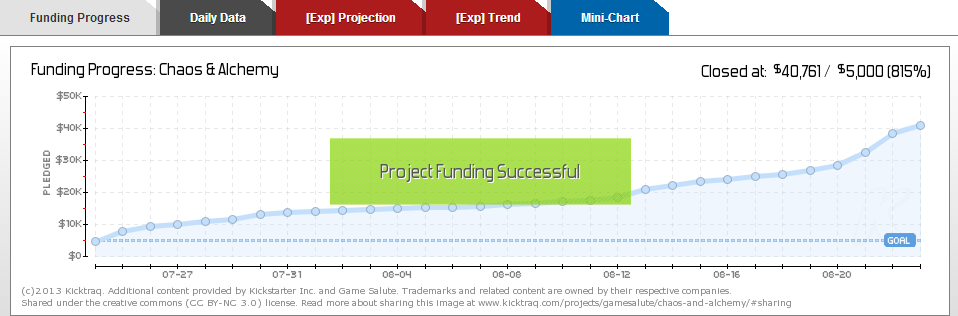
Game Salute (my publisher, who was running the campaign) was looking for $5,000 in order to publish Chaos & Alchemy. We ended up with $40,761 and, even more exciting to me, 1,066 backers.

That’s an unqualified success in my book! How did we get there?

Pre-pre-campaign

It’s worth noting the history of Chaos & Alchemy. I did a small (125 copies) self-published print run with black and white illustrations in mid 2012, which I sold through by last October. I then started planning my own Kickstarter campaign to fund full color artwork and a full size print run.

Example cards from first edition - black and white illustrations

Example cards from first edition – black and white illustrations

In preparation for that campaign, I sent copies of Chaos & Alchemy to several game reviewers and set up some advertising (primarily a video preview by Tom Vasel of the Dice Tower). I also got manufacturing quotes, started lining up illustrators, etc.

Then, Game Salute stepped in to publish my game. I no longer needed to worry about manufacturing and hiring illustrators, but the review copies and advertising would still come in handy (although I had to tell those folks to delay their reviews and ads, since Game Salute needed more time).

Also, having a hundred or so copies of Chaos & Alchemy in the hands of gamers who had bought the original print run definitely helped. I already had ratings on BoardGameGeek and some honest-to-goodness fans of my game out there. Most Kickstarters don’t have this luxury, but I can tell you that it helped.

Pre-campaign

It took about eight months from the signing of my contract with Game Salute until the launch of the campaign. The most important things that happened during this time were the new graphic design and illustration. Dann May did a great job with the former, and Enggar Adirasa is doing a great job with the latter.

Examples of some of the new cards from the Game Salute edition

Examples of some of the new cards from the Game Salute edition

20 of the 43 cards were finalized before the Kickstarter campaign launched, which was hugely important. Being able to show backers what the game was going to look like, even if it wasn’t completely finished, mattered a ton.

Game Salute had some more review copies of Chaos & Alchemy printed and sent them to more reviewers in preparation for the campaign.

They also figured out the manufacturing cost and the plan for pricing the game. My original print run shipped with 26 dice, but that was going to be prohibitively expensive for Game Salute. We would either need to have an unacceptably high pledge level to get the game, or lower the cost somehow.

I campaigned hard for the latter, and we ended up going with a “pass the dice” approach. The game would come with 10 dice instead of 26, which is enough if players pass the experiment dice and free success marker around the table rather than giving each player their own. I think this was the right choice, as it made the pledge level to get Chaos & Alchemy $25 instead of $30 or more.

I also sought input on the campaign page from people whose opinions I value, including the BGG game designer forum and the Card and Board Game Designers Guild on Facebook. I highly recommend doing this for your Kickstarter campaign.

Campaign launch

For launch day, I had arranged to take a day off work. We launched around 10:00 AM Mountain time (I live in Colorado), and I spent most of the day spreading the word.

I went a little nuts with my excitement on Twitter; I recommend not overdoing it (but people will cut you some slack if you’re just overly excited).

I announced the campaign on my personal Facebook page as well as the Clay Crucible Games Facebook page.

I updated the Clay Crucible Games and Chaos & Alchemy web sites to include links to the Kickstarter.

I thanked the BGG and Facebook designers groups for their help with the campaign page, also mentioning that it was now live.

I sent emails to people who would be interested in the game. I went with personalized emails for most of these, though I had a copy-and-paste email for the people who had signed my sheet at Denver Comic Con to be notified of the Kickstarter.

I kept checking the Kickstarter page itself, keeping a close eye on the comments so that I could answer questions. Same goes for BoardGameGeek; I made sure to chime in on threads where people were discussing my game, especially where there were questions I could answer.

I stayed in close contact with Game Salute about the questions that I couldn’t answer – namely, anything to do with money.

And I stayed up late to watch the campaign hit its funding goal on the first day. Huzzah!

Ongoing campaign management

As the campaign rolled along, I spent a lot of energy talking to Game Salute about stretch goals. We had some goals in mind, but I don’t think Game Salute was expecting to need them quite so soon!

The initial stretch goal plan was not well received by backers. Basically, we started adding extra dice to the game every few thousand dollars. This went over like a lead balloon.

Plans were revamped. $15K became the level to get a cool cube to mark the Free Success. $20k would come with upgraded art for the success / failure tracker card. $25k would get upgraded card stock.

Success Cube

The big one, though, ended up coming at $18k: the Enhanced Edition. See, I had designed the Substances expansion last year, and it’s a lot of fun. I know that fans will love it, and the only question was at what level it would become economical to make it available.

Ultimately, with the campaign mired in the mid-campaign slump, Game Salute decided to pull the trigger and unleash the expansion. This was important not just because it made more content available, but also because it gave fans a way to pledge more than $25 if they wanted to support Chaos & Alchemy (the Enhanced Edition cost $39).

This is a important point: it’s really useful to have ways for fans to pledge at higher levels if they want to do so. Game Salute is very opposed to add-ons (custom dice bags, premium game box, play mats, sleeves, etc.), which is one common way of creating premium pledge levels. The Enhanced Edition gave us this option without adding too much administrative complexity.

Gen Con

One nice feature of the timing of this campaign was that it was running during Gen Con. Game Salute had scheduled six Chaos & Alchemy events, which all sold out pretty quickly even though the Kickstarter campaign came way later than the Gen Con event sign-up period. I asked my players at the GenCon events what led them to sign up to play this particular game, and it was largely because it was something new and it sounded interesting based on the name and description. A few even mentioned the good ratings on Board Game Geek!

Ultimately, though, Gen Con didn’t make a huge difference to the campaign because no one was demoing it in a booth. My Gen Con was really about pitching my new games to publishers, not about Chaos & Alchemy.

Final days

The Chaos & Alchemy campaign ended the Friday morning after Gen Con. This meant that the reminder emails for people who were interested in the campaign but not ready to back yet would go out Wednesday morning after Gen Con.

Most Kickstarter campaigns get a significant boost in the last few days, of course. This is partly because of that reminder email – people who glanced at the campaign a few weeks ago will take another look, see the stretch goals that have been reached, and decide to get on board. I think the boost is also in part because of human nature – many of us are procrastinators!

Looking at other gaming projects, I was trying to guess how much of a boost we might get in that final stretch. I was estimating that 20% of our funding could come in the last 2-3 days.

As it turns out, the final boost was much bigger – we got about 30% of our funding in the last three days.

Kicktraq chart. Note the huge increase in the last three days.

Kicktraq chart. Note the huge increase in the last three days.

I think a big part of the late-campaign success was the $35K stretch goal that was announced near the end of the campaign: custom dice.

Blue Starry Dice

This at last was a stretch goal that people were really excited about, and I’m so glad we got them!

Done!

In the end, the Kickstarter campaign for Chaos & Alchemy was tremendously successful. We hit 800% of our funding goal and managed to unlock the expansions and the custom dice. My personal work is mostly done; I just need to finalize the design of the new Apprentices mini-expansion (let me know if you’re interested in playtesting!). I’m really looking forward to seeing the finished products in my hands – and in stores – next year.

Thank you so much to everyone who supported me!

Michael Iachini

Clay Crucible Games (@ClayCrucible on Twitter)