Living Forgotten Realms – third time’s a charm

Last night I returned to Enchanted Grounds (my friendly local game store) for a third session of Living Forgotten Realms (LFR).  This was the first session I’ve played with my half-elf Paladin, Rhogar, at second level.  Before heading off to the store to play, I leveled Rhogar up in the Character Builder.  Going to second level meant that I got to choose a utility power and a feat.  For my feat I took Versatile Expertise – Heavy Blades (he wields a longsword) and Holy Symbols (since he could use one of those, potentially).  In the process I discovered a bug in the Character Builder.  Apparently if you are a half-elf, your dilettante power (in my case a Cleric power) doesn’t appropriately include the holy symbol, whether for expertise or for a magic holy symbol.  I tried equipping it in every available place, and it made no difference.  Oh well, so I have to manually modify one power card.  I’ll live.

The adventure last night was actually kind of dull.  The party makeup was two dwarven Clerics, two Fighters and my Paladin (who has a healing bent).  So no strikers and no controllers.  Hm.  Fortunately the Fighters were built for dishing out damage.

Our party was hired by an innkeeper (I’m noticing a pattern here…) to escort him to the home of a minor noble to return a ring that had been found in a fish that the innkeeper had served to a customer.  We ran into a cart driver being ambushed by a gang of halflings, an elf and a gnome, so we helped the driver out.  It was a little annoying to try to chase down so many halfling minions without a controller – some of them got away with the cart driver’s goods, so we didn’t get a real reward from him.

The minor noble was happy to get his ring and told us that it had belonged to his parents who had died in a shipwreck.  Their bodies had washed ashore but the ring hadn’t.  He wanted to speak with his parents’ ghosts, but he needed some wood from the wrecked ship.  Off to the wharves we went to hire a boat to take us out to the wreck.  Getting the wood was easy, and we returned to the noble to escort him to the graveyard for the ritual.

On the way to the graveyard our party was attacked – and I never did get the story reason for the attack, frankly.  The battle was interesting in that it involved a tiefling spellcaster who teleported all over the place, two dwarves in heavy armor, a human brute of some sort and a bunch of elven archers on the surrounding roofs.  My Paladin spent pretty much the whole battle trading shots at one of the dwarves, who apparently had an armor class of 25!  Man, was he hard to hit.  We eventually killed off the rest of the bad guys, and it was assumed that we would eventually finish off the dwarf.

With that, the noble performed his ritual and we were done.  I’m not quite sure why, but I just found this session to be pretty unsatisfying.  My character did get to do some interesting things in combat, and a little bit of role playing too, but it just didn’t “pop” for me.  The DM was only so-so.  Maybe the fact that we had only defenders and leaders in the party was a drag.  Maybe I just wasn’t in top D&D form.

I did get a better understanding of some of the LFR rules.  First, I learned that gold that people give you along the way (“The noble offers you 30 gp if you will escort him to the graveyard…”) is irrelevant.  At the end of the session you get 100 gp, period. (I assume this would be higher for higher-level adventures, of course.)  If you decide to take one of the magic items that were found during the session, fine, but you can only accumulate one per level (I currently have my two already).  If you don’t take a magic item, you can have an extra 75 gp.  Also, you can only use magic items of up to your level +4, so the two seventh-level items Rhogar has must stay in his backpack until he gets to level 3.

This does bring up a question: Since Rhogar has over 360 gp now, he could buy a first-level magic item, such as +1 Magic Plate Mail Armor.  Alternatively, if he waits a session he’ll have enough money to buy a second-level magic item.  I’m leaning toward waiting – what do you think?  Should I keep saving up indefinitely and finally splurge on a high-level item someday?

Chaos Scar campaign begins

At long last, my in-person D&D group has begun its second campaign.  Last time Nate served as our DM and we began with an adventure from the Dungeon Delve book that Nate adapted to his own setting and that went into home brew territory fairly quickly.  We ended up stopping that campaign after a few months when my wizard died and the rest of the party wasn’t feeling all that enthusiastic about their characters (except for Bree, who was fine with her character but was itching to try her hand as dungeon master).

With that campaign three weeks behind us, we entered the world of the Chaos Scar, which I believe is an adventure from Dungeon magazine.  The Chaos Scar is an area where a meteor had fallen and shards of the meteor were sending out evil energy that corrupted the land and creatures around them.  Bree was great about asking us to think about how our characters might fit into this world, how they got involved with the Chaos Scar, and how they’re connected to one another.  I love that.  Even better, when we got to the table she presented us each with an honest-to-goodness hand-made map on vellum paper!

Chaos Scar Map

How cool is that?  It’s probably worth mentioning here that Bree is studying to be a professional artist.  She knows what she’s doing.

Anyway, our party trekked into a cave in the Scar to try to wipe out a cult of Torog.  The first battle involved us fighting some constructs who could use ranged at-will attacks to daze us – ouch!  We took some licks but prevailed.  The second battle involved a rope bridge across a chasm with archers on the far side and some semi-sentient mushrooms below.  The two dextrous characters (my Avenger and Kyle’s Monk) crossed the bridge while the less-dextrous characters (Barbara’s Runepriest and Nate’s Fighter) crossed the chasm below.  We prevailed there, too, but I took a lot of damage and used up all of my surges.  The final encounter of the day saw us fighting the cultists and their leader in their little temple, during which time I mainly stayed out of the way and shot my ranged at-will attack that gave me temporary hit points.  Even with that, the cult leader hit me with a ranged attack that erased my temps and dropped me from 18 to 8 (remember, no surges).  Yikes.  We finished that battle and searched the cult leader’s chamber and ended the session.  We thought we were about to take an extended rest, but Bree informed us that the mushrooms were arising now that the cult leader was dead.  This could get ugly for my Avenger!

I don’t have a lot of DM lessons to share today, except to say that Bree is clearly going to be a lot of fun as a DM!  I did take away some player lessons, though I haven’t figured them all out just yet.  At the very least, I’m certain that having my Avenger just rush headlong into melee is not the way to go, despite the fact that he really wants to fight in melee in order to use his Oath of Enmity.  I have to let the tank characters get there first, I think, which is tough when I’m so mobile.  I’ll probably lower my Dexterity a little in order to pick up more Constitution.  That will lead to slightly lower armor class but higher hit points, more surges, and a greater surge value.  Good tradeoff?  I’d like to hear your opinions and suggestions in the comments about making a more effective Avenger.

Free RPG Day 2010

Since yesterday was Free RPG Day, I decided to head down to my friendly local game store to participate in the festivities.  Specifically, I knew from their Facebook feed and their podcast (yes, I listen to my local store’s podcast!) that they were running a free Dark Sun adventure.  Since I’m never able to play in D&D Encounters thanks to my Wednesday night bowling league, I thought this would be a good chance for me to experience Dark Sun.

I went to the store a little before the 9:00 AM start time for the game, and had no trouble getting a seat at the table.  We soon had the full six players, and a seventh showed up about 10 minutes after the hour, which the DM accommodated by handing her one of the player cards from Encounters.  She played a second healer, which turned out to be much needed!

My character was a goliath fighter, a former gladiator in the city of Tyr who was fleeing the chaos in the city along with his adopted cousin and a friend, both clandestine arcane spellcasters (apparently arcane magic is taboo in much of the Dark Sun setting).  We joined up with the other PCs, who were on a quest to get water for their people living in the mountains.  We all signed on with a elven caravan going from Tyr to Alderak, hired to protect the elves and their cargo.

The first part of the adventure was a loose skill challenge or two about surviving the desert and badlands, which we had no trouble with.  We were then set upon by raiders in a canyon for our first battle.  I enjoyed role-playing my fighter throughout – he had 10 Intelligence and 8 Wisdom, so he wasn’t too bright and he was quite gullible, very willing to go along with whatever his allies wanted to do.  He liked to smash bad guys with his sword and defend his buddies when they were in trouble.  It’s all mechanics, but you can totally role-play these things, which I loved doing.

The battle with the raiders was most interesting for me because of the guy sitting next to me, who had never played an RPG before but who had apparently read up on things a little bit before coming into the store.  His character was a wizard, and he found himself surrounded by minions before he could act, so he was thrown right into the fire of having to learn about opportunity attacks.  Every single power that his character had was either ranged or area, which means that if he cast them while standing next to a bad guy, the baddie would get an opportunity attack on him.  I believe he took Second Wind in the first round, then was able to shift away and start blasting in the second round after the rest of the group had pushed some of the minions away from him.  It was fun to see him learning what he could do, including trying to climb a cliff to get out of harm’s way (with 8 Strength, that didn’t go as well as he would have liked).

I did get a DM lesson out of this battle.  The DM generally did a great job all day, with lots of role-playing of the bad guys and description of the effects of attacks and so on.  However, he made one decision that I would have changed.  The minions in this particular battle only took one hit to kill, as with typical minions, but they would then keep fighting until the end of their next turns, at which point they would drop.  I have no problem with the mechanic, and the adventure writers tried to give some flavor for it.  Where I would have done things differently, though, is on critical hits.  Crits on these minions were treated just like any one-damage attack, and the minion still got its next round of actions before dying.  I think it would have made the players feel more awesome if a critical hit would kill one of those minions outright, rather than letting it fight on for another turn.  It’s a minor point, but it’s the type of thing that I would change on the fly to make the game more fun for the players.

After the canyon battle, the party arrived at Alderak and hung out in an elven marketplace while the guy who hired us went into a tent.  My guy, being rather dumb and oblivious, had no clue that anything was fishy, but some of the other PCs didn’t trust the elf who hired us and tried to follow him.  The DM basically said no – which was okay in this case, because the PCs in question happened to roll low on their Insight checks.

Sure enough, the party was soon ambushed by something like eight elven archers and four insects, all of whom acted in a surprise round while only one of our characters acted.  Then the bad guys went first in the first round of combat.  Before I had a chance to act (despite getting a 19 on initiative in this battle, after the 3 I rolled in the last one) I was on the ground making death saves, soon joined by another ally.  Our healer brought me back on her turn, at which point I was immediately dropped again.  The elf leader came back out of the tent, and he was soon killed by two of the other PCs, at which point the town guards showed up and sorted everything out.

This particular battle didn’t feel like it was very well designed.  Being able to take down two PCs (one of them twice) before they even have a chance to act seems far too harsh.  And then having the battle immediately end halfway through that round when the surviving PCs dropped the leader seemed anticlimactic.  I guess this was how this battle was intended to go, but two or three of our PCs didn’t even get to their spot in the initiative order before the battle ended.  It didn’t seem like much fun.

Anyway, the authorities established that we were in the right here, and so they arranged for our party to be paid what it was owed.  In addition, they let us face the elves in the arena games that were going on.  Here is where things got pretty cool.  Instead of a simple arena combat (which is what I think the written adventure called for), our DM modified things to make it an interesting game.  The two sides (the party and the wicked elves) started on opposite sides of the arena (east and west).  In the middle was a pile of seven huge ceramic coins – big enough that they required two hands to carry, but no check to pick them up or move them.  At the north end was a closed chest for our team, and at the south end was a closed chest for the elves.  The goal of the game was to have more coins in your chest than your opponents have in theirs when the battle ends at some unknown time in the future.

The real twist was that we were not allowed to deal any damage directly to one another – doing so would result in forfeit for the team that dealt the damage.  However, the arena was littered with lots of razor vine, which would deal 5 damage to any creature that began its turn in the vines.  Most of the elves were minions, so if we could push or pull them into the brambles, that would be fine within the rules and would kill them off.

The elves acted first and managed to get three coins into their chest right off the bat.  We had an ace in the hole, though – our wizard had Sleep prepared, which was awesome.  Our team grabbed some coins, shoved some minions into vines, etc.  The tide was about even, when suddenly three monster hounds of some sort were released into the arena and started attacking everyone.  Fortunately, we were allowed to fight back, but this would distract from the coin game.  Still, our team took the upper hand after taking a coin from the elves’ chest, putting it in ours (giving us four of the seven coins), closing the lid to out chest and then having a PC stand on top of the chest.

My fighter and our barbarian were keeping the hounds occupied, and the hounds had just dropped (but not totally killed) the barbarian when the elf leader saw the handwriting on the wall.  The evil elf knew that the game was lost, and since the DM said, “This is Dark Sun after all,” the elf decided to coup de grace our unconscious barbarian.  The authorities immediately declared our team the winners and said that we were free to fight to the death now (it’s worth noting that this was a one-shot game, and this was the final encounter).

I followed with what I thought was a winning move.  Surrounded by the two remaining hounds, both of which were bloodied, I Cleaved.  I critted on the attack roll, so I killed off one hound and dealt 5 damage to the other.  That wasn’t enough to kill the second hound, but since it was standing next to the elf leader and the hounds had a history of going after the closest person, I shifted away, figuring that the hound would kill the elf.  He almost did, but the DM decided that would be anticlimactic, so he had the hound come after me instead, which dropped me.  Then the elf coup de graced me as well.  Finally, our wizard killed the last hound and the elf with one spell.

Even though my character was killed off, I didn’t really mind.  It was the last battle, and I understood that it was appropriate for the Dark Sun setting.  I had a good time at the game and I think I picked up a couple of lessons.  I don’t think the Dark Sun setting is my particular cup of tea, but I know that lots of gamers out there love it, so good for them!

I do want to mention one final note about Free RPG Day.  The store was offering 20% off all RPG products, which I hadn’t realized until the afternoon when I was listening to the store’s podcast as I mowed the lawn.  They mentioned that the store was open from 7:00 AM until midnight on Free RPG Day, so I figured I’d stop on by in the evening to pick up Divine Power and Monster Manual 3, two books I’ve had my eye on.  I went to the store a little after 9:00 PM and saw that they didn’t have MM3 on the shelf, but they did have Divine Power.  I went to the register to buy my books, asking about MM3 and hoping to get a rain check (no luck).  When the cashier rang up Divine Power, it came up to full price plus tax.  I asked about the 20% discount for Free RPG Day that they had advertised, and she told me, “That ended at seven o’clock.”

Um, what?  The store’s web site and podcast clearly talked about Free RPG Day lasting until midnight.  I put the book back and left.  I’ve emailed the store owner, whom I know very well from having purchased lots of D&D and Magic stuff in the past, and I’m expecting that he’ll honor the discount.  Assuming he does (and I’ll post the resolution here, of course), I’ll trumpet this as the clear reason that you should support your friendly local game store – they’re not a faceless corporation, and they’ll make things right when problems come up.  If for some reason he fails to correct this, though, my faith in local stores will be shaken.  I really want to support them, but this is the sort of thing that will send me to Amazon with a clean conscience.  Here’s hoping the FLGS comes through!

Edit: I’m happy to say that the owner of the store got back to me promptly and said that this was indeed just a miscommunication with the employee, and that the discounts were supposed to be in place all day.  Even better, they DO have MM3 in stock and have set both it and Divine Power aside for me to come and get at 20% off.  The friendly local game store comes through with flying colors!

First MapTool session

The D&D drought is over!  Last night, after Barbara and I returned home from our business trip to the east coast, we got together with Lane and Zach (our friends in Florida) to continue our adventures in the Keep on the Shadowfell.  This time, we did it with MapTool.  It was, quite simply, a success.

I’ve already written about how much I love MapTool, and my players seemed to really enjoy it as well.  They liked the attack macros (even Barbara, who loves rolling physical dice, even used the attack macros from time to time), they liked being able to keep track of their hit points within their MapTool character sheets, and they LOVED the way MapTool shows the path that their character is taking and the number of squares they’re moving as they drag their token along the map.  One quick tip for playing D&D Fourth Edition in MapTool: Make sure all of the players go to Edit – Preferences and set the Movement Metric to “ONE-ONE-ONE.”  If they don’t do this, MapTool will calculate diagonal movement incorrectly for them.

We played for about two and a half hours, yet only went through one encounter.  This was partly because we spent the first 30 minutes catching up with one another from our recent trips and partly because we had to make sure everyone knew how to use MapTool.  The encounter was the battle with the giant rats and the ochre jelly in the caves beneath the Keep.  I wasn’t quite sure how many giant rats I wanted in the battle – the original adventure calls for 13 rats, but against a party of five characters rather than the three that we have.  I decided I’d start with six rats and add as needed to keep things interesting.  I think this was exactly the right approach, and I ended up with 11 rats in the end.  The rats ended up not being all that interesting; they generally missed with their bite attacks, and they had a lot of trouble isolating one character away from the others.  I realized that this battle didn’t have any enemies with either ranged attacks or area/burst/blast attacks.  Every single monster only had the ability to attack a single character at melee each round.  This made them not especially challenging, although the moment that the jelly split in two when it became bloodied was pretty cool.

The battle was an easy win for the party, and Kana (Lane’s druid) did catch a glimpse of a pillar of white light off to the south, which disappeared before too long.  Hmm, what could that be?  (This is one of the ideas that I want to discuss on the blog, but it looks like we’ll have to wait and see).  When the battle was over, the party decided to take an extended rest, as they were getting low on surges.  Not bad for having battled through all of the goblin areas of the Keep, plus the rat/jelly cave.  Rather than heading back to Winterhaven or just staying in the rat cave, they decided to close themselves into the bedchamber of Balgron the Fat, with Zach’s Eladrin rogue trancing and keeping watch.

Since this decision has already been made, I can talk a little bit about the consequences that the party will face when they resume play on Monday evening.  See, they’ve left the goblin area of the Keep strewn with dead goblins everywhere.  Now, no other monsters have traipsed through this area while the party was exploring, but that doesn’t mean that no one will be passing through any time in the next six to eight hours.  It’s quite possible that other inhabitants of the Keep may pass through the area, discover all of the dead goblins, deduce that there must be enemies about and get reinforcements.  I haven’t challenged the PCs yet.  But this time, with the bad guys knowing what’s coming, it might be different!

Now, while the use of MapTool for the session was great, and I don’t plan to switch to anything else, I did learn a few lessons that I plan to implement before our next session.

  • I need a button for each character to be able to roll their own initiative.  While my macro that rolls initiative for everybody is cool and all, the players like to roll it themselves.
  • I need buttons for each character’s skill checks.  I think I’m going to implement this by adding skills to the character’s properties, but I’ll just have the number next to the skill be the number that gets added for training or any special skill bonuses (racial, item, etc.).  I’ll have the macro look up the appropriate ability modifier and half-level modifier from the character sheet so that I don’t have to touch the macros as characters level up.
  • I should allow the characters permission to edit the macros on their own character token.  I’ll trust them not to mess with the macros, but I want them to be able to look inside and see what’s going on if they’re interested (Zach is – he’s a programmer).
  • I need to figure out how I want to handle the bad guys’ tokens.  Right now, they use the same properties as the players’ tokens.  That’s not ideal, since it means that if I actually put numbers in for armor class, hit points, etc., the players would be able to see them.  I think I’ll create a separate set of properties for NPCs and make them invisible to players.
  • Similarly, I’d like to figure out how to hide the NPC macros from the players.  Strict Token Ownership might accomplish this, but I’m not sure yet.

All in all, it was a fun way to play D&D, and the players are psyched about playing again Monday evening.  Meanwhile, I played a Free RPG Day session this morning at my Friendly Local Game Store, and I’m playing the first session of the new campaign with my regular in-person group tomorrow.  The D&D drought is officially done!

Living Forgotten Realms – Second attempt

Barbara and I were planning on dropping by our friendly local game store tonight to play some Living Forgotten Realms (LFR).  Since I wasn’t that crazy about the Paladin that I played at LFR a week ago, and since Barbara and I have already rolled up the characters that we’re going to be using in the new campaign we’re starting soon with Kyle, Nate and Bree, we planned to try out those new characters at LFR.  Unfortunately, Barbara wasn’t feeling well, so I went on my own and decided to stick with Rhogar, my half-elf paladin from last week.

Similarly to last week, I didn’t officially have a seat reserved at the table, but I was at least on the waiting list.  One of the other players hadn’t shown up by the start time and the DM said he was fine to play with seven players instead of six in case the other player did show up – which he did, about 10 minutes late.  So, we had seven players.  The DM, Doug, said that this module didn’t take long to run, so having the extra player wouldn’t slow us down significantly.

Last week’s session started with a combat encounter, then a lot of roleplaying, then a combat encounter.  This time was all roleplaying for a long stretch, then a random little combat encounter that took no time, then more roleplaying, then basically two back to back combat encounters to finish things off.  The party was hired to recover a sextant that had been stolen from the house of a noble family, along with some other conventionally valuable items.  The sextant was a family heirloom, which they believed would lead to their ruin if it were not returned.  Thus, we went off on a long series of roleplaying encounters to try to track down the thieves.

We went to taverns in sketchy parts of town, making lots of Streetwise, Diplomacy, Bluff and Intimidate checks.  Since my character is a heavily-armored good Paladin, he was a little out of place.  Thus, I hung back and didn’t say much.  The random battle with some drunk dockworkers was a bit of a waste of time, as it had nothing to do with the main plot.  We ended up having a battle with the were-rat thief who stole the goods, along with his bandit associates.  This battle was in the basement of a boot shop, and it led to some interesting movement and use of powers.  The thief told us how to find the gnome merchant to whom he had sold the sextant.

We went to the inn where this gnome was staying, hurrying there before he left town.  Here is where things got a little tense around the table.  Three of the seven players had played this module before, so when it came time to make decisions about what to do, they tried to stay out of it and let the other four of us decide.  I thought that sending four people upstairs and three people around to the alley below the gnome’s window was the way to go – that way, we could keep him from getting away.  This was voted down in favor of having six of us wait downstairs in the inn while one person (our pacifist dwarven Cleric) went to the alley to try to disable the gnome’s wagon.  Well, the gnome’s allies spotted the dwarf at work and fired at him from the window, thus starting combat with all of us downstairs and unable to do anything for the first turn except start to move upstairs while the gnome and his buddies took target practice on our Cleric.  It worked out okay in the end, and the battle of the inn room was an exciting one, but I think that my lesson is that I need to be more assertive around the table, even though I’m still a new player.

Doug wasn’t as engaging a DM as Aarrun from last week was, but he still ran a good game.  The lessons I’d take from playing with Doug are:

  • Feel free to make minor modifications to increase the fun of a battle (such as changing the pointless dockworkers from one-hit minions to two-hit minions)
  • Try hard to make sure all of the players have a chance to be heard (I didn’t feel heard tonight, and I don’t want my players to feel that way)
  • If the battle is well in hand, feel free to call it and wrap it up, even if there are still some baddies to mop up.

Barbara and I are going to be traveling for the next week, so it’s unlikely that I’ll be able to blog for a while. That’s a shame, because I’ve learned some really cool MapTool tips that I’m anxious to share, but I haven’t had the prep time to do so yet.  Soon, though!

Living Forgotten Realms – my first time

While I mainly use this blog to talk about my efforts at serving as a Dungeon Master for my own online games of D&D, I do like to play D&D, too.  At the moment I am between campaigns in real life.  I don’t mean that I have no prospects for my next campaign – the next one will start in a couple of weeks with my same play group, just with a different person taking a turn as DM (as I discussed in my post about the death of my wizard character, Zod).  The online game that I DM is also on hiatus as two of the three players are currently on vacation.  This has given me lots of time to learn about MapTool, for instance, which is great – but I miss playing D&D.

Fortunately for me, I live within walking distance of a fantastic local game store called Enchanted Grounds.  This is a game store / coffeehouse.  I mainly go for the games – formerly a lot of Magic: The Gathering and German-style board games like Pandemic and Settlers of Catan, and more recently of course for Dungeons and Dragons books and dice.  In addition to selling D&D stuff, Enchanted Grounds also runs organized D&D events.  They’ve been running D&D Encounters on Wednesday nights, which I’d love to check out but which unfortunately conflicts with the bowling league that Barbara and I are in (yes, we both play D&D and bowl).  They also have Living Forgotten Realms, or LFR, which I only vaguely understood.  I knew it was a D&D Fourth Edition game, but it’s set in a campaign world that I know nothing about.  Also, I wasn’t sure about the rules for creating a character, getting into a game, etc.  When I finished work Thursday evening, I had a hankering to play some D&D, so I printed out the character sheet for one of the three potential characters I had rolled up for the campaign that we’ll be starting with our friends in a couple of weeks (a character that I was pretty sure I was not going to play in that campaign) and headed off to the store.

I had checked the store’s web site and their LFR Yahoo Group before leaving, and I knew that players had to basically reserve their spots in the game in advance.  There were going to be two tables of players – one in an adventure for level 4-7 characters and one for level 1-4 characters.  I introduced myself to Rich, the man who coordinates the LFR games at Enchanted Grounds, and said that I had never played LFR before and would be watching and learning this evening.  However, when game time rolled around, one of the six seats at the low-level game table was empty because one of the scheduled players hadn’t shown up.  Lucky me – I would get to play!

I introduced myself and my character (Rohgar, the half-elf Paladin) to the group, and we were on our way.  The group had five first-level characters and one second-level.  We were a technically balanced party, though a little heavy on healing.  My Paladin was the only defender, and he was a healing-focused guy.  We also had two Clerics, one of which was a mega-healing pacifist.  We had a controller – a Psion, which I hadn’t seen in action before – and two strikers (a Ranger and an Avenger).

The adventure began with the local king charging our group with the task of investigating some evil activities in the area around the city, and we soon encountered an old man with a broken cart by the side of the road.  As we approached to help him, some shadow creatures came out of the trees and attacked us.  We beat them up without much trouble, fixed the man’s cart, then headed off in pursuit of a black-clad knight we had seen on a nearby ridge during the battle.

From here, the night turned into a long stretch of role playing, which was kind of fun (though mixing in a combat encounter along the way might have been more fun).  We were on horses and had to follow the knight’s trail down a steep slope, which was problematic for me as I was terrible at Athletics.  Most of us ended up breaking our horses’ legs in the descent (so sorry, Starshine!) and had to continue on foot.  We found the knight, who had a skull for a face, in a glade of white-painted trees, which a Religion check revealed were designed to ward off evil spirits.  We talked to the knight instead of attacking, and it turned out that he was a guy from town who had been falsely accused of treason, cursed by his father, and banished from the city.  The skull face was just a mask he used to hide his identity from the townsfolk who hated him (smart choice, going with a skull face).  We wanted to help him clear his name, so we took him back to town with us.

We arrived to find a big, torch-wielding mob freaking out about the evil activities and the approaching (unscheduled) lunar eclipse.  Our knight friend skedaddled.  We dispersed the crowd, repaired a holy obelisk, talked to the knight’s father (who definitely seemed fishy to us), tracked town the town official who had banished the knight (he was incompetent), tracked down some reports about the evil activities that the town official had hidden (they would help to clear the knight’s name) and finally ended up at a temple to an evil goddess.  The cult leader, naturally, was the knight’s father.  We dispersed the cultists and engaged the leader, who was about to sacrifice his baby son on the altar.  Our strikers teamed up on the cult leader while the rest of us handled the shadow creatures that were trying to get into the temple.  Again, it was a fairly easy combat.  We saved the baby, got a new hearing for the knight (I’m sure he’ll win) and were awarded the king’s favor.

My verdict on Living Forgotten Realms as a player is that it’s definitely a way to get that D&D fix when I can’t get it any other way.  I believe this store runs games three times a week, so there are plenty of opportunities to play if I so desire.  I was surprised at the low level of challenge in the battles, but the role playing was quite fun.  Our pacifist Cleric basically stood up and gave a fire-and-brimstone speech to the mob in the city, which had the odd effect of convincing the townsfolk to try to incinerate their lamps, but it was way cool.  My Paladin was supposed to be quite diplomatic, but I sort of stunk when it came to actually talking rather than rolling dice.  I’ll work on it, though.  I definitely prefer the home games with friends, but LFR is something I could see myself playing from time to time.

The magic item system for LFR is a little confusing.  During the adventure we came across a few different magic items, and we had to divvy them up for use during the adventure.  However, at the END of the adventure we could each take one magic item, and multiple players could pick the same thing.  To make matters more complicated, you can only USE a magic item up to four levels higher than your character (so, as a first-level character I could use up to a fifth-level magic item), but you can HAVE any level magic item.  Also, if it’s an enchanted weapon of a particular type, you can transfer the enchantment to any weapon you want.  In my Paladin’s case, I took a seventh-level magical dagger and transferred its enchantment to my longsword, but I can’t actually use that enchantment until I move up to level three.  Confusing, I know.

I could see myself playing LFR again in the future – hopefully with Barbara joining me – but I’m pretty sure I don’t want to play my Paladin again.  He did exactly what he was supposed to do – bring the enemies to himself, absorb damage, dish out healing, punish the enemies he calls out when they attack his allies – but it just wasn’t that much fun.  I really didn’t move around at all in either battle – I stood there and traded blows with bad guys.  It worked for the party, but it was kind of dull.  I know I’m going to play an Avenger in my main campaign with my friends, so I might try LFR again with a Warlord that I’ve rolled up.  We shall see.

How about DM lessons?  Aarrun, the DM for the game Thursday night, was a great DM in my opinion, and I feel like I could learn a lot from him.

  • He knew the rules forward and backward.  For instance, he knew what my Paladin’s powers could do much better than I did.
  • He kept the game moving, letting the table know whose turn it was and who would be up next.
  • He got into the role playing in a good way.  He had a favorite NPC – a batty old lady who ran a book and bird shop – who really came alive with Aarrun’s acting.
  • He let the players try whatever they wanted, even if it was stupid.  Hilarity often ensued.

I have a long way to go before I can be a DM on par with Aarrun, but I feel like I can get there one day.

Old-school Dungeons and Dragons

Barbara and I are on a trip to the northeast from our home in Colorado.  We spent five nights in Boston, where we found time to get together twice on OpenRPG to play in our main online D&D session with Lane and Zach.  On the sixth day, we drove to Albany to meet our friend Sara and her family.  Sara just had a baby (her second) via C-section on Monday of this week, but three days later she was home and ready for her weekly D&D game with her husband Scott and their friends.  Since she knew Barbara and I liked D&D, she invited us to join them for the evening.

The game was first edition D&D, which we’ve never played before.  I found a document online called OSRIC, which seems to be an attempt to build an open, freely available rules system that more or less mirrors D&D first edition.  I glanced at OSRIC a little bit, but didn’t spend much time on it.  When we arrived at Sara’s place (and the baby is adorable, by the way!) and got ready to start playing, I chatted for a few minutes with Shawn, the DM.  He explained that, since all we have really played so far is Fourth Edition, we haven’t really played Dungeons and Dragons – we’ve just played a miniatures game.  He’s definitely an edition purist, and not at all a fan of Magic: the Gathering (a game I played for years, though I’ve pretty much replaced it with D&D now), which he sees as being related to Fourth Edition.  Fair enough – I’m always up for learning something new!

Barbara and I would be playing the characters of Ert and Bernie, who are hired henchmen of the main party.  We were brothers, a half-orc and a half-elf (apparently our mom got around).  We were only paid to carry stuff, and would defend ourselves if need be, but weren’t looking to get into the fray.  The game session lasted about four hours, of which we spent about three hours goofing around and joking with the group.  It was fun, and we fit right in.

The gaming itself, I have to say, was not meaningfully different from what we’re used to in Fourth Edition.  Sure, we didn’t use minis to show where our characters were standing on a map, but that didn’t feel like a big deal.  We only got into combat a couple of times, and the flow of combat was more or less what I was expecting.  Now, the specific numbers are wildly different from Fourth Edition.  Our wizard had four hit points, and our barbarian had a massive 16.  Armor classes are the opposite of what we’re used to (lower ACs make you harder to hit), and when you roll to hit a bad guy, the DM has to look up a table to see, based on your class, whether your attack hits or not.  There were some occasions where I felt like some of the things that exist in Fourth Edition would have helped, such as a nature or history check here or there, but those are minor quibbles.  The battles were a little underwhelming – usually just one or two bad guys, with nothing more exciting than swinging a sword or shooting a crossbow bolt going on – but I’m guessing that’s just because those were the encounters that happened to come up this time around.  The role playing was the same, and just as fun.

My guess is that old-school players don’t like Fourth Edition largely because it’s entirely possible to play Fourth Edition without any role playing.  You could play it as just a game where you move tokens around a board and play cards that make something happen (your powers).  You don’t HAVE to play it this way, though, and we don’t – we emphasize role playing, creative thinking, etc.  It’s way more fun that way.

Another complaint of Shawn’s is that all of the Fourth Edition classes are equivalent to one another in a lot of ways.  The impact of a first-level at-will power is going to be pretty similar across various classes, as will a third-level encounter power, etc.  He feels that the only differences are in the flavor text (one is a wizard casting a spell that causes a missile of force to hit an enemy while another is a rogue throwing a rock at an enemy using a sling, and so on).  First of all, I disagree somewhat here – there are actual mechanical differences, especially in daily and utility powers, but I do agree that the game is built to be balanced so that you don’t have one class’s abilities totally outshining another’s.  I actually like the balance, though – if you want to be a wizard, great!  You have useful things to do at all times.  Cleric?  No problem!  Whatever you want to be, you’ll be able to do something interesting.

I’ve heard of earlier editions as having the “linear warriors, quadratic wizards” phenomenon, where wizards are pathetically weak at low levels and crazy powerful at high levels, while warriors are pretty good at any level.  I think Fourth Edition gets away from that, and this is a good thing in my opinion.

So, D&D is D&D as far as I can see.  You role play, you fight stuff, you have fun.  The details differ, but the underlying game is the same.

Hotel room Dungeons and Dragons part 2

I’m hoping to get up two posts today, as I’ve had two different sessions of D&D in the last two days.  I’ll start with Wednesday evening, when Barbara and I in our hotel room in Boston got online with Lane and Zach from their home in Florida to continue our adventures in the Keep on the Shadowfell.  In our first session in the Keep this past Sunday, we had to improvise in a hurry as we learned that we wouldn’t be able to use Gametable due to networking issues in the hotel, and I switched things over to OpenRPG in a rush.  This time, I was prepared – I had already converted the maps over to OpenRPG and was ready to go (the OpenRPG map of the first level of the Keep is available here or on the downloads page – but my players shouldn’t go poking through it just yet!).  We called each other on Skype, connected to the appropriate room on an OpenRPG server, and we were gaming!

We started with some back story.  When we first began playing together, it was a big rush and no one had any ideas on back story for their characters, why they were adventuring together, etc.  I had thought about this over the past few days and filled in the party (since they were willing to hear my thoughts).  All of the characters are female, so I explained that they had all been approached when they were younger girls (the human equivalent of 10-12 years old) by a Deva named Juni Lamplighter (or one of her allies) to come to the Academy of Adventure.  Juni, being a Deva, remembered times when the world was not so dark and chaotic and wanted to bring some light and order to the world, so she decided to set up a place where individuals with talent, primarily girls who felt like outcasts, could train to become adventurers and work to do good in the world.  The PCs were all pupils at the Academy, and Juni had sent them to Winterhaven after they finished the main body of their training as a way to get started in making a difference.  Yes, it’s a bit Hogwarts-esque, but that’s not a problem.  The players seemed fine with this, and it provides both a reason for adventuring as well as some future plot hooks, so we’ll run with it.

At the end of the previous session, the party had just cleared out the goblin torture chamber and decided to rescue Splug, a goblin prisoner who had been put in a cell for cheating (or as he called it, “being good at playing cards against”) the other goblins.  He offered to serve as a porter for the party and tell them what he knows of the Keep if they would free him.  They let him out, and he told them about the excavation where goblins were digging for some unspecified treasure (but hadn’t found anything), the stairs that lead down to some caves, the main door and the secret door to the chamber of the goblin leader, and the door that led to the deeper part of the Keep, where Splug had never been.

Balgron the Fat

Balgron the Fat

The PCs decided to use the secret door to sneak into the sleeping quarters of the goblin boss, Balgron the Fat, to surprise him while he was asleep.  Zach’s rogue rolled great on her Stealth checks to get into the bedchamber, and they decided to try to tie up Balgron while he slept in order to interrogate him about the rest of the Keep.  This was awesome – the players were thinking outside the box!  They had rope in their packs, so I ruled that this would require a Dexterity check (figuring that Balgron would probably wake up while being tied).  Well, the dexterity roll was crazy high, so I ruled that they succeeded in tying up Balgron, but he woke up as they finished.  Balgron was confused for a moment, but as soon as they started asking him questions, he yelled for his guards and we rolled initiative.

There was only one other goblin in the room with Balgron, and I had that guy poke his head into the curtained area that surrounded Balgron’s bed, see the situation, and run for the door to get the other troops.  The door was locked, so it took him a little time, during which time the PCs attacked him to try to stop him.  Lane’s character had been hanging back, keeping an eye on Splug, but when the battle began and Lane’s character ran into the fray, Splug skedaddled.  The party wasn’t able to stop the goblin guard before he opened the door and raised the alarm.  A bunch of other guards came running down the hall, and the party decided to try to close and re-lock the door rather than just fighting (creative!).

I ruled that Balgron had another copy of the key on him, and since the rogue had decided to sneak attack the crap out of him while he was tied up (not very nice, but brutally effective), Balgron decided to cooperate to save his own hide.  He told the PCs where the key was, and they locked the door.  Naturally, the goblins began trying to bash it down, and wouldn’t you know it, one of the little minions got a critical hit in throwing himself at the door, so I ruled that it broke off its hinges and was now open again.

Balgron was willing to answer some questions now, and also willing to tell his guards to go away, which they did.  The party started asking him about the Keep, who hired him (Kalarel), what he was doing there, etc., and he answered more or less honestly.  Then the party opened up his treasure chest and he started bargaining for his life.  The chest had some gold, an enchanted short sword (which Zach’s rogue coveted) and some potions of healing (which the party had none of, and I figured they could use them).  Balgron was willing to give up the potions in exchange for his life.  The rogue held out for the sword, and Balgron grew enraged, burst out of his ropes and called the guards back in.

The ensuing battle was actually not all that interesting.  Balgron was already badly bloodied, and the fact that all of the goblins were coming down a narrow passageway made them easy fodder for Barbara’s swordmage’s enlarged dragon breath.  A few got into the bedroom and Balgron did his goblin shuffle once, but that was all she wrote. There was barely any damage to any of the PCs.  They rolled really well, and used smart, creative tactics.

Next up, the party knew about the excavation going on, but they weren’t interested in taking on those goblins – they wanted to go down into the caves.  They wanted the digging goblins to leave peacefully and debated whether to charge in and fight them, try to reason with them by telling them that their leader was dead and they were free, or something else.  They decided to leave Balgron’s severed head (yuck) where the goblins would be able to see it when they left the excavation chamber, and then head into the caves, figuring that the goblins would see the head as a sign to get out of there.

Well, I had the goblins roll Perception to see if they noticed the head while they were still working, and they did.  As the adventurers started heading down the stairs, the goblins quietly moved into position and started throwing Alchemist’s Fire.  The battle was on.

Guard Drake

Guard Drake

Two guard drakes charged up to the top of the stairs, and the PCs were basically hemmed in on a stairway.  They came perilously close to backing into the caves at the bottom of the stairs, at which point they very well may have been set upon by more enemies from the back, but they just barely stayed on the staircase and thus only had to face the goblin bombardiers and guard drakes.  This battle was tougher, and Barbara’s swordmage actually fell to zero hit points before being healed by Lane’s druid.  It was a close call, but once the drakes were dead, things turned in the party’s favor.  The last goblin bargained for his life, offering a dirt-covered object that he had dug up in exchange for being allowed to leave.  The party agreed (though not before the rogue observed that they could just kill the goblin and take the item), and the goblin was escorted out of the keep.  I’ve decided that he was named Steek.  The item turned out to be an enchanted totem with some healing powers, which is useful for Lane’s druid.

At this point, we called it a night.  I have to say that this adventure is beginning to feel like a success.  The players seem to be having a good time, and the technology is pretty much transparent (though I’m feeling like the OpenRPG dice roller tends to roll on the high side quite a lot; probably my imagination).  The players are definitely thinking creatively, and I feel like I’m doing pretty well at rolling with the creativity.  They’ve now gone through four encounters with no extended rest and only using one daily power.  I’m pretty sure I need to ramp up the challenge level a little bit (though we discovered that we had been playing Zach’s rogue a little bit wrong on Sunday, letting her get combat advantage too easily with the sling), but everyone seems to be having a good time, so I don’t want to go nuts.  Zach and Lane are going on a two-week vacation soon, so it might be a while before we get to play again, but our in-person game in Denver was just canceled for Sunday, so who knows?  Maybe we can play one more time then.  I’m up for it!

Improvisation is important

Barbara and I are now in Boston for a business trip of mine, so what do we do on our first day in town?  Play D&D online with our friends in Florida, of course!  Hey, we’re all on the same time zone now, so we might as well.

At 11:00 AM, we all met online to play.  I called Zach and Lane via Skype, which worked great.  My maps in Gametable were ready to go, so I loaded up a map and hit Host.  I checked my IP address and told it to Zach… and realized that we can’t use Gametable when the host doesn’t own the internet router that they’re connecting to.  As you may recall from my earlier article about connecting to your players via Gametable, I had to go into my router settings and forward internet traffic that came to my IP address to my computer in particular, rather than to Barbara’s computer or some other device on our network.  Since I didn’t own the hotel router that I was connecting to, I couldn’t go into its settings to forward internet traffic to my computer.  Zach and Lane could host on their computer, but that wouldn’t work since they’re not the DM.  I could send them the complete map with all of the monsters revealed and everything, but that’s a less fun experience for them.

So, I improvised.  Back in the earliest days of my blog, I thought we were going to be using OpenRPG rather than Gametable for running our online games.  Gametable is far easier to build maps in, but OpenRPG is easier on the networking side.  As long as everyone can connect to the same server, OpenRPG is good to go.  So, we could play via OpenRPG – but all of my maps were in Gametable.  What to do?

I started by asking Lane and Zach to give me 20 minutes to get everything set up.

  • I then opened up Gametable, set the view to show the first area of the Keep on the Shadowfell (the entry chamber guarded by goblins) and took a screenshot.
  • I pasted the screenshot into Photoshop Elements.
  • I trimmed the canvas so that the top left corner was on the top left corner of a grid square, and the same for the top right.
  • I resized the map image so that the grid squares were 64 pixels wide (that’s where they started, but I had to zoom out in order for enough of the map to show up on my screen shot).  In order to do this, I counted the number of squares across in the image, multiplied that number by 64, and resized the image (keeping the proportions constant) so that the width equaled the number of squares times 64 pixels.
  • I erased the areas of the map that weren’t part of this first encounter.
  • I saved this image file on my Dropbox public directory (more on Dropbox in a later post).
  • I opened OpenRPG.
  • I set the General property of the map so that the map was plenty large enough for my new image.
  • I set the background color of the map to gray (not necessary, but nice).
  • I set the grid size to 64 pixels and made the grid lines invisible (since my image file had the grid lines from Gametable).
  • I loaded my new map image as the background, using the public URL from the Dropbox directory.
  • I also copied all of my Gametable character and monster pogs to my Dropbox public directory so that I could load them into OpenRPG. (I suppose I could actually do the same with environmental pogs… hmm…)

Once I had this set up, I opened a new room on an OpenRPG server, called Lane and Zach back and told them how to connect to my room in OpenRPG.  I assigned them the role of Player, and they could then move their minis around the map.  Huzzah!

The map image I created is below.  It’s messy, because I had to manually erase the parts of the map that I didn’t want the players to see, but that’s okay.

Entry chamber

We played through the entry chamber and the torture chamber (which I created in the same manner and had to load as a separate background image when they went into that area), and I have to say that it all went pretty well.  I had to manually add each monster as they encountered them rather than revealing them from the private map as I would have done in Gametable, but that was easy enough to do.

It’s worth mentioning that the party ripped through the bad guys like a knife through butter!  Zach’s rogue successfully stealthed down the stairs and got a sneak attack with a sling on the first goblin warrior, then rolled the highest initiative and finished the warrior off with more sneak attack damage before he had a chance to warn his friends.  I had already removed the pit trap and the swarm of rats from the encounter in order to level it down for a party of three PCs, and I was planning to remove one of the goblin sharpshooters as well.  But since the party was handling everything so skillfully, I left the second sharpshooter in the battle, and the PCs had no trouble at all.  The torture chamber was a little more challenging, but it was awesome when Barbara’s swordmage shoved a goblin into the iron maiden and slammed it shut on him to start the battle.  I removed just one goblin from the battle, and that was all I did to level it down (well, I also forgot about the daily power of the hobgoblin’s magic armor, but oh well).  After the two battles, we had played for two and a half hours (including technical difficulty time) and decided to call it a day.  The party did decide to release Splug, cautiously, which should be interesting!  Best of all, they were still excited about the game and want to get together tomorrow evening to continue!  I’d call that a success.  They were within a few XP of leveling up, so I awarded them a few extra points for good roleplaying and general cool moves so that they could begin tomorrow with level 2 characters.

Since I’ve now had a little more time to prepare to run the game in OpenRPG, I’ve figured out the fog of war function and decided to use it for tomorrow’s battle.  I created an image of the entire first level of the Keep on the Shadowfell (even though there’s no way the party will get to all of it tomorrow), loaded it into OpenRPG, and used the fog function to hide everything that the players haven’t discovered yet.  This is a little imperfect, as Barbara can see my screen (we only have the one laptop here in the hotel room), but that’s okay – she’s good at playing based on what her character knows rather than what she as a player knows.  Tomorrow should be even smoother!

Second gaming session – the Irontooth battle

As we planned on Friday, I got together Saturday afternoon online with Barbara, Lane and Zach to finish up the side quest of ridding Winterhaven of the kobold menace.  There was only one encounter to run: the infamous Irontooth battle.  From reading about the Keep on the Shadowfell adventure online, I knew that other DMs said that the Irontooth battle could be a total party kill (TPK), especially if the players were unlucky or if they were still new to the game and not understanding what they could do.  The battle is set up as a sixth-level encounter for a party of first-level players.  Encounters that are a level or two above the players are totally reasonable but challenging, and three or four levels above them should be highly threatening.  Five levels above?  Now you’re just trying to kill your friends, and that’s not fun.

So, in addition to scaling the battle down to work for three players, I wanted to scale it down a little farther still in order to be more like a fifth level encounter.  This is a good time to talk about scaling encounters for smaller parties.

Wizards of the Coast tries to help out DMs when it comes to scaling battles up or down for party size or character level (on pages 56-57 of the DMG1).  Every monster has an experience point value, and an encounter of a given level for a given party is made up of monsters whose XP total equals the XP for a monster of that level times the number of PCs in the party.  If you want a first-level encounter for three players, you see that a first-level monster has XP of 100, so you want monsters that total 300 XP (100 XP times three players).  If it were a third-level battle for a party of six characters, you’d see that a third-level monster has XP of 150, so you want 900 total XP in the encounter (150 XP times six players), and so on.  That could be made up of a whole bunch of tiny little minions or just a couple of higher-level baddies.

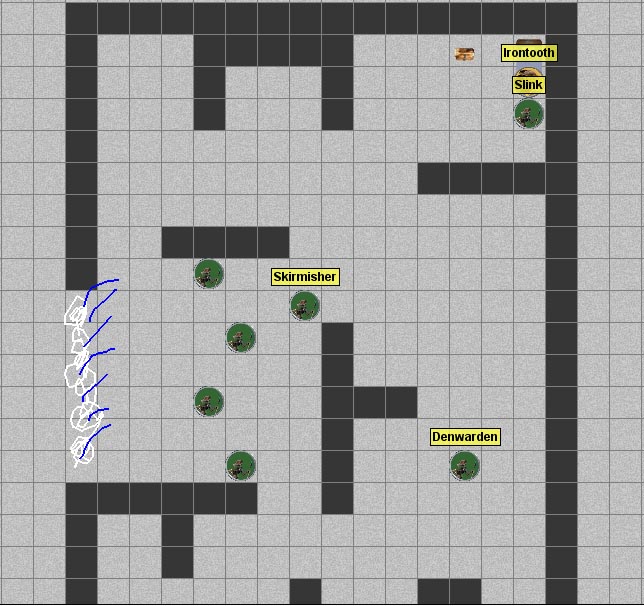
The Irontooth battle as written is worth 1,250 XP – a sixth-level encounter for a party of five players.  I wanted it to be more like a fifth-level encounter for a party of three players, which meant I was aiming for more like 600 XP.  That meant I had a lot of slashing to do.

  • The encounter calls for 10 Kobold Minions at 25 XP each.  I cut this down to 4 minions (100 XP)
  • 3 Kobold Skirmishers at 100 XP each became just one (100 XP)
  • 2 Kobold Denwardens at 125 XP each became one (125 XP)
  • 1 Kobold Wyrmpriest at 150 XP was eliminated, which I hated to do but I had to do something (0 XP)
  • Irontooth himself is built to be worth 300 XP.  I cut his hit points from 106 down to 80 and removed his hit point regeneration ability (getting back 5 HP per turn once he’s bloodied seems too strong), but left his damage and other abilities alone.  I figured this made him worth about 250 XP (250 XP).
  • In addition, a Kobold Slink escaped the previous battle to go into the cave to warn the other kobolds, so he was going to show up here.  However, he was beaten up from the earlier battle and doesn’t have any healing surges, so I started him at his bloodied hit point value and shaved his XP from 100 to 75 (75 XP).

All together, this adds up to 650 XP, which is slightly above a fifth-level encounter for this party.  Hoo boy!  This could be tough.  The map is below (and the Gametable .grm file is at this link, as well as on the Downloads page with my other maps).

Irontooth Battle

The Irontooth battle, scaled for three players

Fortunately, the party’s tactics were sound.  The battle is set up in two waves, with a second group of enemies (including Irontooth) coming into the fray three rounds after the first wave.  The party finished off the first wave (four minions and a skirmisher) during round three, just in time for the second wave (Irontooth, the denwarden and the bloodied slink) to show up.  Had they still had parts of the first wave running around while they were trying to deal with the second, it could have gotten ugly.  As it stood, they did a good job of saving their daily powers and action points for the second wave, where things got challenging.  The Healing Word power that I had given to Lane’s druid, Kana, was used up early on, and everyone’s second winds were used, too, but they ultimately finished off Irontooth with single-digit hit point totals remaining.

My favorite part of this day’s session was the excitement when the treasure chest came into view.  Zach’s character seriously considered ignoring her allies in battle (all three characters are female, even though Zach is male) so that she could sneak over to the chest and try to pop it open during battle.  Cooler heads prevailed, and she decided to keep fighting and pick the lock on the chest later (no one thought to try using the key from Irontooth’s pouch, but the lockpicking went off without a hitch).

We’re going to try to get together on Friday nights, starting this coming week, with the whole group of five adventurers.  This time, they’re ready to take on Shadowfell Keep itself.