MapTool file for free adventure: Tallinn’s Tower

Since I’m such a fan of running adventures in MapTool, I thought I’d share the MapTool file for the free adventure I posted recently, Tallinn’s Tower. For the adventure itself, check out my earlier post (it’s a cool adventure, I promise) or download it directly right here. For the MapTool file to let you run it quickly and easily, click here.

Note that this campaign file was created in version 1.3.b66 of MapTool, so I’m not certain of its compatibility with other versions.

Free adventure (with maps): Tallinn’s Tower

Edit 9/8/2011: I’ve since updated this adventure; the details of the update are at this link.


I’ve just finished writing a new adventure for D&D 4th Edition called Tallinn’s Tower. This is the sequel to my first “published” adventure, the Stolen Staff (aka The Staff of Suha). I’m planning on running this adventure at my local store as a Living Forgotten Realms adventure and then again at TactiCon in September, but this version is not LFR-specific.

Download the adventure here.

And if you’d like the MapTool file to let you run the game online, click here.

Structure

I’ve written Tallinn’s Tower using guidelines for the newest season of LFR for MyRealms adventures, in which an adventure can be run for a variety of levels in the heroic tier. The party chooses the Adventure Level (2, 4, 6, 8 or 10) and the DM runs the appropriate version. There are a few cases in which I’ve picked different monsters for the lower part of the tier and the upper part, and other cases where I’ve just re-leveled the same monster throughout the tier.

I haven’t provided monster stat blocks since I’m using published monsters rather than my own creations (and because I didn’t want to have to create five different sets of stat blocks for each encounter), but if you have any trouble with the level adjustments, just let me know and I’ll be happy to help. [Edit: Monster stat blocks are now included]

Synopsis

The plot of the adventure involves the PCs being hired to investigate the nature of a magic staff that apparently has more to it than meets the eye. They are asked to take the staff to a reclusive wizardess who lives in a tower, but in order to get an audience with her they must prove themselves worthy by navigating the hazards of the tower.

If you like adventures with illusions, traps, in-combat skill challenges and even poetry, check out Tallinn’s Tower! And please provide me with feedback (positive or negative); I fully intend to improve the adventure based on reader input.

Maps

What adventure would be complete without maps? Below are the gridded and gridless versions of each map in the adventure, scaled so that each grid square is 50 pixels (for ease of use in MapTool and similar programs).

Level 1 - Gridded

Level 1 - No Grid

Level 2 - Gridded

Level 2 - No Grid

Level 3 - Gridded

Level 3 - No Grid

Level 4 - Gridded

Level 4 - No Grid

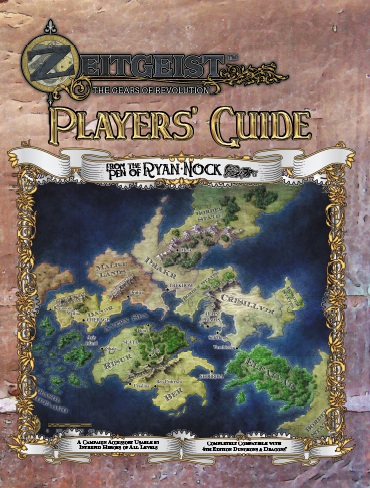
ZEITGEIST adventure path for 4e and Pathfinder is here!

I spend a lot of my D&D time over on EN World, surfing the various forums. It was a great resource for me when I was first learning D&D 4e in early 2010, and it’s where I found the players for my long-running Friday night online campaign. EN World also published the adventure path that I’m using for that campaign, War of the Burning Sky (which I’m very much enjoying running).

Thus, I was excited late last year when word started coming out about their next campaign saga, called ZEITGEIST. I was lucky enough to get into a play-by-forum playtest of the first two adventures run by the author, Ryan Nock. Ryan’s a fantastic writer, and his descriptions of our combats were amazing. Since we were really just running through the adventure to help Ryan fine-tune the plot rather than the combat encounters, he just narrated the fights, and yet this was probably even more fun than rolling the dice would have been.

I’ve been pretty geeked about this campaign path for a while, so I’m excited to say that the two-page introductions to the campaign as well as the 41-page player’s guide are now available, both for D&D4e and for Pathfinder. I have no idea what if I anything I’ll ever do with this campaign, since I’m pretty much full-up as a DM right now, but I could see maybe running it for my in-person group in the future if I decide to take another turn in the DM chair for that group.

D&D Encounters – Dark Legacy of Evard Week 7

I was out of town last week, so I wasn’t running or playing in D&D Encounters. But hey, since I had already put the maps together for Week 6, I figured I might as well share them here.

For Week 7 tonight, I had a table of seven players. Six of them had apparently played together last week (including David, the die-hard who was brand new to Encounters but who’s been there every week so far – rock on!). The party last week had fought a bunch of tieflings who had apparently taken up residence in the home of the long-dead wizard Vontarin, and this week they were delving into the house’s basement via a trap door.

Below the trap door was a long, skinny staircase with an imp statue at the end of it. Our warpriest had a high enough passive perception to realize that there was a trap at hand, triggered by a very faint glyph on the floor at the foot of the stairs. The party’s thief tried to disarm the trap, failed horribly, and set off flames all over himself and the warpriest (oops). The hunter in the party then remembered the password they had discovered upstairs and said it… and then stood there, rather than walking past the statue. Nothing happened.

The thief took another crack at disabling the trap and succeeded this time, so the party moved into a room with three pits – dry cisterns. This is something new that I loved about this evening’s session – for the first time, the party had a chance to do some exploring of a location where each opened door didn’t lead immediately to a fight.

Beyond the cistern room lay a hallway with a big cloud of purple smoke. It turned out to be remnants from an already-triggered trap. At the far end of the hall were two sets of iron doors – one to the east, and another to the north. The northern doors showed signs of having previously been chained and sealed with a bronze plaque to Pelor. The eastern doors were unchained. The adventurers decided to go east.

To the east was a room filled with empty cages, but very lively tieflings, two of whom soon turned into clouds of smoke. The party started beating on this room of enemies…

Only to be surprised when the northern doors burst open and a tiefling warlock started wrecking them with flames. Bwah ha ha!

The hunter did some quick thinking and dropped a zone of mist in the hallway intersection that provided the party with a lot of protection. He then took a shot at the warlock and hit – but the warlock’s infernal wrath dropped the hunter to unconsciousness. The party’s knight fell soon after, but they were taking turns with unconsciousness, letting the warpriest bring them both back.

I had a ton of fun running this fight. I loved the “round one – bad guys to the east; round two – bad guys to the north” which gave the battle a good flow. Lots of moving around, lots of careful thinking. Minions that deal damage on a miss were also intriguing – I’ve never seen that before. The battle ended with the hunter completely out of surges; some of the party expected that this was the last encounter before an extended rest. Oh no no no…

I was also happy that the adventure designers are finally handing out some loot to the PCs. This battle gave out a magic staff, magic armor, and a bunch of cash. Now back to town to spend it, trying to figure out where the possessed wizard has gone.

My thoughts on Pathfinder, based on the Core Rulebook

I’ve finished reading through the bulk of the Pathfinder Core Rulebook in preparation for the campaign in which I will soon be a player, and I thought I’d share my thoughts here. My background with RPGs is:

  • I played a little bit of D&D 3.0 around 2002. I got the core books, read them, loved them, played a session or two, wrote an adventure, never found a good group to play with, drifted away.
  • I started playing D&D 4e in early 2010, and here I am now. I’ve played and DMed a ton of 4e over the past year and a half.
  • In that year and a half, I’ve also had the chance to play one session each of AD&D 1e, GURPS, Savage Worlds and Call of Cthulhu.

So, I’m approaching Pathfinder as an experienced D&D 4e player, with some exposure to other games, including earlier editions of D&D – but just a little.

Introduction

The first thing that struck me about the Core Rulebook is that it opens with some mild politics. I understand that this is about the OGL and such, but it’s really awkward to read all the references to Pathfinder being an evolution of “the 3.5 version of the world’s oldest roleplaying game.” I get it – they don’t own the rights to the Dungeons and Dragons name, so they can’t say the name, but the OGL lets them say a lot of other stuff… it’s very weird.

I love that the single book is basically the Player’s Handbook and Dungeon Master’s Guide rolled into one. I’ve really only been focusing on the player sections of the book, but I appreciate that the game master sections are right there if I want them.

The glossary on pages 11-12 is well-placed, too. Understanding things like Combat Maneuver Bonus right up front is helpful. The index in the back of the book seems to be pretty good, too. If you’re going to write a book that aims to be accessible to new players, a good glossary and index help a lot.

“Generating a Character” on pages 14-15 is not as helpful as it should be. I wish this had been an easier-to-follow step-by-step process, but it involves a crazy amount of flipping all over the book. I think an example would have helped a lot.

Races

Not much to say here. I’m fine with the races that get penalties to certain stats; it’s more flavorful. The races generally seem to have more flavor expressed in mechanics than 4e races do, but this isn’t always a winner for me. Some of the flavor is quite fiddly in practice, such as dwarves getting a dodge bonus to AC against giants and a bonus to Appraise checks involving precious metals or gems. I get the flavor, really, but the mechanics seem likely to be forgotten.

One other note: The illustration of the half-elf woman is fantastic. Half-elf males are lucky critters!

Classes

I see what people mean when they refer to the Essentials class presentations as being more like older editions. No two classes are alike in Pathfinder. They all have their own progression of different features that come at different levels, and that’s cool. Fiddly, yes, but I think the fiddliness comes from not having a Character Builder with power cards. If all of these special abilities were easy to follow and reference on the character sheet, they wouldn’t feel any more fiddly than 4e characters getting powers as they level up. So, no complaints about the progression of the classes themselves here, just a complaint about the lack of an easy-to-use character builder (though I’ve heard good – and expensive – things about Hero Lab).

It strikes me that Pathfinder seems to be a game that relies more on GM and player interpretation rather than rules – often phrased as “rulings rather than rules”. I’m fine with that, but it’s a meaningful difference with 4e.

Some things in Pathfinder make character creation harder than 4e, which gives each class a key ability score (and yes, there are some V-shaped class builds in 4e that depend on two different abilities, I know). When I tried to build a cleric in Pathfinder, I found myself gravitating toward a high Wisdom score. I then realized that Charisma is pretty important, too. And then I saw that if I wanted to have anything to do other than throw off the occasional healing spell, I’d probably want good Strength to get into melee, in which case I’d need reasonable Constitution in order to have some hit points and not just die in one shot… it’s just very different. If it leads to well-rounded characters, well, great! But it’s a very different approach.

Also, I love the way deities and domains are presented in the Core Rulebook. It’s a whole new pantheon of deities, of course, but I love that clerics pick a deity and then get spells and abilities from two of the deity’s domains. Again, good flavor.

Spells are, of course, one of the areas where D&D differs most from earlier editions and Pathfinder. All spells are “dailies” in Pathfinder (Vancian Magic). I have to say that based solely on reading the books, I prefer the 4e system. Any system where the wizard spends the first four levels of his career hiding from combat most of the time until he can start throwing the occasional fireball doesn’t seem that great to me. Yes, I know that the wizard becomes all-powerful later, but reading through the books does not make me a fan of the Linear Warriors Quadratic Wizards phenomenon. Maybe it will be more fun in play.

I’m also annoyed by the difference between character level, caster level and spell level. I get it, but it’s terribly inelegant.

Skills

Again, more flavor than 4e. More judgment calls. More proliferation. More stuff that comes up outside of combat. It’s good, it’s bad… it’s just a difference.

Feats

I didn’t read them all, as you might imagine. But this feels like an area where 4e really didn’t change much from 3.5e / Pathfinder. Feats felt very familiar to me.

Equipment

Again, much like 4e in most respects (at least for starting equipment; I haven’t delved into magic items).

The various weapons confuse me a bit, as there seem to be cases where weapon A is Pareto superior to weapon B… is the difference really just flavor, or am I missing something? The Morningstar, for instance, just seems better than the Heavy Mace. It’s cheaper, it’s lighter, it deals two different types of damage… all I can figure is that dealing two types of damage is bad in some circumstances (such as against a creature that resists piercing damage, even when it’s paired with bludgeoning). I have much to learn, I guess.

A minor innovation that I actually like from 4e is the introduction of the Adventurer’s Kit. I personally think it’s fun to pore over the list of oddball equipment I could buy for my character, but I think it’s a good idea to provide a “default gear” option for players who aren’t interested in that sort of thing.

The illustrations of gear in this book are very nicely done too, in my opinion. Good artwork in lots of places… it’s strange that I’m not seeing artist credits on the images.

Additional Rules

It’s a little weird to me that we don’t see alignment spelled out until this chapter, but I guess there really wasn’t a good place to stick it earlier. I tend to think of alignment as being a very fundamental part of the character creation process. My only other comment on this section is that I find the changes to ability scores as characters age to be annoying rather than flavorful. I guess it’s both… sigh.

Combat

Okay, I read this chapter in detail. And I have to say that this is one where I’ll largely need to reserve judgment until I play the game. So many things are fundamentally different about combat between 4e and Pathfinder that I can’t accurately judge it until I try it.

I get that there’s sort of a Standard – Move – Minor action economy in this game, but I also understand that it’s still a different animal. Full-round actions have no clear analogue in 4e, except maybe the monk’s Full Discipline… but you can still take a 5-foot step with a full round action. It’s going to take some learning by doing on my part for sure.

I will say that combat seems a lot more complicated in Pathfinder. The difference between a weapon attack, touch attack and ranged touch attack is flavorful, but harder to follow. Holding a charge on a spell – also flavorful and hard to follow. Saving throws – I think the 4e system of different defenses works much better. Concentration checks for spellcasting seem like a huge pain in the butt. All the options to do things like fight defensively seem overly complicated. The different buckets for lethal and nonlethal damage seem like a pain. And oh, all the tables! It’s going to take a lot of learning for me.

Magic

Much like combat, I’m going to have to see it in action in order to really judge. Concentration, counterspelling, the shapes of spell areas, areas that originate on a grid intersection rather than in a square, spell resistance… again, it seems really complicated. More “realism” at the expense of clarity.

The Rest

I flipped through some of the spells. I haven’t touched Prestige Classes or the GM parts of the book. I haven’t delved into multiclassing, though I understand the gist of how it works.

Overall impressions

So far, Pathfinder looks like a game that does a much better job of handling the game world “realistically” than 4e, though at the expense of simplicity. I know that tomes have been written about “gamism versus simulationism” by people who’ve spent far more time comparing and contrasting various systems than I have, so I don’t have much I can add. Until I actually get to try the system out at the table, it will be hard for me to say which (if either) I prefer.

Fortunately, I’m not too worried. I had the chance to meet with my awesome GM, Phil, and I know it’s going to be a fun game. He’s not overly concerned about rules, and he’s interested in us focusing far more on the stories of our characters rather than their mechanics. Having played in his Call of Cthulhu game at Genghis Con, I’m really excited about playing in an ongoing campaign that he’s running. I honestly don’t think the system is going to matter all that much – with good people at the table, I’m going to have a good time.

Free RPG Day 2011 – my San Francisco experience

I live in Colorado, within walking distance of the excellent Enchanted Grounds game store / coffee house. Last year I went there for a Dark Sun game on the morning of Free RPG Day and then went back in the evening because they offered a discount on RPG books in addition to giving away free stuff (I didn’t really know what the free stuff was). This year, however, I’m out of town, on a business trip to San Francisco – so I don’t get to participate in Free RPG Day at my friendly local game store. Frown.

Of course, given that San Francisco is a decent-sized city, you’d think that there’d be at least one store that’s participating in Free RPG Day, and in fact there is exactly one – Gamescape (which does not appear to have a functioning web page of its own, so here’s its Yelp page). I used to go to this store when I lived in San Francisco, although I went for board games (it has quite the awesome selection). I found out that Gamescape would be opening its doors at 10:00 AM Saturday, and since I’d heard that other stores had run out of Free RPG Day stuff quickly in past years, I decided to get there early. It helped that I randomly woke up around 6:00 AM local time.

Thus at 9:15 AM on Saturday, I found myself sitting on the sidewalk in front of Gamescape… all by myself. No massive mob for Free RPG Day, it seems. Five minutes before the doors opened, one other guy got “in line” behind me, though I don’t think he was even there for the “event”.

As it turned out, Gamescape was not running any actual Free RPG Day events, though they did have the standard box of goodies to give away – one item per customer. I was interested in the items for D&D 4th Edition, Pathfinder and Savage Worlds. The D&D item was an addition to the Shadowfell: Gloomwrought and Beyond boxed set, which didn’t look especially interesting. Since I’m starting to play Pathfinder pretty soon, I opted for the free Pathfinder adventure (not sure I’ll ever actually run a Pathfinder game, but if I do I now have an adventure ready to go).

I also want to support stores that participate in Free RPG Day, so I browsed through all of their gaming stuff, eventually deciding to buy my own copy of the Pathfinder Core Rulebook (rather than continuing to rely on the copy I checked out from my local public library). Message to game store: You buy stuff to give away for free to me, I spend good money in your store (50 bucks plus tax – which is 9.5% here in San Francisco!).

So, Free RPG Day 2011 was… well, not at all exciting. Had I been back in Colorado, perhaps it would have been more interesting. Oh well; at least I got something for free, and bought something I’d been meaning to buy anyway.

Running an online game for new players

I love it when a plan comes together. A couple of weeks ago I received a comment on my blog from a player who had never played a tabletop role-playing game before but who was interested in trying it out. Since I love to introduce new players to the hobby, I wanted to at least run one game for this prospective new player. So, I advertised here on the blog as well as over on EN World that I would be running a one-shot game for new players.

Getting this game set up went the way I originally expected setting up an online game to go when I first did it last July. For that game, I wanted five players so I recruited seven, figuring that a couple wouldn’t be able to make it. I ended up with eight. Oops.

This time I ended up recruiting six and only four were able to make it work (scheduling was problematic). That’s okay, though – four was plenty!

We gathered Friday evening on MapTool and Skype in the time slot that I normally run my long-running War of the Burning Sky campaign (my regular players were very understanding – thanks, guys!). I gave the new players some choice about what adventure we ran, and I ended up running a Living Forgotten Realms game – CORM 1-1 The Black Knight of Arabel (available here as part of a big archive file if you’re interested). This was, coincidentally, the first LFR game I had ever gone through as a player and one of the first I had run as a DM.

I specifically wanted to run an adventure I had run before in order to keep my prep time to a minimum (time was tight last week). Most of the prep time for this game went into getting the four PCs set up in MapTool. I did change the monsters in the adventure, too. First, I updated the damage expressions and defenses and everything to the post-Monster Manual 3 numbers. Second, since this particular adventure has the possibility of three fights with the same shadow creatures over and over, I mixed things up by bringing in some monsters from the Dark Legacy of Evard season of D&D Encounters that I’m running.

The group that gathered on Friday consisted of two new players (one of them in England – I somehow manage to attract players who are willing to play in the middle of the night!), one player who was rusty, and one player who at least hadn’t played online before (but he was looking for a game and I needed the fourth player to fill out the party). We had some minor technical difficulties at first, but soon enough we were all on MapTool.

I had created characters for the two new players based on descriptions they gave me – a tiefling cleric and a half-orc barbarian. The more experienced players created their own characters – an elf mage and a goliath warden. I started with some basics about how the MapTool program works and how the rules of the game work for the new players, and then we dove in.

SPOILERS AHEAD FOR THE BLACK KNIGHT OF ARABEL

The adventure began with the party on their way to Arabel to investigate reports of a black rider and shadow creatures. Near nightfall the party was approaching the city and came upon a wagon driver frantically trying to repair a wagon wheel before darkness came. The party offered to help, but just then the sun dipped below the horizon and some shadow creatures emerged. A battle ensued, using the Shadow Hulk and Shadow Seeker from the adventure, but using the Leeching Shadows from Dark Legacy of Evard instead of the Shadow Motes that were written. The fight was a little intense and the cleric ended up unconscious at the end, but the party stabilized her. They had seen the dark rider on a ridge in the distance during the fight and decided to go after him.

At this point, the party started tracking the rider through the woods and came to a steep downhill slope that was tricky for their horses. The barbarian ended up basically carrying his horse and then the cleric’s horse down the slope. It was awesome.

When the group came upon the rider’s horse, dead from shadow attacks, they started suspecting that the dark figure wasn’t commanding the shadow creatures after all. Eventually they found the dark creature and talked to him rather than fought. They learned that he was an exiled knight and that he was trying to fight the shadows, but that the townspeople thought he was commanding them. He also mentioned that his father had cursed him to an evil god. The PCs teamed up with him and tried to clear his name.

Next came a trip into town to confront his father, who wasn’t at his pub – but this didn’t stop the barbarian and the warden from starting a bar fight! I decided to roll with it and threw some brawlers at them. They fought for a couple of rounds and prevailed easily. Of course, they had to skedaddle because the barmaid went to fetch the guards (they DID start the fight, after all).

Ultimately, the group ended up at the theater where the cult of the evil god was meeting. They convinced the cultists (confused townspeople) that the cult leader was leading them astray as he wanted to sacrifice a baby to the evil god. The cultists left, leaving the party to fight the leader and more shadow creatures. This time I did use the original Shadow Motes but I paired them with the Dusk Beasts from Dark Legacy of Evard.

This ended up being an awesome battle, ranging all over the place. The mage used Mage Hand to pluck the baby off the altar, but the Dusk Beasts knocked him unconscious. The barbarian started raging and charging all over the place, twice getting knocked down to just one hit point. The cleric eventually grabbed the baby and took it up into a balcony for safekeeping, whereupon the warden smashed the ladder to the balcony to keep the cult leader from getting to it. Lots of damage, lots of heroism… it was a great fight, and the good guys just barely pulled it out in the end.

Everyone had a fun time, and I’m happy to say that one of the players has volunteered to DM the group through an ongoing campaign. Success!

This “game for new players” is something I would love to do on a regular basis, maybe once every few months. So, if you’re reading this post and are interested in learning to play D&D via an online game, drop me a line!

D&D Encounters – Dark Legacy of Evard Week 5

This week marked the beginning of the second adventuring day for the intrepid travelers in the town of Duponde. A total of eight players showed up this week, so we split into two tables of four each. My table had:

  • Garro the hunter (the new player from week 1, now with a leveled-up PC!)
  • Sever the paladin (the new player’s friend, brand-new to D&D)
  • Markus the cleric (the replacement PC for the one I killed in week 1)
  • Jarren the mage

Having survived a night in the Shadowfell, the players napped through the morning back at the beloved Old Owl Inn, feeling a little shaky when they awoke (I’m using the Despair Deck, so they all drew a card). Some of the PCs spent some time studying the mysterious journal they had discovered at Evard’s tomb; it belonged to the wizard Nathaire who had disappeared from the Old Owl, and it was written in code. They haven’t fully deciphered it yet, but they’re making progress.

A young Vistani boy (basically a gypsy) came to the heroes to tell them that his grandmother Grivelda had a vision and needed to tell the heroes about it. She saw them as being the key to stopping whatever had happened to Duponde. We had a nice bit of role playing with Grivelda, with the PCs very interested in asking her about her visions. Three of them volunteered to have their palms read (two with poor results). They got the impression that she might know a thing or two about potion making, and I allowed them to make diplomacy checks to see if they could persuade her to whip up a healing potion, but none of them were very diplomatic (the best roll was an 8; I set the DC at 10). Oh well.

Before long, Grivelda’s grandson came running into the house, crying out that wolves were coming, along with a werewolf. As written, the battle starts with the PCs inside the house, but I thought the battle would be more interesting outside (the house was tiny), so I let them move outside as a free action when we rolled initiative.

Since there were only 4 PCs and most of them were level 1, I scaled the battle down. I threw two wolves at them instead of three, and I leveled the werewolf down by one level on the fly (reduced HP by 8, reduced defenses by 1 each). I left his attacks and damage alone.

The werewolf won initiative and rushed into battle, coming after the nearest target – the cleric (whose predecessor character from the same player, remember, I had killed in week 1). He went into his lycanthropic fury, in which he makes both a claw and a bite attack and deals himself 5 damage in the process. The claw was a critical hit, dealing a bunch of damage and knocking the cleric to the ground; fortunately, the bite missed.

The hunter in the party climbed onto the roof of the house and took at shot at a wolf  – and missed. The cleric used his turn to stand up, smack the werewolf, and then a minor action to increase the party’s AC for the encounter (rather than heal himself). One wolf came after the wizard while the other climbed up onto the roof after the hunter – who was quite surprised to have company up there!

The paladin and wizard went to work on the ground-bound wolf, and then Grivelda gave the werewolf a dirty look to turn off his regeneration (which ended up being hugely important) and his disease-bearing nature. The werewolf got back to savaging the cleric, who decided to heal the hunter on the roof instead of himself. This ended up being a mistake, as the werewolf dropped the cleric unconscious in the third round.

Eventually the mage started wrecking the ground foes with arc lightning and the paladin started drawing their attention. The hunter climbed off the roof and was pounced on from the roof by the wolf, who dropped him unconscious. Meanwhile, the cleric was busy failing death saves.

The mage’s dice were hot, and she started dropping the enemies one after the other. The last wolf tried to run but was met with a magic missile in the back.

Unfortunately, this was too late for the cleric, who failed three straight death saves. Pow. And once again, I killed one of Chris’s characters. Man, did I feel bad! But really, the dice just betrayed him. If he had just made one of those saves, he would have pulled through.

The other table breezed right through the encounter; maybe I should have scaled it down even farther. Well, so it goes. At least Grivelda was able to bring the cleric back with a four-healing-surge penalty, so Markus lives to fight another day!

No map this time, since I used the official Wizards of the Coast map for this one (it’s a map from Reavers of Harkenwold, which they put on their web site). If you’re a DDI subscriber, you can get the map here.

Previous sessions:

Week 1

Week 2

Week 3

Week 4

Factotum will try anything

Given that I’m still pretty new to D&D (having started in early 2010), I’m still having “firsts” that are old hat for most gamers. I’ve just created my first character with a real concept, who I can really role play.

Factotum the Human Bard probably uses the same concept as a lot of 4e bards out there: Multiclassing. His motto is, “Oh, I’m great at that!” He’ll try anything. Note that he’s not especially GOOD at any of those things, but he thinks he’s ultra-capable.

His starting pre-racial stat array was 13 in every ability, with the one extra point in  Charisma (I wonder how many 4e players ever discover that trying to balance your stats gives you five 13s and a 14). As a slight nod to character effectiveness, I put his +2 human racial bonus in Charisma. So, he has 16 Charisma and 13 everything else. Optimized, he is not!

Factotum’s feats are, of course, his bread and butter. I made him a human so that he could have an extra feat at first level. Naturally, both feats are multiclass feats, so he’s a Warlord and a Rogue. Yeah, sneak attacking bards – woo hoo! I’m only picking feats that give him skill training; right now he’s trained in eight skills.

I’ve had a chance to play two Living Forgotten Realms sessions with Factotum. The first was not so great for him; it was the only LFR game I’ve seen so far that was four straight fights, with no time carved out for skill use. He muddled through all right, but he didn’t really shine.

The second session was this past week, and it was a blast. I hadn’t realized that the always-awesome Andy had set up a long series of LFR adventures at the local store with the intention of having a semi-consistent group of characters start at level 1 and go all the way through the heroic tier over the course of many months. I just happened to have signed up for the first game in this series. Two other players had brought fourth-level characters, so they obviously didn’t know about the series either. No matter – off we went!

SPOILERS AHEAD for CORE 2-1 The Radiant Vessel of Thesk

Our quest was to go to Thesk and find a mysterious “radiant vessel” on behalf of an insane halfling. We had a great opportunity for role playing in a small community in an effort to figure out what the heck this radiant vessel was. Factotum tried to turn on the charm, but managed to stick his foot in his mouth more often than not. With the help of the rest of the group, though, we ultimately got a lead: the radiant vessel was a woman with a mystical aura around her that destroyed undead creatures. She had been taken by orcs to some distant mountains, but her cousin had a map to get there (the cousin had been having a fling with one of the orcs – the hussy).

Into the mountains, then; Factotum was happy to stealthily lead the way. When we came to a room with ladders leading down to a chamber with enemies, most of the party climbed down to fight. Factotum, naturally, jumped down the 20 feet (and almost reduced enough damage with his Acrobatics check to land on his feet). He charged into a flank in order to sneak attack a minion. When confronted with a pit to cross (which could be done with ladders), Factotum jumped it.

Eventually the party found the kidnapped woman, surrounded by orcs and an imp. Factotum Bluffed his way in, saying that he was a trained physician. It would have gone well, too – if only he had been trained in Heal. A few failed skill checks later (the party’s Goliath Barbarian/Warlord didn’t have much luck, either), and we had killed the poor woman and her baby.

It was a sad moment around the table, but we wiped our tears and brought the body back to the cousin. Factotum was a blast to play, even though he usually missed in combat (his attacks were at +6 versus Armor Class or +3 versus other defenses). The best moment was when one of the other players said, “Factotum HAS to come back next week!”

Well all right then! It’s a lot of fun to have a character with actual personality. I need to learn to bring some of this to NPCs when I’m running games, too.

And since I think Factotum is so much fun, I decided it was worth taking 15 minutes to hack the five-page PDF that the Character Builder spits out into a one-page version. You know, I should probably just use the original offline Character Builder for this guy…

D&D Encounters – Dark Legacy of Evard Week 4

I wasn’t expecting to be running D&D Encounters this week. Our local store has tried to set up a rotation so that no DM is running two weeks in a row (to prevent burnout). Thus, I ran the first 5:00 PM table on week 1, Andy ran it week 2, I ran it week 3, and Andy was scheduled to run it week 4 (this week). Wes has been the second table DM for all three weeks, but we haven’t had a second 5:00 PM table yet (we had only six players for each of the first three weeks).

However, I got an email from the store owner today asking me if I could be available to run a second table in case it was needed; Wes was unavailable. We haven’t had a second table yet, but hey, school’s out now – you never know.

So, I showed up at the store at 4:30 (I’m so glad to have a job with some flexible hours!) and set up my projector rig, just in case. It was a good thing that I did: We had 14 players! That meant two overly-full tables of seven players each. Woo hoo!

My table consisted of one player who had been attending most of this season of Encounters, one player who’s attended past seasons of Encounters, and five first-time Encounters players (two of whom were very new to D&D altogether – awesome!). The party was:

  • Hiver the Dwarf Fighter
  • Steven the Half-Elf Sentinel (our regular)
  • Chilliax the Drow Executioner (thanks again to Wielding a Bohemian Ear Spoon!)
  • Keira the Elf Thief
  • Balin the Elf Mage (a red box character!)
  • Fargrim the OTHER Dwarf Fighter
  • Thetari the Dwarf Cleric of Death

The session began with some recapping of the prior three sessions (since only one of the players had been present for any of them). This meant that it was tough to do much role playing; we pretty much just got the mission from the local cleric to head to the graveyard, since he believed all of the shadow troubles began there.

The players all made Perception checks as they entered the graveyard, none of which were especially great. This meant that the party saw some zombies shambling toward them, but they DIDN’T see the ghouls or shadows lying in wait. The ghouls actually acted very early in the initiative order, successfully attacking from hiding and throwing two characters to the ground and grabbing them. The rest of the party rushed to the rescue, with one ghoul getting pushed away by Smite Undead from the cleric and the other being Hypnotized by the Mage and forced to walk away, breaking both grabs (nice teamwork!).

Graveyard map for session 4 of Dark Legacy of Evard - with grid

Graveyard map for session 4 of Dark Legacy of Evard - no grid

When the shadows oozed out of the trees near the end of the first round, the brief panic around the table was awesome – “There are MORE monsters?!” The shadows did what they do, melding with PCs and draining their life for several turns. Zombies grabbed characters and started smashing them.

In the end, though, this party of largely fresh characters will full healing surges, action points and daily powers made short work of a graveyard full of undead monsters. Since I had more than the five PCs that the encounter was written for, I followed the guidelines and added one more zombie. Normally I would have added two, or perhaps even a zombie and a ghoul, but since so many players were new to the game I didn’t want to overdo it. I needn’t have worried – they rocked the encounter.

After the monsters were dead, we had a little more time for role playing. The adventurers examined the mausoleum of Evard’s tomb and saw that the main sarcophagus had been forced open and that some kind of magical curse had blasted whoever opened it. It was clear that the zombies were recently-killed workers who had helped to break into the tomb, but the wizard Nathaire and his halfling assistant were nowhere to be found. The group did, however, find a journal written in code that belonged to the halfling. The plot thickens!

After the party left the mausoleum, the sun came up and Duponde shifted back out of the Shadowfell. Ah, but for how long?

Previous sessions:

Week 1

Week 2

Week 3